
Heat Transfer Vinyl (HTV) vs Sublimation vs DTF: 2026 Guide
Heat transfer vinyl (HTV) starts at $200 and presses at 305-320F on any fabric color. Compare HTV, sublimation, and DTF on cost, durability, and feel.
HTV vs. Sublimation vs. DTF: Your Friendly Guide to Picking the Perfect Print Method
Whether you're just dipping your toes into the custom apparel world or you're ready to level up your existing setup, you've probably found yourself staring at your screen wondering: "Which printing method is actually right for me?"
Trust us, we've been there. The good news? You've got three fantastic options that have completely democratized custom apparel: Heat Transfer Vinyl (HTV), Dye Sublimation, and Direct to Film (DTF). Each has its own superpowers, quirks, and perfect use cases. For the deep technical pillar on DTF specifically, see our complete guide to DTF printing. If you are only choosing between two of them, our DTF vs HTV breakdown compares cost, wash durability, and fabric fit side by side.
Let's break it all down in plain English – no confusing jargon, just the straight scoop on what works, what doesn't, and what might be perfect for YOU.
What Is Heat Transfer Vinyl (HTV) and Why Start There? 🎨
Remember when making custom shirts meant either screen printing in your garage or paying someone else big bucks? Yeah, HTV changed all that. This is the method that launched a thousand Etsy shops and turned kitchen tables into production facilities.
What Are the Technical Details of HTV?
HTV is exactly what it sounds like – vinyl that you transfer onto fabric using heat. You design on your computer, cut it out with a machine (hello, Cricut and Silhouette!), peel away the parts you don't want (we call this "weeding" – and yes, it can be as tedious as actual weeding), then press it onto your shirt. Boom. Custom apparel.When Does HTV Work Best?
- Simple is beautiful: Text, numbers, basic shapes? HTV is your best friend
- Small batches: Making 5 shirts for your family reunion? Perfect
- Special effects: Want glitter? Holographic? Glow-in-the-dark? HTV's got you covered with more specialty finishes than you can shake a heat press at
- On-demand personalization: Adding names to jerseys at an event? HTV is unbeatable
What Are the Downsides of HTV?
- Photos and gradients? Nope, not happening
- That 12-color mandala design? Unless you want to spend three hours layering vinyl (and end up with a shirt that feels like cardboard), maybe reconsider
- Intricate designs = weeding nightmare. Your fingertips will hate you
What Does the DTF Database Team Recommend for Beginners?
If you're just starting out and want to test the waters without breaking the bank, HTV is your lowest-risk entry point. You can literally start with a $200 cutting machine and a household iron (though we recommend a heat press for consistency). For shopping HTV by brand and finish, see our heat transfer vinyl buying guide, and for press picks see the best heat press machine for shirts buying guide.What Is Sublimation and How Does It Work? 🔬
Sublimation sounds fancy because, well, it kind of is. This is where your design literally becomes ONE with the fabric. No layer sitting on top, no texture – just pure, vibrant color that's part of the shirt itself.
How Does the Sublimation Process Work?
Special sublimation inks + special paper + REALLY hot heat press (we're talking 400°F) = ink that turns from solid to gas and permanently dyes the fabric. It's like the fabric drinks up your design. Science is cool, folks.Where Does Sublimation Excel?
- Athletic wear: Those moisture-wicking polyester jerseys? Sublimation paradise
- All-over prints: Want to cover an entire shirt with a galaxy design? This is your method
- Photo-realistic images: Your dog's face on a shirt? Sublimation makes it happen in stunning detail
- Zero feel: Seriously, you can't feel the print AT ALL
What Are the Limitations of Sublimation?
- The polyester rule: Sublimation NEEDS polyester to work. 100% cotton? Forget about it. That 50/50 blend? You'll get a vintage, faded look (which some people love!) The exception is Sawgrass's VersiFlex system, a dedicated ink set that prints light-colored cotton from an SG500 or SG1000. See our VersiFlex vs DTF comparison, and for every cotton workaround including Epson's new cotton primer, Can You Sublimate on Cotton?
- Light colors only: No white ink means dark shirts are a no-go
- Equipment investment: You'll need a printer that can handle sublimation inks (or convert an existing one – risky but doable)
What Should You Know Before Starting with Sublimation?
A lot of HTV folks naturally graduate to sublimation as their "second method." It opens up the world of full-color printing without too much additional complexity. Plus, once you nail the process, it's actually faster than HTV for complex designs.What Is Direct to Film (DTF) and Why Is It So Popular? 🚀
Okay, let's talk about the elephant in the room – or should we say, the game-changer in the print shop. DTF is relatively new, but it's spreading like wildfire because it basically said "Why choose?" and gave us everything.
How Does the DTF Process Work?
- Print your design on special film (colors first, then white ink on top)
- While it's still wet, coat it with adhesive powder
- Cure it with heat to melt the powder
- Press it onto literally ANY fabric in 10-15 seconds
- Peel off the film and admire your work
What Makes DTF So Versatile?
- The ultimate fabric flexibility: Cotton? Yes. Polyester? Yes. Blends? Yes. Leather? YES. That weird synthetic material? Probably yes
- Dark fabrics? No problem: That white ink layer means your designs pop on black shirts
- Durability that surprises: We're talking 50+ washes without breaking a sweat
- Detail level: Photos, gradients, tiny text – DTF handles it all
What Are the Challenges of Running Your Own DTF Setup?
Here's where it gets interesting. Setting up your own DTF operation is... complicated. And expensive. And maintenance-heavy. We're talking specialized printers, RIP software, powder shakers, curing ovens – it's a whole production.BUT (and this is a big but) – this complexity created an entire ecosystem of DTF suppliers. These heroes have the equipment and expertise, and they'll sell you ready-to-press transfers. You get all the benefits of DTF without the $10,000+ investment and daily printer maintenance. There's probably a DTF supplier within 50 miles of you right now.
Should You Buy DTF Equipment or Use a Supplier?
We've seen a lot of people jump straight into DTF equipment without understanding what they're getting into. Unless you're planning to produce hundreds of transfers daily, consider starting with a transfer supplier. You can always invest in equipment later when you know the demand is there.How Do HTV, Sublimation, and DTF Compare Side by Side?
| Feature | Heat Transfer Vinyl (HTV) | Sublimation | Direct to Film (DTF) |
|---|---|---|---|
| You Should Use This For | Team names, simple logos, text, single-color designs, last-minute personalization | Performance wear, full-color polyester items, photo mugs, mouse pads | Everything else – seriously, it's that versatile |
| Design Complexity | Simple to moderate (unless you love layering) | Sky's the limit | Sky's the limit |
| Works on Cotton? | ✅ Yes | ❌ No | ✅ Yes |
| Works on Polyester? | ✅ Yes | ✅ Yes (Required!) | ✅ Yes |
| Works on Dark Colors? | ✅ Yes | ❌ No | ✅ Yes |
| How It Feels | Noticeable layer (thin to thick) | Nothing – zilch – nada | Super thin, barely there |
| Durability | Good (may crack/peel over time) | Excellent (outlasts the shirt) | Excellent (50+ washes) |
| DIY Difficulty | Easy peasy | Moderate | Don't do it (use a supplier!) |
| Startup Cost | $200-$500 | $500-$1,500 | $10,000+ equipment (or just pennies per sq inch from suppliers) |
| Production Speed | Slow for complex designs (all that weeding!) | Fast once you're set up | Fast with suppliers |
| Learning Curve | Weekend project | Few weeks to master | Months (or minutes with suppliers) |
Which Printing Method Is Right for You?
You're Team HTV If...
- You're just starting out and want to test the custom apparel waters
- Your designs are mainly text and simple graphics
- You love the hands-on craft aspect (some people find weeding therapeutic – we don't judge)
- You need to personalize items on-the-spot at events
- You're all about those specialty finishes
Sublimation Is Your Jam If...
- You're obsessed with full-color, photographic designs
- You work primarily with polyester (athletic teams, we're looking at you)
- The idea of a print with zero texture makes you giddy
- You want to expand beyond shirts into hard goods (mugs, coasters, phone cases)
- You've mastered HTV and want to level up
DTF Is Calling Your Name If...
- You want professional results on ANY fabric type
- Dark cotton shirts are a big part of your business
- You need maximum durability for products you're selling
- You're ready to scale up production
- You want the flexibility of full-color prints without fabric limitations
Can You Use Multiple Printing Methods Together?
Here's something the purists won't tell you – you don't have to choose just one! Many successful decorators use multiple methods:
- HTV for simple personalization and special effects
- Sublimation for polyester and hard goods
- DTF (via suppliers) for everything else
This gives you maximum flexibility to say "yes" to more customers and projects.
What Are Your Next Steps?
- Honest assessment time: What are you actually planning to make? How many? How often?
- Budget check: Include not just equipment but supplies, learning time, and mess-ups (we all have them)
- Test before you invest: Order some transfers from a DTF supplier, buy a small HTV starter kit, try sublimation prints from a local shop
- Join the community: Facebook groups, Reddit communities, and yes, DTF Database are full of people who've been where you are
- Start small, dream big: Whatever method you choose, master it before adding more to your arsenal
What Is the Bottom Line on Choosing a Print Method?
The beautiful thing about today's custom apparel world? There's no wrong choice – just different paths to awesome results. Whether you're crafting in your spare bedroom with HTV, running sublimation prints in your garage, or building a DTF empire (or wisely using DTF suppliers), you're part of a revolution that's made custom apparel accessible to everyone.
Remember, every pro was once a beginner who probably ruined a few shirts along the way. The key is to start, learn, and keep creating.
Got questions? Need supplier recommendations? Want to share your first successful print? That's what DTF Database is here for. We're all in this together, one heat press at a time.
Happy printing, friends! 🎉
P.S. – If you're still on the fence, here's a thought: The "best" method is the one that gets you creating. Analysis paralysis is real, but your first custom shirt is just a decision away. Pick one, start learning, and adjust as you go. You've got this!
Can You Use a Cricut Heat Press for DTF Transfers?
This is one of the most common questions from crafters who already own a Cricut EasyPress or Cricut Mug Press. The short answer: yes, with limitations.
What Works
- The Cricut EasyPress 2 and EasyPress 3 can reach the temperatures needed for DTF transfers (typically 300–325°F)
- For small transfers like left-chest logos, pocket prints, and neck labels, a Cricut EasyPress works fine
- The EasyPress 3 with Bluetooth connectivity lets you set exact temperatures and track press time through the app
What Doesn't Work Well
- Uneven pressure: The EasyPress relies on you pressing down by hand, which does not match the consistent mechanical pressure of a clamshell or swing-away heat press. Inconsistent pressure leads to poor adhesion and peeling
- Size limitations: The largest EasyPress (12"x10") cannot handle full-front or oversized DTF transfers
- No pressure gauge: Professional heat presses have adjustable pressure settings, which matter for DTF adhesion
DTF Transfer vs Vinyl on a Cricut
If you already own a Cricut machine, you might wonder whether to stick with HTV vinyl or switch to DTF transfers from a supplier. The key difference: DTF transfers do not require a Cricut cutter at all. You simply order the transfers and press them. This means you can produce full-color photographic designs without weeding, cutting, or layering vinyl. Many Cricut users add DTF transfers to their workflow for complex designs while keeping their cutter for simple HTV personalization jobs.Bottom Line
A Cricut EasyPress can work for DTF transfers on small placements, but for consistent production-quality results — especially on larger prints — a dedicated heat press with adjustable pressure is the better tool. The best heat press machine for shirts guide compares clamshell, swing-away, and auto-open presses by budget.Frequently Asked Questions
Q: Can I use a regular inkjet printer for sublimation?
A: Sometimes! Certain Epson EcoTank models can be converted to sublimation, but once you put sublimation ink in, there's no going back. It becomes a dedicated sublimation printer. Do your homework on compatible models before converting.Q: What's the actual cost difference between buying DTF transfers vs. making them myself?
A: From suppliers, DTF transfers typically run a few cents per square inch (think $1-3 for a standard chest logo). Making them yourself? Factor in $10,000+ for equipment, plus ink ($200/liter), film ($100/roll), powder ($50/5 lbs), electricity, maintenance, and failed prints. Unless you're producing hundreds daily, suppliers are almost always more economical. The full break-even math is in our DTF transfer cost and durability business economics guide.Q: Will HTV last as long as screen printing?
A: Quality HTV can last 50+ washes with proper care, which is comparable to screen printing. The key is using quality vinyl (not the cheap stuff) and following proper application instructions (right temp, pressure, and time).Q: Why does my sublimation look faded on my 50/50 blend shirt?
A: Sublimation only dyes polyester fibers. On a 50/50 cotton-poly blend, only half the fibers (the polyester ones) accept the dye, creating that vintage, faded appearance. For vibrant results, you need 100% polyester.Q: Can I mix and match methods on the same shirt?
A: Absolutely! Many decorators use DTF for the main full-color design and add HTV for names/numbers. Just be mindful of layering order and temperature requirements for each method.Q: What's the learning curve really like for each method?
A: HTV: You'll be making decent stuff in a weekend. Sublimation: Give it 2-3 weeks to nail your color profiles and pressure. DTF printing yourself: Months to get consistent results (hence why we recommend suppliers).Q: Is DTF really better than screen printing?
A: Different tools for different jobs. Screen printing is still king for 100+ identical designs. DTF shines for small batches, complex designs, and when you need to print different designs without setup fees. The full side-by-side is in our DTF vs screen printing comparison.Q: Can I wash DTF transfers immediately after pressing?
A: Wait 24 hours before the first wash for maximum durability. The adhesive continues to cure after pressing. Same goes for HTV, actually.Q: What about vinyl plotters vs. print-and-cut for HTV?
A: Plotters (like Cricut/Silhouette) cut solid colors from sheets of vinyl. Print-and-cut prints your design on special HTV then cuts around it – great for multicolor designs without layering, but more expensive per shirt.Q: Do I need a heat press or can I use an iron?
A: You CAN use an iron for HTV (not recommended for sublimation or DTF), but a heat press gives you consistent temperature, pressure, and results. Even a cheap 15"x15" press ($150) is worth the investment if you're serious about this. See our iron vs heat press buying guide and the DTF heat press temperature chart and the DTF heat press settings guide for fabric-specific settings.Q: Can you use DTF on vinyl or combine DTF with vinyl methods?
A: DTF and vinyl (HTV) are separate methods — you don't apply DTF transfers "on" vinyl. However, you can combine them on the same garment: apply the DTF transfer first for the full-color design, then layer HTV vinyl on top for specialty effects like metallic foil names or glitter accents. Press the DTF first at standard temperature, then apply the HTV at its required temperature. Many decorators use this hybrid approach to get the best of both worlds — photographic DTF quality with specialty vinyl finishes.Q: Is DTF transfer vinyl?
A: No. DTF transfers are not vinyl. DTF transfers are digitally printed onto PET film using CMYK plus white inkjet ink, then coated with adhesive powder and heat-pressed onto fabric. Vinyl (HTV) is a pre-colored film material cut into shapes and weeded before heat pressing. They are completely different products with different production methods, materials, and results. DTF prints unlimited colors from a digital file; vinyl is limited to one color per layer.Q: What is gold HTV?
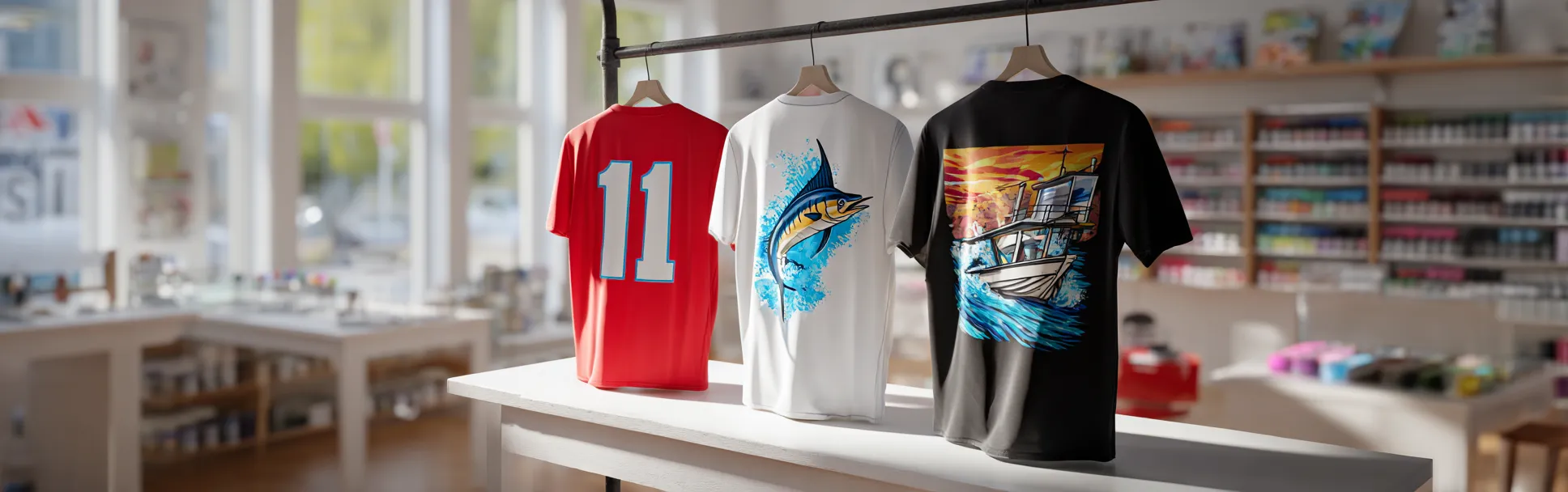
A: Gold HTV (heat transfer vinyl) is a metallic gold-colored vinyl material used for lettering, numbers, and simple graphics on apparel. Gold HTV provides a reflective, foil-like finish that standard DTF printing cannot replicate. It is popular for varsity lettering, names on jerseys, luxury branding, and holiday apparel. Gold HTV is cut on a vinyl cutter, weeded, and heat pressed at approximately 305–315°F for 10–15 seconds. Many decorators combine gold HTV accents with DTF full-color designs on the same garment for a premium layered effect.Beginner overview: heat transfer t-shirts.
Tags
About the Author
DTF Database Founder
Darrin DeTorres has over 10 years of experience in the print industry, specializing in screen printing, sublimation, embroidery, HTV, and DTF printing. He runs Notice Me Marketing and Media, a custom apparel production company that prints thousands of shirts per month.
More from Product Comparisons
Explore DTF Database
Browse and compare 20+ verified DTF printer models by price, features, and specifications.
Read moreCalculate your per-print costs, profit margins, and ROI for DTF printing.
Read moreBrowse verified DTF suppliers for ink, film, powder, and equipment.
Read moreFind DTF transfer suppliers shipping to your state, with verified turnaround times.
Read moreMetro-level DTF supplier guides for Los Angeles, NYC, Dallas, Houston, and more.
Read moreStep-by-step guide to the DTF printing process with temperatures and troubleshooting.
Read more