Best Heat Press for T-Shirts: Buying Guide
Compare the best heat presses for t-shirts by type, size, pressure and price, with picks for beginners, small shops and DTF transfer users.
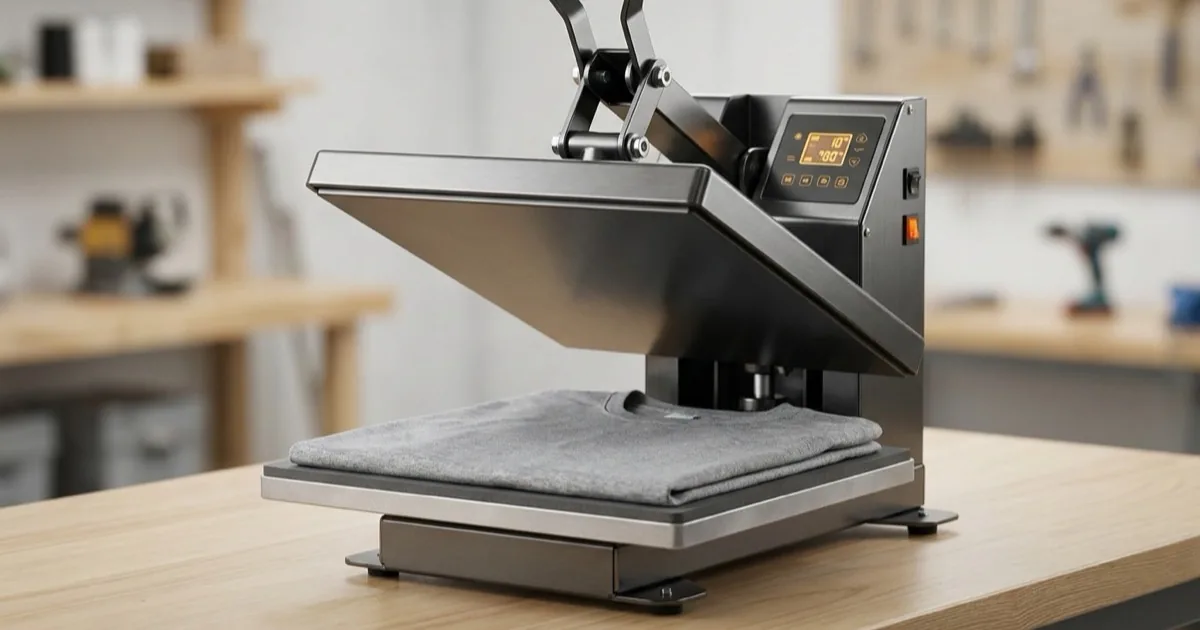
The best heat press machine for shirts depends on your production volume, workspace, and the types of transfers you apply. A quality heat press provides consistent temperature, even pressure, and reliable timing — the three factors that determine whether your DTF transfers, HTV vinyl, and screen print transfers adhere properly and last through dozens of washes.
What is the best heat press for t-shirts?
The best heat press for t-shirts is a 15 x 15 inch clamshell or swing-away press with digital temperature control and adjustable pressure. That size fits standard adult shirt prints and handles vinyl, sublimation and DTF transfers. Beginners often choose a clamshell for its small footprint, while a swing-away keeps the hot platen away from your hands while loading.
Our picks, with prices dated and sourced:
| Model | Press type | Platen | Best for | Price (as published) |
|---|---|---|---|---|
| Cricut AutoPress 2 | Auto-open clamshell | 15 x 15 in. | Beginners and low-volume DTF | $299 on cricut.com, Nov. 14, 2026 (MSRP $349) |
| STAHLS' Hotronix Fusion IQ | Swing-away or draw (pull-out) | Interchangeable platens | Small shops pressing daily | Darrin paid over $2,500 for his setup with extra platens; Hotronix quotes through distributors |
| Upload Transfers Dual Swing Away 16x20 | Pneumatic dual station | 16 x 20 in. | Shops pressing 30+ shirts an hour | $2,500, in stock on Sept. 22, 2026 |
The Fusion IQ and the dual station press are the two we use in our own shop; the AutoPress 2 row comes from Cricut's published specs. Details are in the Fusion IQ review, the dual station write-up and the AutoPress 2 specs.
How to choose a heat press for t-shirts
- Size it to your largest regular print. A 15 x 15 in. platen covers most adult fronts; buy 16 x 20 in. if you press full backs or 2XL and larger shirts often.
- Pick the opening style. Clamshell for small spaces and speed, swing-away or draw for even pressure and safer loading, auto-open if you multitask.
- Confirm the pressure range. You need light pressure for polyester and firm pressure for cotton and patches, so check that the adjustment covers both.
- Check temperature accuracy. Measure the center and four corners with an infrared thermometer when the press arrives; cheap plates can run 20 to 30°F apart.
- Read the warranty and parts policy. Heating elements, controllers and springs wear out; a maker that sells parts keeps the press running. See the heat press repair guide.
What makes a good heat press machine?
A good heat press machine heats evenly across the whole plate, holds its set temperature, and applies adjustable, consistent pressure. For most beginners, a 15x15 inch clamshell press is a practical choice for T-shirts and DTF transfers. Buyers with larger designs or higher volume should consider a swing-away or auto-open model.
Everything else on a spec sheet matters less than those three. A press that runs 20°F cold at one corner, or that can't be set to firm pressure, gives you transfers that peel no matter how good the transfer is. This guide compares press types, sizes and features, gives the DTF settings to use, and lists the presses we can speak to: the ones Darrin uses in his own shop, and others described from their makers' published specs.
Heat press types compared
| Clamshell | Swing-away | Draw (slide-out) | Auto-open | Hat, mug and specialty | |
|---|---|---|---|---|---|
| Best for | Beginners, small spaces, HTV and DTF on shirts | DTF placement, thick items, medium volume | Production shops, precise layout | Consistent dwell times, multitasking | Caps, mugs, tumblers, small items |
| Footprint | Smallest | Needs room to swing the upper platen aside | Needs room in front for the drawer | Same as its base style | Small, single-purpose |
| Pressure evenness | Can be lighter toward the hinge | Even across the platen | Even across the platen | Depends on the base style | Made for one shape |
| Burn risk | Higher: hands work under the open heated platen | Lower: platen swings away | Lower: work area slides out | Lower: opens on its own | Varies |
Specialty presses are covered in the heat press buying guide for sizes, types and specialty presses, and patch work in heat press for iron on patches.
What size heat press do you need?
Pick the size from the largest print you will press regularly:
| Platen | Fits | Good for |
|---|---|---|
| 9x12 in. | Left-chest logos, youth prints, sleeves | A second press for small placements |
| 15x15 in. | Adult full-front prints up to about 12 in. wide | Most shirt and DTF work; the usual first press |
| 16x20 in. | Oversized fronts, full backs, 2XL and larger shirts | Shops printing large designs or hoodies |
| 16x24 in. and larger | Long prints, tote bags, multiple transfers at once | Production pressing |
DTF gang sheets are printed on wide film but cut into single transfers before pressing, so the press only needs to fit your biggest single design, not the sheet. Check print sizes by garment in the placement calculator.
Which heat press settings work for DTF transfers?
Start from the transfer supplier's instruction sheet; it overrides any general chart. Without one, the DTF Database temperature and time chart gives these starting points:
| Fabric | Temperature | Time | Pressure |
|---|---|---|---|
| 100% cotton | 300–325°F (149–163°C) | 10–15 sec | Medium–firm |
| 50/50 cotton/polyester | 285–295°F (141–146°C) | 12–15 sec | Medium–firm |
| 100% polyester | 270–285°F (132–141°C) | 10–12 sec | Medium |
A press that can't hold these temperatures within a few degrees across the platen will give uneven results, which is why plate evenness tops the feature list below. Transfer makers in the DTF supplier directory each publish their own settings, and the DTF transfer temperature guide covers peel types and troubleshooting.
Types of Heat Press Machines
For a deeper comparison of iron vs heat press, manual vs auto-press, and laser-aligned options, see the dedicated buyer guide.
Clamshell Heat Press
- How it works: The upper platen hinges up and clamps down onto the lower platen
- Pros: Compact footprint, affordable, fast operation
- Cons: Uneven pressure toward the back of the platen; some models have a hot upper platen that can be uncomfortable in warm shops
- Best for: Beginners, low-to-medium volume, small workspaces
- Price range: $150–600
Swing-Away Heat Press
- How it works: The upper platen swings to the side, giving full access to the lower platen for garment positioning
- Pros: Even pressure across the entire platen, easier garment placement, no risk of burns during positioning
- Cons: Larger footprint, slightly slower operation (swing out, place, swing back)
- Best for: Medium-to-high volume, DTF transfers where precise placement matters
- Price range: $300–1,200
Draw/Slide-Out Heat Press
- How it works: The lower platen slides out on a drawer for garment loading, then slides back under the upper platen
- Pros: Full access for positioning, consistent pressure, professional workflow
- Cons: Higher cost, larger footprint
- Best for: Professional shops, high volume, production environments
- Price range: $800–3,000+
Auto-Open Heat Press
- How it works: The press automatically opens after the set time expires
- Pros: Prevents over-pressing, consistent results, allows multitasking
- Cons: Higher cost than manual presses
- Best for: Production environments where consistency is critical
- Price range: $400–2,000
Automated Rotary (Carousel) Heat Press
- How it works: Garments ride a rotating ring of stations through fixed heat zones while one operator loads and unloads
- Pros: Hundreds of garments per hour from one operator
- Cons: Quote-only pricing, three-phase power, very large footprint
- Best for: Contract decorators and fulfillment shops pressing the same placement in bulk
- Example: The Hotronix Carousel, rated at up to 300 garments per hour
2026 update: For DTF shops pressing more than a few dozen shirts a day, the next step up from auto-open is a pneumatic dual station press. Our hands-on write-up, Dual Station Auto Heat Press: 30 to 70 Shirts an Hour, covers what one costs, what it needs (a compressor and a sturdy bench), and what it did to our output.
Key Features to Compare
| Feature | Why It Matters |
|---|---|
| Platen size | 15"x15" handles most adult t-shirt transfers; 16"x20" covers oversized designs |
| Temperature range | Must reach 400°F+ for screen print transfers; 325°F is sufficient for DTF |
| Pressure adjustment | Adjustable pressure is essential for different fabric weights |
| Digital controls | Digital temperature and timer provide more accuracy than analog dials |
| Even heat distribution | Verify with a thermal gun — cheap presses can have 20–30°F variation across the platen |
| Auto-open | Prevents over-pressing and frees your hands |
| Interchangeable platens | Lets you swap to hat, mug, or small platens for accessories |
Features that matter, and ones that don't
Matter most:- Heating plate evenness. Check it with an infrared thermometer at the center and all four corners; the table above flags 20–30°F variation on cheap presses.
- Pressure adjustment. You need light pressure for polyester and firm pressure for cotton and patches, so the knob has to cover that range.
- Digital controller accuracy. A digital readout only helps if the plate actually reaches it; confirm with a thermometer when the press is new.
- Warranty and parts. Heating elements, controllers and springs wear out. A maker that sells parts and publishes its warranty terms keeps a press running; see the heat press repair guide for how the main brands handle it.
Heat presses we can speak to
These picks separate what we have used from what comes from a maker's specs:
- Hotronix Fusion IQ (used daily). Darrin has pressed DTF transfers on a STAHLS' Hotronix Fusion IQ in his own shop for more than six years; the Fusion IQ review covers what holds up and what doesn't.
- Dual station pneumatic press (used in our shop). Our dual station auto heat press write-up covers output, cost and setup.
- Cricut AutoPress 2 (based on manufacturer specifications). A 15x15 inch auto-open press with pressure up to 220 lbs and DTF on its official materials list, starting at $349 per Cricut's press release; see the AutoPress 2 specs.
- Hotronix Air Fusion (based on manufacturer specifications). The pneumatic sibling of the Fusion IQ, compared in Fusion IQ vs Air Fusion.
We have not bench-tested other brands, so we don't rank them.
Heat Press Recommendations by Use Case
Best for DTF Transfers
DTF transfers need 300–325°F with consistent medium pressure. A swing-away press with digital controls provides the most consistent results. The Stahls [Hotronix Fusion IQ](/blog/stahls-hotronix-fusion-iq-heat-press-review) is a professional-grade option with interchangeable platens and built-in presets — see the Hotronix Fusion IQ vs Air Fusion comparison for help choosing between the manual and pneumatic models.Best for HTV/Vinyl
HTV requires precise temperature and firm pressure for adhesion. Any quality press with accurate temperature control works. Clamshell presses are popular for HTV because the operation is fast and simple.Best for Screen Print Transfers
Screen print transfers need higher temperatures (375°F) and firm, even pressure. A swing-away or draw-out press is preferred because screen print transfers are more sensitive to pressure consistency.Best Budget Option
For beginners, a 15"x15" clamshell press with digital controls ($150–300) gets you started. It handles DTF, HTV, and screen print transfers adequately. Upgrade to a swing-away when your volume justifies the investment.2026 update: In the crafter tier, the Cricut AutoPress 2 is a 15 x 15 inch auto-open press with adjustable pressure up to 220 lbs and DTF on its official materials list. Cricut's MSRP is $349, and cricut.com listed it at $299 on Nov. 14, 2026. It suits low-volume work, not all-day production. Cricut also sells a 12 x 12 version for $249 with a fixed 110 lbs of pressure. 2026 update: For high-volume shops, automatic rotary presses now start around $28,990. See the Microtec APEX X-Series price breakdown and the Hotronix Carousel.
For what to do when a press stops heating or shows an error code, see the heat press repair guide.
Common heat press mistakes
- Too little pressure. The most common cause of DTF transfers lifting at the edges. Increase pressure until the press closes with real resistance on the garment.
- Uneven plates. A cold corner leaves one side of a transfer under-bonded. Measure the plate, and on a clamshell keep large prints centered rather than near the hinge.
- The wrong size. A 15x15 press can't cover a 14 inch wide back print evenly; buy for your largest regular design.
- Skipping the pre-press. A few seconds of pre-press drives moisture out of cotton and flattens the print area.
- Trusting the dial. Check the actual plate temperature with a thermometer or temperature strips, especially on a new or older press.
Frequently Asked Questions
What is the best heat press machine for t-shirts?
A 15"x15" or 16"x20" swing-away heat press with digital temperature and timer controls is the best all-around choice for t-shirt decoration. It provides even pressure, easy garment access, and handles DTF, HTV, and screen print transfers.How much should I spend on a heat press?
For a home business or side hustle, $200–400 gets a reliable clamshell press. For a production shop, $600–1,500 provides a swing-away or draw-out press with professional features. Avoid presses under $100 — they typically have poor temperature accuracy and uneven pressure.Can one heat press work for DTF, HTV, and screen print transfers?
Yes. All three transfer types use the same basic heat press. The differences are in temperature settings, pressure, and dwell time, which you adjust per application. Any quality press with accurate controls handles all three.What size heat press do I need?
A 15"x15" press handles most standard adult t-shirt transfers. If you regularly print oversized designs (14"+ wide), upgrade to a 16"x20" press. For hats and small items, a mini press or interchangeable platen system adds versatility.For the pressing steps themselves — and what to do when a transfer peels, lifts, scorches, or fades — see how to press DTF transfers.
Written by Darrin DeTorres, DTF Database founder, from his own pressing experience plus the makers' published specs where noted. AI helped organize and draft the 2026 update; settings come from our temperature chart.Tags
About the Author
DTF Database Founder
Darrin DeTorres has over 10 years of experience in the print industry, specializing in screen printing, sublimation, embroidery, HTV, and DTF printing. He runs Notice Me Marketing and Media, a custom apparel production company that prints thousands of shirts per month.
More from Equipment Reviews
Explore DTF Database
Browse and compare 20+ verified DTF printer models by price, features, and specifications.
Read moreCalculate your per-print costs, profit margins, and ROI for DTF printing.
Read moreBrowse verified DTF suppliers for ink, film, powder, and equipment.
Read moreFind DTF transfer suppliers shipping to your state, with verified turnaround times.
Read moreMetro-level DTF supplier guides for Los Angeles, NYC, Dallas, Houston, and more.
Read moreStep-by-step guide to the DTF printing process with temperatures and troubleshooting.
Read more