
Cricut AutoPress Review: Specs, Pros & Hotronix Comparison
The Cricut AutoPress retails at $999 with a 15x12 in heat plate, 400F max temp, and auto-pressure. Specs, pros and cons, and how it stacks up to Hotronix.
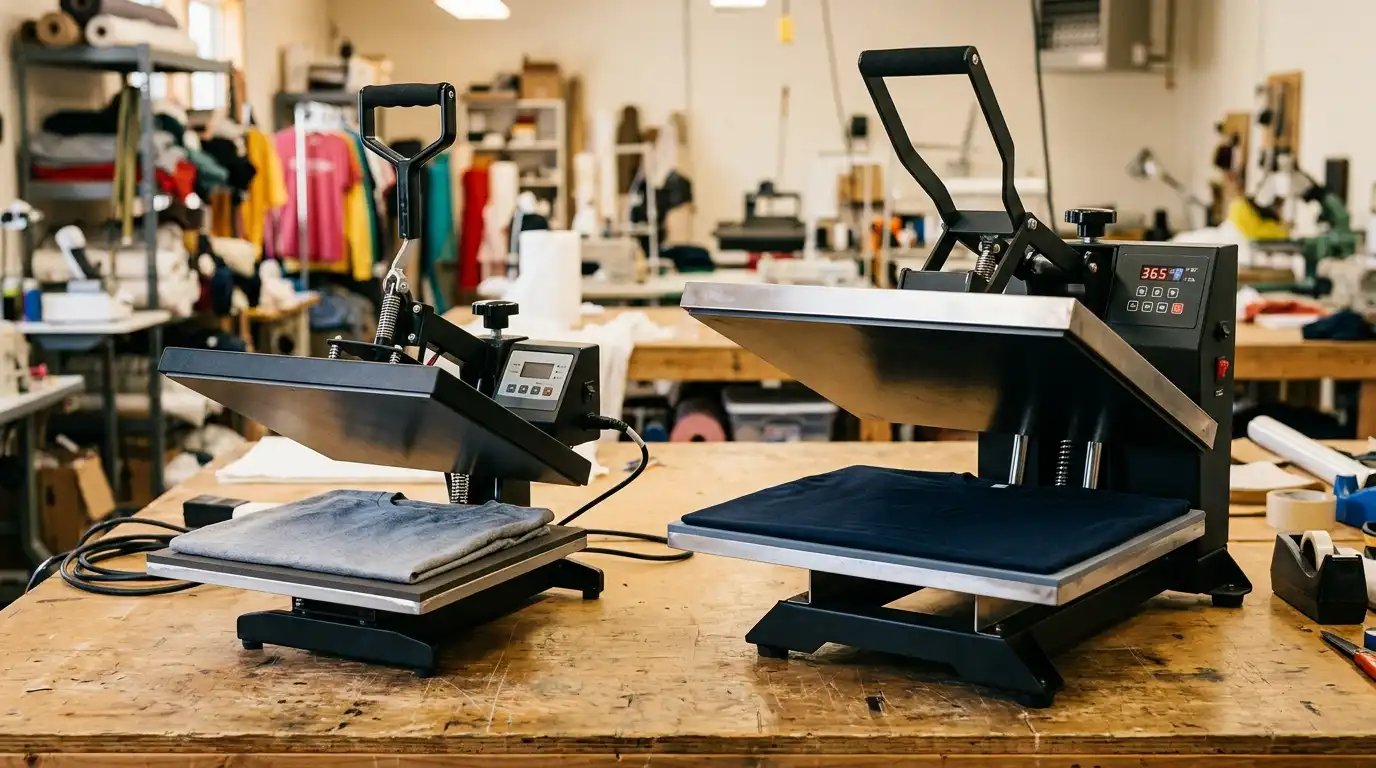
Cricut AutoPress Review: Specs, Pros, Cons, and How It Compares to Hotronix
The Cricut AutoPress is Cricut's biggest, most automated heat press, sitting well above the EasyPress family in both size and price. It is positioned as a prosumer clamshell-style press for crafters, Etsy sellers, and small Cricut-ecosystem shops who want to skip the manual pressure dial of a traditional commercial press.
This review is built from published manufacturer specs on cricut.com and the Cricut Help Center. We have not run a long-term hands-on test on this specific machine, so anything below is either a verifiable spec or clearly marked as editorial opinion.
DTF heads-up: Cricut markets the AutoPress for HTV (iron-on), Infusible Ink, and sublimation. DTF transfers are not in the official material list. The press can reach typical DTF cure temperatures, but it is not Cricut's stated use case.
What the Cricut AutoPress Is
The AutoPress is a top-down, auto-pressure clamshell heat press. According to Cricut, it uses a "Zero Effort" closing mechanism and auto-adjusts pressure to materials up to 2 in (5 cm) thick, so the user does not turn a knob to set pressure. A separate Control Pod handles temperature, time, and presets.
In the Cricut lineup, it sits between the handheld EasyPress family and traditional commercial clamshells from brands like Hotronix or Geo Knight. Cricut calls it "commercial-grade," but its 15 x 12 in plate and ~53 lb chassis put it squarely in the home-and-side-business tier rather than all-day production.
Verified Cricut AutoPress Specs (Manufacturer Sourced)
The specs below are pulled from the Cricut AutoPress product page on cricut.com and the Cricut Help Center. Numbers from third-party retailers are noted.
| Spec | Value | Source |
|---|---|---|
| Retail price | $999.00 USD (sale pricing varies) | cricut.com |
| Heat plate size | 15 in x 12 in (38 cm x 30 cm) | cricut.com |
| Plate surface | Ceramic-coated | cricut.com |
| Max temperature | Up to 400F (205C) | cricut.com |
| Auto-pressure range | Materials up to 2 in (5 cm) thick | cricut.com |
| Voltage | Dual voltage (120-240V) | cricut.com |
| Wattage | ~1300W | Third-party retailer listings |
| Weight | ~53.2 lbs (24.13 kg) | Third-party retailer listings |
| Auto-off | After 13 minutes of inactivity | cricut.com |
| Materials supported | Iron-on (HTV), Infusible Ink, sublimation | cricut.com |
| Control | External Control Pod with 4 presets | cricut.com |
| In the box | AutoPress, Pressing Mat, Control Pod, User Guide | cricut.com |
| Warranty | 1 year | cricut.com |
| Activation | One-time setup via PC/Mac with USB and internet | cricut.com |
For anything not listed, contact Cricut Support rather than relying on third-party numbers.
Pros
- Auto-pressure removes the most common user error. Uneven pressure is the #1 cause of failed transfers and edge lift on manual clamshells; top-down auto-pressure removes that learning curve.
- 15 x 12 in plate beats every EasyPress. Covers an adult tee front in a single press and handles tote bags and hoodie fronts without repositioning.
- Reasonable home-shop footprint that sits on a sturdy work table rather than a dedicated commercial stand.
- Cricut ecosystem integration for existing Maker / Explore / Design Space users.
- Dual voltage for users outside the US.
Cons
- Smaller and slower-cycling than commercial presses. A Hotronix Fusion IQ or MAXX has a 16 x 20 in platen and faster recovery; the AutoPress is not built for hundreds of shirts per shift.
- Auto-pressure is also a limit — no manual dial for puff transfers, heat-sensitive substrates, or lighter-pressure specialty work.
- Not officially marketed for DTF. Cricut's listed materials are HTV, Infusible Ink, and sublimation; DTF support is unofficial.
- One-year warranty with a thinner replacement-parts ecosystem than commercial brands. See our Hotronix Fusion IQ review.
- Requires one-time PC/Mac activation before the press will operate.
Who the AutoPress Is For
- Home crafters and Etsy sellers who have outgrown a 12 x 10 EasyPress.
- Sub-50-shirts-per-week side businesses that want consistent pressure without learning a commercial press.
- Cricut ecosystem users and schools, libraries, and makerspaces with multiple operators.
It is not the right pick for full-time DTF production, 100+ shirts a day, or anyone who needs a 16 x 20 platen.
Cricut AutoPress vs Hotronix Fusion IQ
The Hotronix Fusion IQ is the obvious step up. We have a long-term Hotronix Fusion IQ review from six years of daily shop use.
| Category | Cricut AutoPress | Hotronix Fusion IQ |
|---|---|---|
| Approx. price | ~$999 retail | $2,500+ as configured |
| Plate size | 15 x 12 in | 16 x 20 in (interchangeable platens) |
| Pressure | Auto, top-down | Manual dial, swing-away or pull-out |
| Presets | 4 via Control Pod | Touchscreen + custom recipes |
| Build target | Home / prosumer | Production shop |
| Warranty | 1 year | Commercial-grade |
Cricut AutoPress vs EasyPress / Budget Presses
For users debating cheaper Cricut options:
- Cricut EasyPress SE 12 x 10: $99 (MSRP $119) on cricut.com. Manual handheld, no auto-pressure. Good for occasional crafters.
- Cricut EasyPress 3 (refurb): $109.99 (MSRP $249) for the 12 x 10, currently out of stock on cricut.com. Bluetooth app guidance.
- Sub-$300 third-party clamshells (PowerPress, etc.): Available, but pressure is manual and build varies. We do not publish specs we have not verified.
The AutoPress is the only Cricut machine with auto-pressure and the only one with a 15 x 12 plate.
Is It Worth It?
At $999, the AutoPress is priced where a serious crafter or part-time apparel seller can justify it without committing to a $2,500 commercial press. It earns that price if the workload is HTV, Infusible Ink, or sublimation. If the workload is DTF production, a commercial press with a manual pressure dial and a larger platen is the better long-term buy. Our DTF press settings guide walks through the time, temp, and pressure variables.
FAQ
Is the Cricut AutoPress good for DTF?
The AutoPress reaches DTF cure and final-press temperatures (typical DTF runs roughly 300–325F, within the 400F ceiling Cricut publishes). However, Cricut does not officially list DTF as a supported material. The auto-pressure is calibrated for thinner HTV and Infusible Ink workflows, and there is no published DTF preset. For a hobbyist applying occasional DTF transfers, it can work. For a dedicated DTF business, a commercial press with manual pressure is the safer pick.Can the Cricut AutoPress press dark shirts?
Yes. Shirt color does not change the press's capability. What matters is the transfer or HTV and its time/temp/pressure profile. DTF and HTV use the same settings on dark or light shirts; for sublimation, dark shirts need dye-blocking blanks or specialty sublimation materials regardless of which press is used.How does it compare to a traditional clamshell press?
A traditional clamshell vs auto-press comparison (Hotronix Fusion IQ, Geo Knight DK20S, Hotronix MAXX) has manual pressure, typically a larger platen, and an interchangeable-platen system for sleeves, pockets, and youth shirts. The AutoPress trades that flexibility for a one-touch closing mechanism. For production, the manual clamshell wins on speed and longevity. For a home setup, the AutoPress wins on simplicity.Is the Cricut AutoPress worth it?
Against the EasyPress: yes, if the user is doing more than ~10-20 shirts a week and wants the larger 15 x 12 plate plus auto-pressure. Below that, an EasyPress is plenty. Against a Fusion IQ: only if the workload does not justify a $2,500 commercial press. The AutoPress fills a real gap in the middle of the market.Sources
- Cricut AutoPress product page on cricut.com (price, plate size, max temperature, auto-pressure, voltage, accessories, warranty, materials, activation)
- Cricut Help Center "All About Cricut AutoPress"
- Cricut EasyPress collection page on cricut.com (EasyPress SE and EasyPress 3 pricing)
- Our Hotronix Fusion IQ heat press review
External links to cricut.com or other vendors are rel="nofollow" per our editorial policy. We did not perform a long-term hands-on test of the Cricut AutoPress; spec data is manufacturer-sourced.
Tags
About the Author
DTF Database Founder
Darrin DeTorres has over 10 years of experience in the print industry, specializing in screen printing, sublimation, embroidery, HTV, and DTF printing. He runs Notice Me Marketing and Media, a custom apparel production company that prints thousands of shirts per month.
More from Equipment Reviews
Explore DTF Database
Browse and compare 20+ verified DTF printer models by price, features, and specifications.
Read moreCalculate your per-print costs, profit margins, and ROI for DTF printing.
Read moreBrowse verified DTF suppliers for ink, film, powder, and equipment.
Read moreFind DTF transfer suppliers shipping to your state, with verified turnaround times.
Read moreMetro-level DTF supplier guides for Los Angeles, NYC, Dallas, Houston, and more.
Read moreStep-by-step guide to the DTF printing process with temperatures and troubleshooting.
Read more