
Custom Sizing Tags & Tear-Away Brand Ranking (2026)
How to make custom sizing tags for a private label apparel brand: FTC legal requirements, a tear-away ranking of District, Next Level, Bella+Canvas and the rest, plus the cleanest ways to apply the tag.
Custom Sizing Tags & Private-Label Tear-Away Ranking
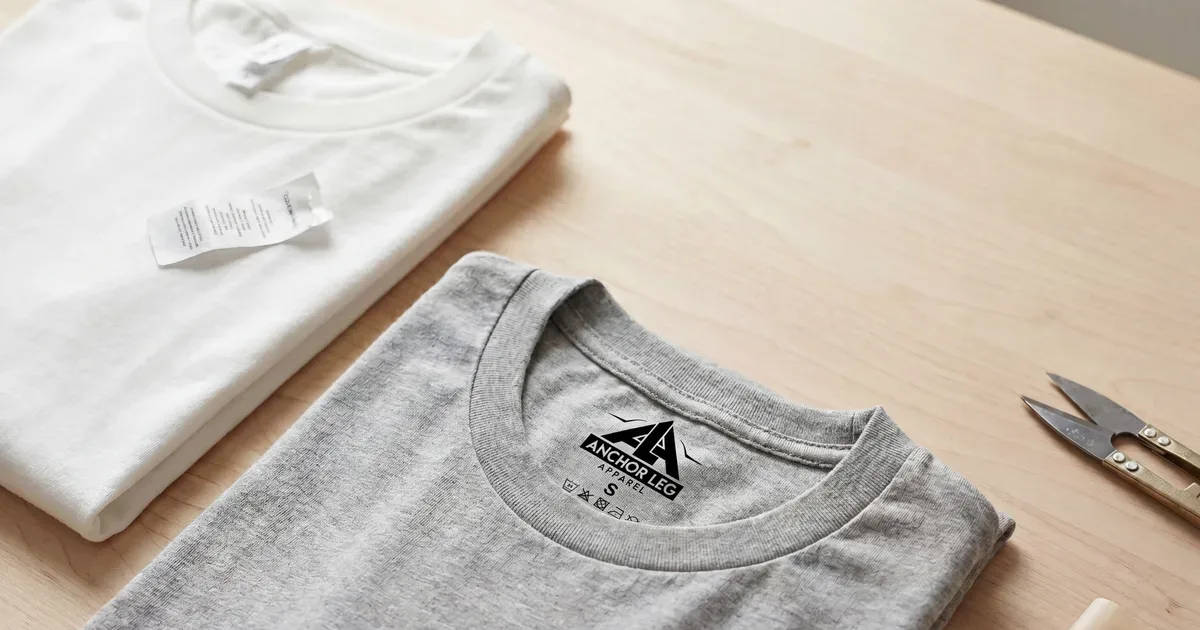
A custom sizing tag is the small printed or sewn label on the inside of a garment that carries the brand mark, the size designator, and the legally required content for apparel sold in the United States. For a private-label brand, it is the cheapest single upgrade between "decorated blank" and "finished product." Done right, it costs pennies per unit and turns a Bella+Canvas tee into a brand-owned good.
This guide covers three things in order: what the law actually requires on the tag, a head-to-head ranking of the major tear-away blanks (District, Next Level, Bella+Canvas, plus Gildan Softstyle, Tultex, Allmade, AS Colour, and Comfort Colors), and the cleanest method to add the tag once the original is gone.
What U.S. Law Actually Requires on the Tag
Three FTC rules govern apparel labeling in the United States. Two of them apply to nearly every shirt, hoodie, and woven-fabric garment on the market:
- The Care Labeling Rule (16 CFR Part 423) requires a permanent label with regular care instructions — washing or dry-cleaning, drying, ironing, and bleaching guidance.
- The Textile Fiber Products Identification Act (16 CFR Part 303) requires the fiber content, the country of origin, and the identity of the company responsible for the product (either the company name or its FTC-issued Registered Identification Number, the RN).
In practical terms, the permanent label on a finished garment needs to carry five pieces of information:
- Fiber content. "100% Cotton" or "60% Cotton / 40% Polyester," by generic fiber name and percentage.
- Country of origin. "Made in Honduras," "Made in USA," "Made in Pakistan," or similar.
- Care instructions. Either standard care symbols or written instructions covering wash, dry, bleach, and iron behavior.
- Manufacturer / dealer identity. The brand's full registered company name or its RN number.
- Size designator. Required by retail convention rather than the FTC rule itself, but every retail-grade tag carries it because it is the first thing a customer reads.
The label must be permanent, securely attached, and legible for the useful life of the garment. It can live in the inside collar, on a side seam, or split across both — what matters is that the required information is present somewhere permanent.
Brand-Mark Tag vs. Side-Seam Care Label
Most private-label brands solve this with a two-label setup:
- A brand-mark tag in the inside of the collar carrying the logo and the size — small, clean, designed for visual identity.
- A side-seam care label carrying the fiber content, country of origin, care symbols, and RN or company name — sewn into the side seam where it does not show and does not touch the back of the neck.
This split keeps the inside-collar label minimal and on-brand while still complying with the law. The single most common mistake in private-label apparel is a beautiful brand-only collar tag with no care, content, or origin information anywhere on the garment.
The RN Number
The RN is a number issued by the FTC to U.S. firms that manufacture, import, market, distribute, or otherwise handle textile, wool, or fur products. Including an RN on the label satisfies the manufacturer-identity requirement without printing the company's full legal name. RNs are issued at no cost and are not transferable. A brand selling in the U.S. should either register for an RN or print its full company name on the label — the requirement is one or the other, not both.
The Relabeling Rule
When a brand removes the manufacturer's tag and replaces it with its own, the new label has to carry the required information or be paired with a side-seam label that does. Removing the tag without replacing the required content is technically a violation of the Textile Act. Records of the relabeling — what was removed and from whom the goods were received — must be kept for three years.
Tear-Away Brand Ranking
A tear-away tag is a manufacturer label attached at a perforation, designed to pull out cleanly without a seam ripper, scissors, or damage to the neck binding. For a brand running 100 or 1,000 shirts, the difference between a clean tear-away and a sewn-in label is measured in hours of labor and the occasional ruined collar.
The ranking below scores the major blank brands across five criteria:
- Catalog coverage. What share of the brand's catalog ships with tear-away labels.
- Removal cleanness. How clean the tear is — does it leave residue, frayed thread, or a visible scar.
- Tag footprint. How small the original tag is, which determines how much area needs to be covered by the new label.
- Decoration friendliness. How well the inside-collar fabric accepts a DTF, screen-print, or HTV neck label after the original tag is removed.
- Hand feel of the host garment. Soft, retail-grade fabric reads as more premium once it is rebranded.
Notes on each brand below are based on published manufacturer specifications and retailer product listings as of 2026. Specific product features can change at the manufacturer's discretion — always confirm with the supplier before placing a private-label order.
1. Bella+Canvas
Bella+Canvas leads the category for private-label work, and the 3001 unisex jersey tee is the most-relabeled blank in the United States. Tear-away tags ship across the entire core line, including the 3001, 3413 triblend, 6004 women's tee, 8800 flowy tank, and the 3719 fleece pullover. The original tag is small, the perforation is consistent, and the inside-collar fabric (4.2 oz, 100% Airlume combed and ring-spun cotton on most colors) takes a heat transfer cleanly.
The trade-off is price — Bella+Canvas runs at the higher end of the wholesale blank market. For brands selling at premium price points, the math works. For volume programs at the lower end, the cost difference matters.
2. Next Level Apparel
Next Level positions tear-away tags as a brand-level feature rather than a per-style option. The 3600 cotton tee, 3900 women's boyfriend tee, 6210 CVC crew, and most of the women's and youth catalog ship with tear-away labels. The tag itself is slightly larger than the Bella+Canvas tag, so the replacement label has more area to cover, but the perforation is reliable and the soft 4.3-oz cotton fabric is well suited to in-house DTF or HTV neck labels.
Next Level sits between Bella+Canvas and the volume brands on price, which makes it a frequent choice for brands trying to balance retail feel with margin.
3. District (a Port & Company / SanMar brand)
District is built specifically around the relabeling use case. According to multiple wholesale retailers, almost every item in the District catalog ships with a tear-away tag — the DT6000 Very Important Tee, DM130 Perfect Tri Tee, DT104 Perfect Weight Tee, the DT6100 V.I.T. Fleece Hoodie, the DT6104 V.I.T. Fleece Crew, and most of the women's and youth styles. The fabric weights and feel sit in retail-fashion territory (soft, slightly slimmer fits, shorter sleeves), which means a brand can build an entire product line on District blanks without breaking visual consistency. SanMar distributes District and offers it through the same channel as the rest of the catalog.
District ranks slightly behind Bella+Canvas and Next Level on consumer brand recognition among private-label buyers, but the catalog breadth is hard to beat for shops that need tees, tris, hoodies, and crews on the same tear-away program.
4. Tultex
Tultex's tear-away program is unusual: the manufacturer states that the labels can be torn anywhere along the tag, not only at a single top-edge perforation. Across the catalog — including the 0202 unisex fine jersey tee, the 0216 misses fine jersey tee, and the 241 / 242 fleece styles — every garment ships with a tear-away tag. Tultex also produces in a single North American facility, which appeals to brands that emphasize supply-chain transparency.
The trade-off is recognition and feel. Tultex blanks run at competitive price points and the fabric is solid, but the retail-fashion polish of Bella+Canvas or District is a notch above. For volume programs where price matters more than premium feel, Tultex is the strongest tear-away play.
5. Gildan Softstyle
Gildan ships tear-away labels across the Softstyle line (64000 / G640 unisex tee, 67000 / G670 women's tee, and the matching long-sleeve and youth styles), as well as on a number of the heavier styles such as the G500 Heavy Cotton tee and the G185 Heavy Blend hoodie. Gildan publishes that the program is transitioning to recycled-material tear-away labels.
Gildan's strength is price and availability. The Softstyle 64000 is one of the cheapest tear-away tees on the market and ships from every major distributor. The trade-off is the brand's reputation as a budget blank — which is changing, but lingers in some retail customer perceptions.
6. Allmade
Allmade is a smaller brand built around recycled-material blanks (the AL2300 unisex tee uses recycled polyester and organic cotton), and the catalog ships with tear-away labels designed for relabeling. Pricing is higher than Bella+Canvas, and catalog breadth is narrower — Allmade is best understood as a sustainability-positioned option for brands whose customers care about that story.
7. AS Colour
AS Colour's heavier-weight Staple tee (5001) and matching styles in the catalog ship with tear-away labels and a fabric weight (around 5.0 oz on the Staple) that appeals to boutique brands wanting a heavier, more substantial garment than a Bella+Canvas 3001. Distribution is narrower in the U.S. than the volume brands, which means lead times can run longer.
8. Comfort Colors
The Comfort Colors 1717 — the iconic garment-dyed heavyweight tee — ships with a sewn-in label, not a tear-away. Some current retailer listings describe the 1717 as having a tear-away, but the manufacturer's own product information and most direct sources describe a sewn-in tag. For brands that specifically need the garment-dyed Comfort Colors look, plan on seam-ripper time per shirt rather than a clean tear, and confirm the current label format with the supplier before placing the order. Comfort Colors as a brand sits in a different bucket than the others here: customers buy Comfort Colors for the garment-dyed color story, often with the original tag intact.
Quick-Reference Table
| Brand | Tear-Away Coverage | Tag Footprint | Relative Price | Best For |
|---|---|---|---|---|
| Bella+Canvas | Across core catalog | Small, clean | High | Premium private label, retail price points |
| Next Level | Most styles, brand-level feature | Medium | Mid-high | Soft-hand fitted streetwear, women's-led brands |
| District | Almost all items | Small | Mid | Catalog breadth across tees, tris, hoodies, crews |
| Tultex | Across catalog (tear anywhere) | Medium | Low-mid | Volume programs, supply-chain-transparent brands |
| Gildan Softstyle | Softstyle line + select Heavy styles | Medium | Low | Volume basics, lowest landed cost |
| Allmade | Across catalog | Medium | High | Sustainability-positioned brands |
| AS Colour | Across catalog | Small | Mid-high | Boutique heavier-weight tees |
| Comfort Colors 1717 | Sewn-in (not tear-away) | N/A | Mid | Garment-dyed color story; plan for seam-ripping |
What to Put on the Custom Sizing Tag
A well-built custom sizing tag balances three jobs: brand visibility, legal compliance, and quick readability of the size at retail. A typical layout, top to bottom:
- Brand mark or logo — top of the label, the largest visual element
- Size designator — large enough to read at arm's length ("M," "LARGE")
- Care symbols — wash, dry, bleach, iron — kept small but legible
- Fiber content — "100% COMBED RINGSPUN COTTON"
- Country of origin — "MADE IN HONDURAS" or "MADE IN USA"
- Brand wordmark or website — optional, turns the label into a marketing surface
- RN number — if the brand has one registered
If any of the FTC-required content does not fit on the inside-collar label, it has to live somewhere else permanent on the garment — most commonly a side-seam care label.
Sizing Tag Dimensions
The vast majority of custom collar tags fall in this range:
- Width: 2 to 3 inches
- Height: 1 to 2 inches
- Placement: centered horizontally, top edge approximately 1 inch below the inside of the collar seam
Labels taller than about 2 inches risk peeking out of the collar from the outside of the shirt. Labels narrower than about 2 inches make the size designator hard to read quickly.
Designing for Multiple Sizes
Brands running tags across S through 3XL produce a separate artwork file per size — same brand-mark and care content, only the size character changes. The cleanest workflow is a master template at 2.5 inches by 1.25 inches at 300 DPI, duplicated across sizes with only the size character swapped. Dropping all the size variants into a single DTF gang sheet (with the artwork repeated to match the size mix being produced) is the standard approach for in-house production.
How to Add the Tag
Four decoration methods cover almost every private-label tag program. The ranking below is by hand feel, soft to most noticeable.
1. Sublimation (poly only, zero hand feel)
Dye sublimation prints into the fibers of the fabric itself, which leaves zero raised material and the softest possible label. The constraints are that sublimation only bonds to polyester (or polyester-coated fabric) and that there is no white sublimation ink — the label can only be a darker color on a lighter substrate. For brands running poly performance apparel or jerseys, sublimation is the cleanest tag method available. For brands running cotton tees, sublimation does not work.
2. Screen-Print Transfer
Screen-printed plastisol or hybrid transfers produced specifically as neck labels are very thin, very durable, and deliver a hand feel close to a direct print. Companies like Transfer Express and Howard Custom Transfers offer dedicated neck-label or tagless-transfer programs. Minimums typically run 50 to 100+ per design, which is the trade-off — for brands with stable artwork and consistent volume, screen-print transfers are the highest-quality method short of sublimation.
3. DTF Transfer
A small DTF transfer (cut down to 2.5 to 3 inches wide by 1 to 1.5 inches tall) is heat-pressed inside the collar at standard DTF settings — typically 300 to 320°F for 8 to 10 seconds with the peel timing the film manufacturer specifies. DTF prints in unlimited color, has no minimum order, and works across cotton, polyester, and blends. Gang-sheeting dozens of label artworks onto a single 24-inch film sheet is the standard in-house workflow. Ninja Transfers, Heat Transfer Warehouse, and the broader network in the DTF Database supplier directory all offer neck-label gang sheets.
The trade-off is hand feel — DTF is slightly thicker than a thin screen-print transfer. A 5-second post-press through parchment paper after the initial press flattens and softens the label considerably.
4. HTV Cut Vinyl
Heat transfer vinyl (Stahls' EcoFilm Soft, Siser EasyWeed, Chemica Hotmark, and similar) cut on a vinyl cutter and pressed inside the collar is the simplest path for shops that already own a Cricut or Roland cutter. It is single-color per piece (multi-color requires layering), has no minimum, and the thinnest softshell HTVs feel almost as soft as a screen-print transfer. For simple wordmark logos and small batches, HTV is the lowest-cost in-house option.
Equipment for Application
A mini heat press in the 4-inch by 4-inch range makes neck-label application substantially easier — the platen fits inside the collar without touching chest decoration, which avoids re-pressing artwork that has already been applied. A standard 16x20 press works as well with a small pressing pillow placed under the collar area, but the workflow is slower and the risk of accidentally pressing over chest art is higher.
Application settings depend on the chosen method:
- DTF: 300–320°F, 8–10 seconds, peel per film spec, optional 5-second post-press through parchment
- HTV: typically 305°F, 10–15 seconds, peel per vinyl spec
- Screen-print transfer: per the supplier's data sheet — usually 320°F, 6–8 seconds
- Sublimation: 385–400°F, 35–60 seconds with firm pressure on a poly garment
All four methods benefit from a simple alignment guide — a piece of cardboard cut to a known height drops into the collar and lines up the top edge of the label at a consistent point, shirt after shirt.
Sourcing the Custom Sizing Tag
Three practical paths cover most brands:
- In-house DTF. A brand that already owns a DTF printer can produce its own sizing tags at a marginal cost of pennies per unit by gang-sheeting all size variants onto a single film. This is the most flexible option for brands running multiple SKUs.
- Specialty neck-label printers. Transfer Express, Howard Custom Transfers, and Heat Transfer Warehouse all run neck-label or tagless-transfer programs. Pricing depends on quantity, color count, and method — confirm directly with the supplier.
- Woven-label suppliers. For brands that want a sewn-in fabric label rather than a printed tag, woven-label producers run through Jacquard looms in minimums of 100 to 500+ pieces. The look is the most premium of any option, but the lead time is weeks rather than days.
For blank apparel sourcing in tear-away configuration, the wholesale blank apparel buying guide and the blank shirt product code references in the DTF Database content library cover catalog selection across Bella+Canvas, Next Level, District, Gildan, Tultex, and the rest in detail.
Frequently Asked Questions
Is it legal to remove the manufacturer's tag from a shirt?
Yes, as long as the brand replaces it with a label that carries the FTC-required information — fiber content, country of origin, care instructions, and either the full company name or the RN — or carries that information elsewhere on the garment in a permanent way. Tear-away blanks are sold specifically for this use case. Records of the relabeling must be kept for three years under the Textile Act.Does the size have to be on the same tag as the care info?
No. The FTC rules require that the care, fiber, country, and manufacturer information be permanent and legible somewhere on the garment, but they do not require all of it on a single label. Most private-label brands run a brand-mark + size tag in the collar and a separate side-seam label that carries the rest of the FTC content.What is an RN number and does a brand need one?
An RN (Registered Identification Number) is an FTC-issued number that identifies a U.S. company on textile labels in place of the company's full legal name. RNs are issued at no cost. A brand selling apparel in the U.S. needs to print either its full registered company name or its RN on the label — one or the other, not both.Which tear-away brand is best for a new private-label brand?
For most new brands, Bella+Canvas (premium feel, broad catalog) or Next Level (soft-hand fitted styles, brand-level tear-away program) are the strongest starting points. District is the strongest catalog-breadth play across tees, tris, hoodies, and crews on a single program. Tultex is the strongest price-driven option. Gildan Softstyle is the strongest pure-volume option.What is the softest custom sizing tag method?
Sublimation, on a poly substrate — the print sits inside the fibers and has zero raised material. After sublimation, thin screen-print transfers are next, followed by thin softshell HTVs, then DTF transfers (which soften considerably with a post-press through parchment).How small can the size character be on the tag?
Large enough to read at arm's length without squinting. In practice, that means at least 12-point type on a 2.5-inch wide tag, often larger. The size designator is the single most-read element on the label at the moment a customer is sorting through stock or pulling a shirt out of a drawer — it earns its space.Can the same DTF gang sheet hold all the sizes?
Yes. The standard in-house workflow is a master template at 2.5 inches by 1.25 inches at 300 DPI, duplicated across S through 3XL with only the size character swapped, then gang-sheeted onto a single 24-inch film. Most DTF sheets hold 50 to 100+ neck label transfers depending on layout, which covers a full production run for a small to mid brand.Conclusion
A custom sizing tag is small artwork doing disproportionate brand work. The right blank — Bella+Canvas, Next Level, or District for retail-feel programs; Tultex or Gildan Softstyle for volume — comes pre-built for relabeling. The right method — DTF, screen-print transfer, HTV, or sublimation — depends on volume, color count, fabric, and required hand feel. The right legal content — fiber, origin, care, manufacturer identity, plus the size — keeps the brand on the right side of FTC rules and out of relabeling-record trouble.
For sourcing across all of the above, the DTF Database supplier directory covers blank distributors, transfer printers, woven-label producers, and the heat-press equipment that makes the application clean. For the application mechanics in more depth, the custom heat transfer neck labels guide and the tagless branding guide cover method-by-method workflows. And for the host garments themselves, the brand-specific size-chart and style guides in the DTF Database content library cover Bella+Canvas, Next Level, District, Gildan, and the rest of the catalog one blank at a time.
Tags
About the Author
DTF Database Founder
Darrin DeTorres has over 10 years of experience in the print industry, specializing in screen printing, sublimation, embroidery, HTV, and DTF printing. He runs Notice Me Marketing and Media, a custom apparel production company that prints thousands of shirts per month.
More from Business Tips
Section 301 forced-labor tariffs of 10% to 12.5% replaced the Section 122 tariff on July 24, 2026. How they hit blank tees, DTF film and ink, who is exempt.
Explore DTF Database
Browse and compare 20+ verified DTF printer models by price, features, and specifications.
Read moreCalculate your per-print costs, profit margins, and ROI for DTF printing.
Read moreBrowse verified DTF suppliers for ink, film, powder, and equipment.
Read moreFind DTF transfer suppliers shipping to your state, with verified turnaround times.
Read moreMetro-level DTF supplier guides for Los Angeles, NYC, Dallas, Houston, and more.
Read moreStep-by-step guide to the DTF printing process with temperatures and troubleshooting.
Read more