
Longer ePrint UV Printer: DTF and UV DTF Modes
Longer's ePrint desktop UV printer is listed at a $1,699 sale price with DTF, DTG and UV DTF modes, plus October shipping.
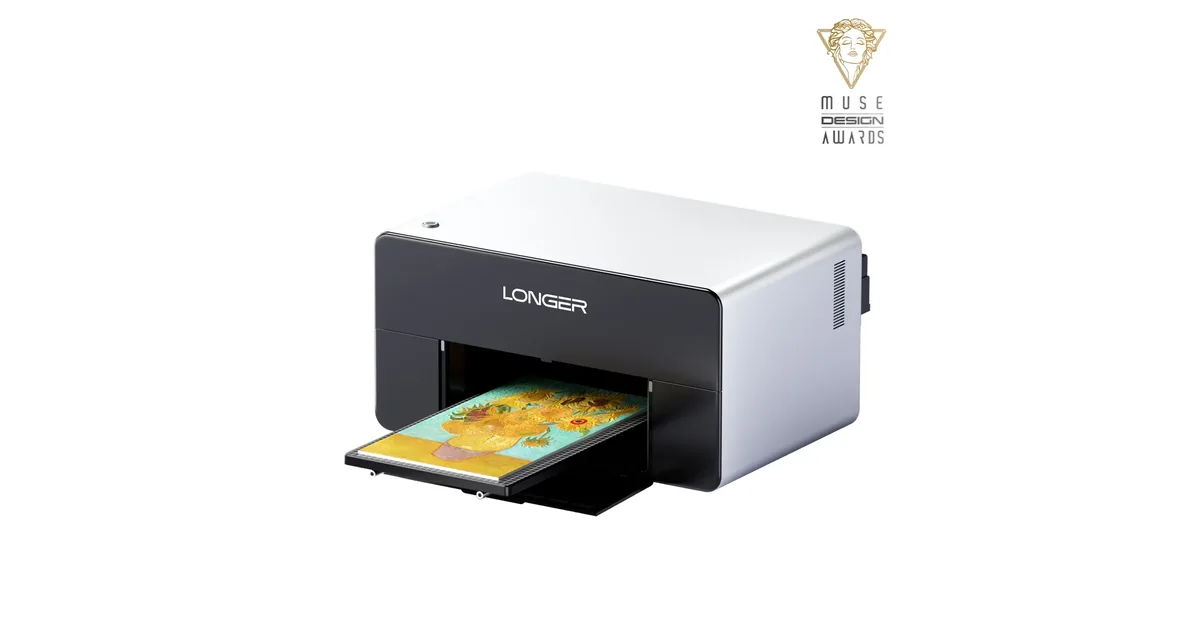
Image: Longer
Longer has opened sales for the ePrint Dual-head Desktop UV Printer, a compact UV system that its product page lists with UV printing, DTF, DTG and UV DTF decal modes. The page shows a $1,699 sale price against a $2,499 regular price for the single-machine Single UV option, and it lists estimated shipping from October.
Specs
| Spec | Detail |
|---|---|
| Product name | Longer ePrint Dual-head Desktop UV Printer |
| Base price shown | $1,699 sale price; $2,499 regular price |
| Shipping timing | Estimated shipping from October |
| Printhead | Two Epson F1080 printheads |
| Ink channels | 12 channels |
| Ink cartridge capacity | 12 x 200 ml on ePrint; 6 x 200 ml on ePrint SE |
| Listed modes | UV printing, DTF, DTG and UV DTF decals |
| Printing area | 310 x 420 mm standard platform; 310 x 75 mm mini platform |
| Print speed | 2 m²/h at 8 pass, 3 m²/h at 6 pass, 4 m²/h at 4 pass |
| Resolution | 1440 DPI |
| Dimensional print height | Up to 15 mm raised color texture |
| Height variation support | Up to 10 mm across uneven surfaces |
| Machine size | 650 x 445 x 330 mm; 25.59 x 17.52 x 12.99 in |
| Net weight | 30 kg; 66 lb |
| Connectivity | USB, WiFi and app control |
| Ink system | Third-party ink compatibility listed as yes |
| Included with the ePrint basic set | ePrint dual-head machine, 12 x 200 ml inks, standard flatbed, mini flatbed, data cable, power cable, instruction manual, USB flash drive and accessory box |
| Shaker or curing oven in the basic set | Not published |
What Longer is selling
Longer's page names the product as the ePrint Dual-head Desktop UV Printer and places four processes around the same product page: UV printing, DTF, DTG and UV DTF decals. The same page also lists five machine modes: flatbed, rotary, transfer film, conveyor belt printing and roll-to-roll printing.
The material list is broad for a desktop product. Longer names rigid blanks such as acrylic, metal, ceramic, stone, glass and wood, and it also names canvas, leather, fabric, plastic and film. That puts the page's emphasis on small customization work across hard surfaces, textiles and films. The closest DTF Database context is the printer directory for dedicated printer options and the beginner DTF printer guide for entry-level equipment shoppers.
The product configurator shows several price points. The single-machine Single UV option is listed at $1,699 sale pricing. Longer also lists rotary, laminator and all-in-one combinations for the Single UV setup, as well as Dual UV and UV + DT options with higher prices. The DTF Combo under the UV + DT module is listed at $2,699 sale pricing against a $3,299 regular price. Shops comparing the ePrint should treat the selected module and bundle as part of the price, not assume that the $1,699 entry line includes every accessory.
Why the modes matter for a DTF shop
For a DTF transfer business, the important distinction is between the dual-head ePrint and the single-head ePrint SE. The Longer page says the dual-head ePrint supports UV printing, DTF, DTG and UV DTF, while its FAQ says the single-head ePrint SE is limited to UV printing and UV DTF. It also says the editions cannot be upgraded after production, so the head configuration is a purchase decision rather than a later add-on.
Longer's own mode list gives a shop several reasons to read the fine print. DTF appears in the dual-head ePrint's supported processes, UV DTF appears in both the product headline area and the FAQ, and the page also names DTG for the dual-head edition. For DTF Database readers, the DTF vs UV DTF comparison and the UV DTF use-case guide give background on how those categories differ before a buyer studies Longer's bundle options.
Longer lists a 310 x 420 mm standard platform, with an inch equivalent of 12.21 x 16.54 in, plus a 310 x 75 mm mini platform with an inch equivalent of 12.21 x 2.95 in. Those measurements are part of the buying question because the same product page also lists transfer film and roll-to-roll printing among the machine's five modes.
What is confirmed and what is still missing
The published spec table is unusually detailed for a desktop machine. Longer lists two Epson F1080 printheads, 12 ink channels, 12 cartridges at 200 ml each, USB/WiFi/app connectivity, 1440 DPI output, and print speeds of 2, 3 or 4 square meters per hour depending on pass count. It also lists the machine at 650 x 445 x 330 mm and 30 kg.
The product page also makes several application claims that shops should test before building pricing around them. Longer says the ePrint can create raised color texture up to 15 mm and handle surface height differences up to 10 mm. Longer names several ink families for the machine, including UV, DTG, DTF, varnish, foil-varnish, embroidery-effect and fluorescent options. Those are useful capabilities if a shop wants small-batch specialty products.
Several buying details still need caution. Longer lists the ePrint basic set contents, and the same page separately offers LongerCare for UV Print Head at $399 against a $499 regular price. The basic-set list names the printer, inks, two flatbeds, a data cable, a power cable, an instruction manual, a USB flash drive and an accessory box. It does not list a powder shaker or curing oven as part of that basic set. For buyers choosing the UV + DT or DTF Combo options, the safest approach is to confirm the exact accessory list with Longer before ordering, especially if the printer is expected to handle textile transfers on day one.
Who should look at it
The clearest fit is a small customization shop that wants one desktop machine for experiments across garments, hard goods and decals. Longer's FAQ says the ePrint is aimed at studios, customization businesses and commercial users, while the ePrint SE is described for beginners, hobbyists and small-batch customization. Those descriptions make the dual-head version the more relevant one for a DTF shop that is considering the product page's DTF and DTG claims.
It is a less direct fit for a shop whose main job is selling full-size DTF gang sheets. The work area, bundle choices and cross-process ink options point toward flexible short-run work rather than pure transfer volume. Shops in that category should still compare production DTF printers, shaker requirements and curing capacity before moving budget from a dedicated transfer line.
The ePrint also competes for attention with other hybrid or crossover machines. Anker's eufyMake Fabric Printer has been positioned around desktop fabric printing with DTG and DTF. DTF Database has also covered UV DTF equipment and media through the Mimaki UJV300DTF-75 post and Roland UV DTF media post. Shops should treat the mode list as a starting point for testing, not as proof that every workflow will match a dedicated machine.
Frequently asked questions
How much does the Longer ePrint cost?
Longer's product page lists the single-machine Single UV option at a $1,699 sale price and a $2,499 regular price. Other modules and bundles on the same page carry higher prices.
Does the Longer ePrint support DTF printing?
Longer lists DTF among the ePrint's modes and says the dual-head ePrint supports UV printing, DTF, DTG and UV DTF. The page also lists transfer film and roll-to-roll printing among five machine modes.
What is the print area on the Longer ePrint?
The published print area is 310 x 420 mm on the standard platform and 310 x 75 mm on the mini platform. Longer also gives inch equivalents of 12.21 x 16.54 in and 12.21 x 2.95 in.
Does the basic set include a shaker or curing oven?
The basic set list names the dual-head machine, inks, two flatbeds, cables, an instruction manual, a USB flash drive and an accessory box. It does not publish a shaker or curing oven in that list.
When will the Longer ePrint ship?
The product page says estimated shipping from October. Buyers should confirm timing with Longer before planning customer deadlines around the printer.
Where it fits in the DTF Database
The ePrint belongs on the watch list for shops comparing desktop crossover machines, not on a shortlist for high-volume transfer production. Start with the printer directory for dedicated DTF options, use the DTF vs DTG comparison to sort garment workflows, and use the DTF vs UV DTF comparison if the real target is decals for hard goods rather than shirt transfers.
About the Author
DTF Database Founder
Darrin DeTorres has over 10 years of experience in the print industry, specializing in screen printing, sublimation, embroidery, HTV, and DTF printing. He runs Notice Me Marketing and Media, a custom apparel production company that prints thousands of shirts per month.
More from Industry News
Explore DTF Database
Browse and compare 20+ verified DTF printer models by price, features, and specifications.
Read moreCalculate your per-print costs, profit margins, and ROI for DTF printing.
Read moreBrowse verified DTF suppliers for ink, film, powder, and equipment.
Read moreFind DTF transfer suppliers shipping to your state, with verified turnaround times.
Read moreMetro-level DTF supplier guides for Los Angeles, NYC, Dallas, Houston, and more.
Read moreStep-by-step guide to the DTF printing process with temperatures and troubleshooting.
Read more