
Roland UV DTF System: UV-DTFA and UV-DTFB Media Explained
Roland DGA launched a new UV DTF system in February 2026: UV-DTFA print sheets and UV-DTFB transfer film for its UV flatbeds. Compatible printers and price.
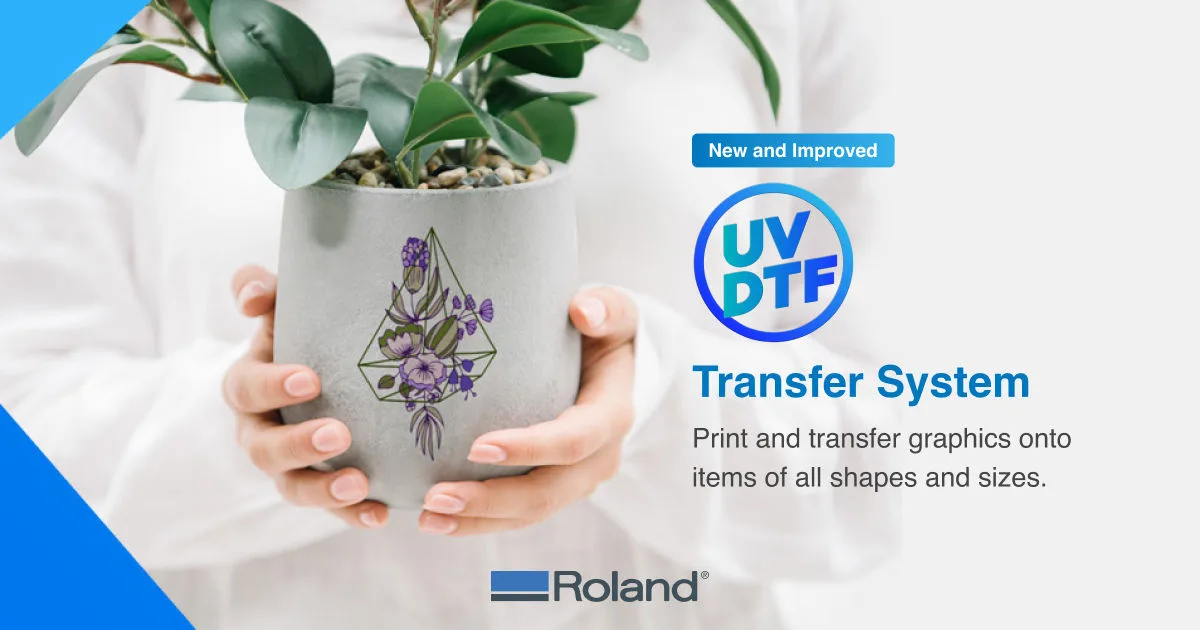
Image: Roland DGA Corporation
This article covers what the two films are, which printers run them, what they cost, the four-step process, and how the system compares with the generic A/B film most UV DTF shops use.
What UV DTF Is
UV DTF is a hard-surface decoration method, not a garment method. A UV flatbed printer lays down white, color, and a clear varnish layer onto a coated film, the UV lamps cure the ink instantly, and a second adhesive-backed film is laminated over the top. Peeling the sandwich off the base sheet lifts the printed graphic on the adhesive film, and rubbing it onto a tumbler, glass, phone case, or planter transfers it without heat. Our UV DTF versus DTF comparison covers the difference from textile DTF in full.
Generic UV DTF media has always been sold as "A film" (print side) and "B film" (transfer side). Roland's naming follows the same convention.
The Two Roland Media Products
| Product | Item number | Format | Price |
|---|---|---|---|
| UV-DTFA Print Sheets | UV-DTFA-A3B-25 | Box of 25 A3 sheets (11.7 x 16.5 in) | $90.99 on the Roland DGA Store |
| UV-DTFB Transfer Film | UV-DTFB-A3R-82 | 12.2 in x 82 ft roll | Not listed on the DGA Store page at time of writing |
At $90.99 for 25 sheets, the A sheets cost about $3.64 each before the B film, ink, and varnish. The print sheets were listed as out of stock on the DGA Store when this was written, so check availability with a dealer.
Roland's stated improvements over its earlier UV DTF products and over competing media:
- Adhesion up to two times better than competitive systems, by Roland's own testing.
- No adhesive residue left on the substrate around the graphic.
- Greater dimensional stability of the print sheet through printing and lamination.
- Layered B film construction that Roland says makes the lift-and-apply step more consistent.
- Dishwasher tested on glass substrates with what Roland calls excellent results.
Roland has not published cycle counts for the dishwasher testing.
Compatible Printers
The media is designed for Roland UV flatbeds running Roland UV ink:
- VersaSTUDIO BD-8 and BD-12 desktop UV printers with ECO-UV 5 ink. These are the machines most small shops and craft businesses run for UV DTF.
- VersaOBJECT MO-180 and MO-240 benchtop UV flatbeds.
- VersaOBJECT CO-i series large-format UV flatbeds.
Roland does not state that the media is incompatible with other UV printers, but its adhesion claims and support apply to Roland hardware and ink.
The Four-Step Process
Roland describes the workflow in four steps:
- Print the graphic, including white and varnish layers, onto a UV-DTFA print sheet.
- Lay UV-DTFB transfer film over the printed graphic and laminate it down.
- Peel the A sheet away, position the graphic on the object, and apply light manual pressure.
- Peel the B transfer film away, leaving the graphic on the object.
No heat press is involved. A hand roller or squeegee is enough, which is why UV DTF is the standard method for tumblers, glassware, and irregular shapes. Substrate prep still matters: see the UV DTF substrate compatibility guide for what to clean and what to avoid.
Roland Media Versus Generic A/B Film
Most UV DTF shops buy generic A/B film from DTF suppliers at a fraction of Roland's per-sheet price. The trade-offs:
- Cost. Generic A3 print sheets and B film rolls are widely available at lower prices, especially in rolls rather than cut sheets.
- Consistency. Roland's argument is that matched media, tested with its ink and varnish, produces repeatable adhesion and clean release. Generic film quality varies by supplier and batch, and edge lift on glass is the most common complaint.
- Support. A Roland dealer will troubleshoot lamination and release problems on Roland media. Generic film is on you.
- Format. Roland sells the A sheets only in A3 cut sheets, which suits the BD-8 and BD-12 but limits larger flatbeds to sheet-fed production.
If you run a BD-8 or BD-12 for stickers, cup wraps, and decals and have fought edge lift or residue with generic film, the Roland media is the first thing to test. If your process is already stable on generic film, the price gap is hard to justify. Our UV DTF cup wraps and transfer stickers guide covers the production side either way.
Frequently Asked Questions
What is the Roland UV DTF transfer system?
The Roland UV DTF transfer system, launched February 18, 2026, is a pair of media products: UV-DTFA print sheets that run through a Roland UV flatbed printer and UV-DTFB transfer film that lifts the cured graphic and applies it to hard objects. Roland claims adhesion up to two times better than competing systems and no adhesive residue.
Which Roland printers work with UV-DTFA and UV-DTFB media?
The media is designed for the VersaSTUDIO BD-8 and BD-12 desktop UV printers with ECO-UV 5 ink, VersaOBJECT MO series benchtop flatbeds, and VersaOBJECT CO-i series large-format flatbeds.
How much does Roland UV DTF film cost?
UV-DTFA print sheets sell for $90.99 per box of 25 A3 sheets on the Roland DGA Store, about $3.64 per sheet. The UV-DTFB transfer film comes in a 12.2 inch by 82 foot roll; its price was not listed on the store page at the time of writing.
Do you need a heat press for Roland UV DTF?
No. UV DTF transfers apply with light manual pressure from a hand roller or squeegee. The Roland process is print on the A sheet, laminate the B film over it, position on the object and press by hand, then peel the B film away.
Is Roland UV DTF dishwasher safe?
Roland says the system was dishwasher tested on glass substrates with excellent results but has not published cycle counts. For customer-facing products, run your own dishwasher test on the exact glass or tumbler you sell before promising dishwasher durability.
Related Resources
For applying UV DTF to tumblers, glass, and phone cases, read the UV DTF stickers and decals application guide. For the hardware side, the heat press hard goods, UV DTF, and sublimation guide explains when a UV flatbed pays for itself versus buying transfers from a supplier.
Tags
About the Author
DTF Database Founder
Darrin DeTorres has over 10 years of experience in the print industry, specializing in screen printing, sublimation, embroidery, HTV, and DTF printing. He runs Notice Me Marketing and Media, a custom apparel production company that prints thousands of shirts per month.
More from Industry News
STAHLS' updated the Hotronix Threadable LowRider 6x6 heat press in September 2026: slide-on platen, bottom access, and a four-platen kit at the same price.
Powderless DTF jets a liquid adhesive onto the film instead of shaking on TPU powder. How DuPont Artistri JA1100 works, who sells it, and what it changes.
Roland DG launched the VersaStudio BY2-20 desktop DTF printer in June 2026 at $7,995. Confirmed specs, dual white ink, built-in cutter, and BY-20 differences.
Explore DTF Database
Browse and compare 20+ verified DTF printer models by price, features, and specifications.
Read moreCalculate your per-print costs, profit margins, and ROI for DTF printing.
Read moreBrowse verified DTF suppliers for ink, film, powder, and equipment.
Read moreFind DTF transfer suppliers shipping to your state, with verified turnaround times.
Read moreMetro-level DTF supplier guides for Los Angeles, NYC, Dallas, Houston, and more.
Read moreStep-by-step guide to the DTF printing process with temperatures and troubleshooting.
Read more