How to Design a Crewneck Sweatshirt: Print Sizes, Placement, Blanks and Pressing
How to design a crewneck sweatshirt: print sizes for the front, back, chest and sleeve, where each design sits, which crew blank to use and how to press it.
How do you design a crewneck sweatshirt?
Design a crewneck sweatshirt in five steps:
- Choose the placement. Full front, left chest, full back, sleeve or a combination.
- Size the design to that placement using the table below, and check it against the smallest size in the order.
- Build the artwork at print size, at 300 DPI, with a transparent background.
- Pick the blank and colour so the design contrasts with the fleece.
- Press one test sweatshirt before the full run.
The design work is mostly about scale. Artwork drawn for a t-shirt usually fits a crewneck at the same width, because adult crews and tees share similar chest widths.
Crewneck sweatshirt print sizes and placement
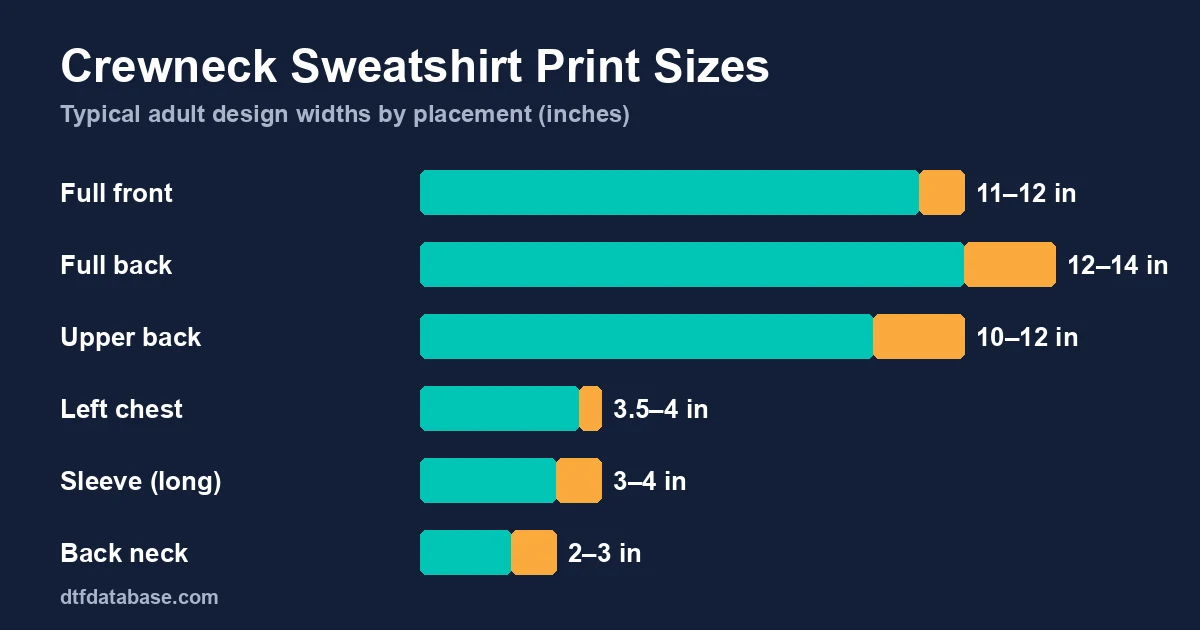
These are the adult widths DTF Database's placement calculator gives for tops. The offset is where the top of the design sits.
| Placement | Design width | Where it sits |
|---|---|---|
| Full front | 11–12 in | Top edge 3–4 in below the collar seam |
| Oversized front | 12–14 in | Top edge 2–3 in below the collar seam |
| Left chest | 3.5–4 in | 7–9 in down from the left shoulder seam |
| Full back | 12–14 in | Top edge 3–4 in below the collar seam |
| Upper back | 10–12 in | Top edge 2–3 in below the collar seam |
| Back neck | 2–3 in | 0.5–1 in below the collar seam |
| Sleeve (long sleeve strip) | 3–4 in wide, 11–12 in long | Running down the arm |
Crewneck sweatshirts have a ribbed waistband, so leave at least 2 to 3 inches between the bottom of a front design and the rib; a print that runs onto the rib stretches when the band does. On a 3XL or larger, the full front can go to the top of the range, while on a small the lower end keeps the design from wrapping toward the side seams. The crewneck size chart for the Gildan 18000 gives a small at 20 inches wide, so an 11 inch design leaves about 4.5 inches each side.
Crewneck sweatshirt design ideas that suit the garment
Crewneck sweatshirts are worn as outer layers in cool weather, so designs that read from a distance work well:
- Collegiate arch text across the chest, the classic varsity crew look.
- A small left chest logo with a large back print, common for businesses, teams and events.
- A centred wordmark or city name at 10 to 12 inches, sitting high on the chest.
- Sleeve text running down one arm, often paired with a chest logo.
- Vintage or distressed graphics on garment-dyed crews, which suit the washed fabric.
For text-heavy designs, keep letter strokes at least 1/16 inch thick at print size so fine lines do not get lost in the fleece texture. The t-shirt design placement guide covers alignment and centring in more detail.
Artwork file for a crewneck sweatshirt design
Send a PNG with a transparent background at 300 DPI at the final print size. An 11 inch wide front design needs 3,300 pixels across. A vector file (AI, EPS, SVG or PDF) also works and scales without blur. Remove any background colour unless it is part of the design, because DTF prints every pixel, including white boxes.
Match the design to the fleece colour: dark crews need a design with enough light colour to stand out, and heather fabrics can make thin pale lines look washed out.
Which crewneck blank should you use?
| Crewneck | Fabric | Weight | Best for |
|---|---|---|---|
| Gildan 18000 Heavy Blend | 50/50 cotton/polyester | 8.0 oz | Budget orders, teams, events |
| Jerzees 562MR NuBlend | 50/50 cotton/polyester | 8 oz | Budget orders with pill-resistant fleece |
| District DT6104 V.I.T. Fleece Crew | 65/35 ring-spun cotton/polyester | 8.3 oz | Retail-style crews with a softer face |
| Comfort Colors 1566 | 80/20 ring-spun cotton/polyester, garment-dyed | 9.5 oz | Vintage looks and premium resale |
The weights and fabrics come from each style's guide on DTF Database. The cheapest sweatshirt blanks guide compares prices, and the blank hoodies and sweatshirts guide covers more styles.
How to press a DTF transfer on a crewneck sweatshirt
Fleece holds moisture, so pre-press the crewneck for 3 to 5 seconds before placing the transfer. On the Gildan 18000, DTF Database's guide gives 285 to 300 degrees F for 15 to 20 seconds at medium pressure with a cold peel; other blends have their own settings in the DTF temperature and time chart. Lay the sweatshirt flat with the collar seam square to the platen, use a pressing pillow if the side seams or collar rib lift the platen, and re-press for a few seconds with a cover sheet after peeling.
Frequently asked questions
What size should a design be on a crewneck sweatshirt?
A full front design on an adult crewneck sweatshirt is usually 11 to 12 inches wide, a left chest logo 3.5 to 4 inches and a full back design 12 to 14 inches. Size down for small and youth sweatshirts.
How far down should a design go on a crewneck sweatshirt?
The top of a full front design usually sits 3 to 4 inches below the collar seam. A left chest logo sits 7 to 9 inches down from the left shoulder seam.
Is a crewneck or a hoodie better for a large design?
A crewneck. It has no pouch pocket, so a large front design can run lower without crossing a seam. On a hoodie the front design has to stay above the pocket.
Can you put a DTF transfer on a sweatshirt?
Yes. DTF transfers press well on cotton, polyester and blended fleece. Pre-press to remove moisture and follow the transfer supplier's temperature, time and peel instructions.
What file do you need to design a custom sweatshirt?
A 300 DPI PNG with a transparent background at the final print size, or a vector file such as SVG, AI, EPS or PDF.
Tags
About the Author
DTF Database Founder
Darrin DeTorres has over 10 years of experience in the print industry, specializing in screen printing, sublimation, embroidery, HTV, and DTF printing. He runs Notice Me Marketing and Media, a custom apparel production company that prints thousands of shirts per month.
More from Tutorials
Streetwear fonts for shirt designs: 20 free Google Fonts by style, from heavy condensed to blackletter and graffiti, what their licenses allow and print tips.
Explore DTF Database
Browse and compare 20+ verified DTF printer models by price, features, and specifications.
Read moreCalculate your per-print costs, profit margins, and ROI for DTF printing.
Read moreBrowse verified DTF suppliers for ink, film, powder, and equipment.
Read moreFind DTF transfer suppliers shipping to your state, with verified turnaround times.
Read moreMetro-level DTF supplier guides for Los Angeles, NYC, Dallas, Houston, and more.
Read moreStep-by-step guide to the DTF printing process with temperatures and troubleshooting.
Read more