Heat Press Silk Screen Look: How Screen Print Transfers Give a Screen-Printed Finish
How to get a silk screen look with a heat press: what screen print (plastisol) transfers are, published press settings, finish, and how they compare to DTF.
What is a screen print transfer?
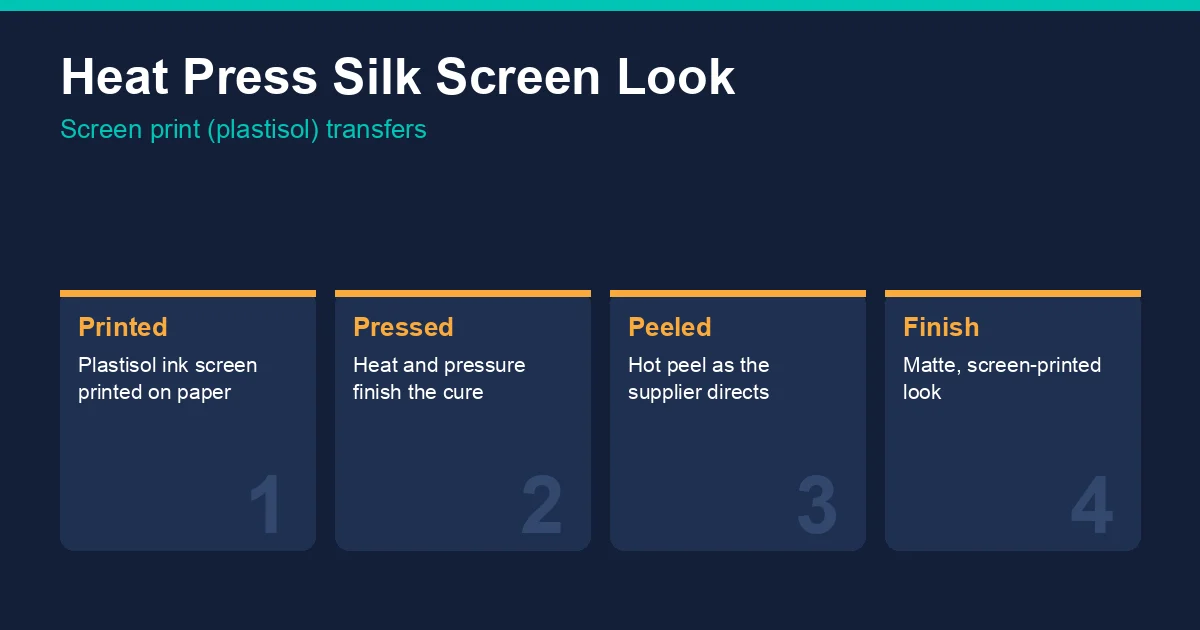
A screen printer prints the design in plastisol ink onto release paper instead of a shirt, with an adhesive layer, and leaves the ink partly cured. The decorator presses it onto the garment, where heat and pressure finish the cure and bond the ink to the fabric. F&M Expressions explains that plastisol needs to reach 300 to 330 degrees F to cure, and that transfers with added adhesive can apply at lower temperatures, which helps on polyester and polypropylene. Silk screen is the older name for screen printing; the screens now use synthetic mesh.
Published press settings
Settings differ by product and formula. These are the supplier's own figures:
| Product | Temperature | Time | Pressure | Peel |
|---|---|---|---|---|
| Transfer Express, Express Names screen printed transfers | 365°F | 4 sec | Medium-firm (6-8) | Hot |
| Transfer Express, Express Names, low-temperature option | 290°F | 15 sec | Medium-firm (6-8) | Hot |
| Velflex screen print transfers | 160-165°C (320-329°F) | 10 sec | Firm | Hot, after a few seconds |
Transfer Express adds 10°F for presses other than Hotronix. Velflex adds a 5-second post-press under a cotton cover to settle the ink and remove surface sheen. Always use the instructions that ship with the transfer.
Getting the screen-printed finish right
- Check real platen temperature. F&M Expressions tells customers to check the press with an infrared temperature gun and use adequate, even pressure; too little pressure is a common cause of poor application.
- Skip the Teflon sheet. F&M Expressions says never to use Teflon sheets, covers or pillows with its plastisol formulas. Press the paper directly unless the transfer's instructions say otherwise.
- Peel as directed. Hot-peel transfers come off cleanly only while hot; letting them cool can lift ink.
- Post-press for matte. A short second press under a cotton or paper cover, where the supplier calls for it, reduces gloss.
Screen print transfers vs DTF for a screen-printed look
| Screen print (plastisol) transfers | DTF transfers | |
|---|---|---|
| Colours | Priced by number of colours | Full colour at no extra cost |
| Best for | Repeat logos in 1 to 3 colours, larger quantities | Photos, gradients, many colours, short runs |
| Setup | Screens per colour, built into the price | No screens |
| Feel | Ink finish suppliers describe as soft and matte | Thin printed film; F&M Expressions says DTF tends to feel thicker than its screen print transfers |
For a one- or two-colour logo printed in quantity, a screen print transfer gives the closest thing to direct screen printing from a heat press. For full-colour art, DTF is usually simpler and cheaper. The screen print transfers vs DTF comparison goes deeper, the screen charge guide explains how colour count drives the price, and the best screen print transfer companies list covers suppliers. The puff print transfers guide covers the raised specialty version.
Frequently asked questions
Can you heat press a silk screen print?
Yes, as a screen print transfer. The design is screen printed in plastisol onto transfer paper and then applied with a heat press.
What temperature do you press plastisol transfers?
It depends on the formula. Transfer Express publishes 365°F for 4 seconds for its Express Names transfers, or 290°F for 15 seconds for its low-temperature option, both at medium-firm pressure with a hot peel.
Do screen print transfers feel like screen printing?
They use the same plastisol ink, and suppliers describe the result as a soft, matte, screen-printed finish.
Should you use a Teflon sheet with plastisol transfers?
Not unless the supplier says to. F&M Expressions says never to use Teflon sheets, covers or pillows with its plastisol formulas.
Tags
About the Author
DTF Database Founder
Darrin DeTorres has over 10 years of experience in the print industry, specializing in screen printing, sublimation, embroidery, HTV, and DTF printing. He runs Notice Me Marketing and Media, a custom apparel production company that prints thousands of shirts per month.
More from Tutorials
How to design a crewneck sweatshirt: print sizes for the front, back, chest and sleeve, where each design sits, which crew blank to use and how to press it.
Streetwear fonts for shirt designs: 20 free Google Fonts by style, from heavy condensed to blackletter and graffiti, what their licenses allow and print tips.
Explore DTF Database
Browse and compare 20+ verified DTF printer models by price, features, and specifications.
Read moreCalculate your per-print costs, profit margins, and ROI for DTF printing.
Read moreBrowse verified DTF suppliers for ink, film, powder, and equipment.
Read moreFind DTF transfer suppliers shipping to your state, with verified turnaround times.
Read moreMetro-level DTF supplier guides for Los Angeles, NYC, Dallas, Houston, and more.
Read moreStep-by-step guide to the DTF printing process with temperatures and troubleshooting.
Read more