
Does Cotton and Polyester Shrink? A Guide for DTF Blend Shirts
By Darrin DeTorres, DTF Database founder · Published
A 50/50 tee, a CVC tee and a tri-blend all shrink differently, and a shirt that shrinks after pressing takes the DTF print with it. This guide covers how much each blend moves and what to do before the transfer goes on.
Will a cotton and polyester shirt shrink?
Yes, a cotton and polyester blend can shrink, but usually less than a 100% cotton shirt. The cotton fibers shrink when washed hot or tumble dried on high heat; the polyester fibers resist shrinking and help the garment hold its size. The more cotton in the blend, the more it can shrink. Wash cold and dry low.
Why the cotton shrinks and the polyester doesn't
Cotton is a natural fiber that absorbs water and swells. Heat, water and tumbling let cotton fibers relax into tighter positions as they dry, so a cotton yarn ends up shorter than it was knitted.
Polyester is a synthetic fiber that absorbs very little water and is heat-set into shape at the mill. Normal washing leaves polyester close to its original size, though very high heat can deform polyester. Custom Ink states that polyester fibers begin to distort above 302°F (150°C).
A cotton and polyester blend contains both behaviors. The cotton portion does most of the shrinking and the polyester portion limits how far the fabric can move, which is why a 50/50 shirt moves less than a 100% cotton shirt under the same hot wash.
How much does a blend shrink?
A 50/50 cotton/polyester shirt shrinks under 1% with a cold wash and low dry, and 2–3% with a hot wash and high dry, according to Custom Ink's June 27, 2026 care guide. The last column converts those percentages to inches on a shirt 18 inches wide and 28 inches long, which is the math DTF Database added.
| Fabric | Cold wash, low heat | Hot wash, high heat | Hot and high, in inches |
|---|---|---|---|
| 100% cotton (preshrunk, 5.3 oz) | About 1% | 3–5% | 0.8–1.4" length, 0.5–0.9" width |
| Tri-blend | Under 1% | 2–4% | 0.6–1.1" length, 0.4–0.7" width |
| 50/50 cotton/polyester | Under 1% | 2–3% | 0.6–0.8" length, 0.4–0.5" width |
| 100% polyester | 0.3–0.5% (warm wash, low dry) | 2–3% (repeated cycles) | 0.6–0.8" length, 0.4–0.5" width |
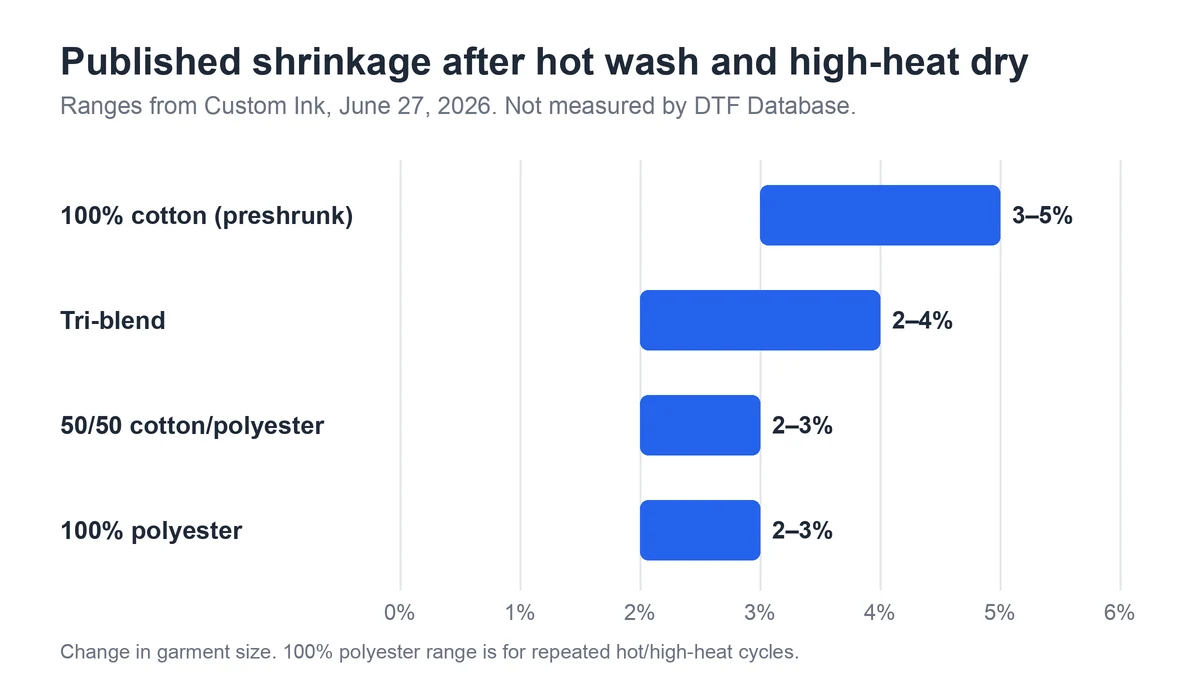
DTF Database has not run its own wash test, so these are not our measurements. Custom Ink does not publish its test method, and its guide gives no separate figure for CVC. Fabric weight, knit and whether the mill preshrunk the fabric all change the result, so treat the table as a guide and measure the blank when fit matters:
- Lay the shirt flat and measure body length from the high point of the shoulder to the hem.
- Measure chest width from side seam to side seam, 1 inch below the armholes.
- Wash and dry the shirt on the settings the customer will use, then measure the same two lines again.
- Divide the change by the original measurement and multiply by 100 to get the percent change.
Does polyester shrink in the dryer or under a heat press?
Polyester resists shrinking in a normal wash, and high heat is the risk. Custom Ink puts 100% polyester at 2–3% after repeated hot washes and high-heat drying, and it describes a high dryer setting as above 150°F. The full polyester shrinkage guide covers 100% polyester in detail.
A heat press runs far hotter than a dryer, so on polyester the concern is scorching, shine marks and dye migration rather than shrinkage. Scorching and shine marks are heat damage to the fabric surface around the print. Dye migration happens on dyed polyester when heat releases the fabric dye, which then bleeds into the white or light ink layers of the transfer. The dye migration guide explains how to prevent it.
The press temperature listed by the transfer supplier is the number to follow, because film and powder differ. STAHLS' UltraColor MAX instructions, for example, list 325°F (163°C) for 100% cotton and 290°F (145°C) for all other fabrics, at 12–15 seconds, medium pressure and a hot peel. If a supplier publishes nothing, these DTF Database starting points apply, tested on a spare garment first:
| Fabric | Temperature | Time | Peel |
|---|---|---|---|
| 100% Cotton | 300–325°F (149–163°C) | 10–15 sec | Hot or Cold |
| CVC / Cotton-Dominant Blend (60/40, 80/20) | 290–310°F (143–154°C) | 10–15 sec | Warm or Cold |
| 50/50 Cotton / Polyester Blend | 285–295°F (141–146°C) | 12–15 sec | Warm or Cold |
| Tri-Blend (cotton/poly/rayon) | 280–300°F (138–149°C) | 10–12 sec | Warm or Cold |
| 100% Polyester (incl. sportswear) | 270–285°F (132–141°C) | 10–12 sec | Cold |
How to pre-shrink and pre-press a blend shirt before applying a DTF transfer
A garment that shrinks after pressing can pucker the fabric around the print, because the fabric tightens and the transfer does not shrink with it. Pre-washing is most useful on cotton-rich blanks and on small or fit-critical orders.
- Wash and dry the blank the way the customer will. Skip fabric softener, and test one pre-washed blank first, since a change in the fabric finish can affect how a transfer bonds.
- Pre-press for 3–5 seconds to remove moisture and wrinkles.
- Let the shirt cool before positioning the transfer.
- Press the transfer at the supplier's settings. Check placement on the washed shirt, since its measurements may have changed.
- Wait before the first wash per the supplier's instructions. The DTF Database care guide recommends at least 24 hours when a supplier gives no figure.
How to wash cotton/polyester so it doesn't shrink
- Turn the shirt inside out.
- Wash in cold water.
- Tumble dry on low, or air dry.
- Keep the shirt out of a high-heat dryer cycle, where most of the cotton shrinkage happens.
For a DTF print, the same routine applies, and Transfer Kingdom's washing instructions also call for a detergent without bleach or softener. STAHLS' care line is machine wash cold, then tumble dry low or hang dry.
Can you shrink a cotton/polyester shirt on purpose?
Yes, a hot wash followed by a high-heat dry will shrink a cotton/polyester shirt somewhat, and the cotton portion does most of the shrinking. The result is hard to control, since Custom Ink's hot-and-high figure for a 50/50 is only 2–3%, or under an inch on a 28-inch shirt. Do not do this once a transfer is applied: high dryer heat can stress the print, and the fabric tightens underneath a transfer that does not shrink with it.
Which blend is best if you're worried about shrinkage?
For the least movement in the wash, choose a higher polyester content. A 50/50 is a common middle ground for DTF because it moves less than cotton and is less exposed to press damage than 100% polyester. Shrink figures below are the Custom Ink ranges cited above; the DTF notes come from the DTF press temperature chart.
| Fabric | Shrink tendency | Feel | DTF suitability |
|---|---|---|---|
| 100% cotton | Most: 3–5% hot and high heat | Soft and breathable | The most forgiving fabric to press; pre-wash first when fit matters |
| CVC (such as 60/40) | No published figure found; more cotton than a 50/50 | Close to cotton | Takes more heat than a 50/50, less than 100% cotton |
| 50/50 cotton/polyester | Moderate: 2–3% hot and high heat | Soft, with some polyester smoothness | A lower press temperature than cotton guards against polyester scorching |
| Tri-blend | Moderate: 2–4% hot and high heat | Light and drapey | Rayon limits the heat, and thin fabric shifts on the platen, so use medium-light pressure |
| 100% polyester | Least in normal care: 0.3–0.5% | Smooth and slick | Stable in the wash, but the most exposed to scorching and dye migration |
Specific styles are compared in the best blank shirts for DTF guide, and transfer companies are listed in the DTF supplier directory.