
Can You Shrink Polyester? What Works, What Doesn't, and What It Means for DTF
Can you shrink polyester? Yes, but only with high heat, and results vary. Learn safe methods, blend behavior, and what it means for DTF prints.
Can you shrink polyester?
Yes, but only a little. Polyester is a heat-set synthetic fiber, so normal washing barely changes it. Very hot water and high dryer heat can shrink it slightly, and blends with cotton shrink more. Excess heat can also warp, wrinkle or damage the fabric, so test a garment first.
The reason is how the fiber is made. Polyester is a thermoplastic, and manufacturers stretch and heat-set the fibers into shape. The fabric holds that shape until it is exposed to more heat than it saw during manufacturing, which is why household heat changes it so little and why the changes that do happen are often distortion rather than a clean drop in size.
Why polyester resists shrinking
Cotton shrinks because its fibers absorb water, swell, and relax into tighter positions as they dry. Polyester absorbs very little water, so it does not go through that cycle. What it responds to is heat. Heat above the temperature it was set at can soften the fiber and let it relax, tighten, or deform.
That is also why polyester behaves differently under a heat press than cotton does. The same thermoplastic quality that limits shrinking is the reason polyester can glaze, scorch, or release dye when pressed too hot. The heat pressing polyester guide covers those press-side effects.
How to shrink polyester on purpose
Shrinking polyester is unreliable, so treat it as a last resort for a garment that is slightly too large. Results vary by fabric weight, knit, and finish.
- Read the care label. Note the fiber content and any "do not tumble dry" or "cold wash only" warnings. High heat can ruin garments with coatings, prints, or elastane.
- Wash on the hottest setting the label allows. Hot water is the first step because it starts to relax the fibers.
- Dry on high heat. Tumble dry on the highest setting the label allows. Dryer heat does most of the work.
- Check the fit while the garment is still warm. Stop as soon as it fits. More heat does not guarantee more shrinkage and raises the risk of damage.
- Repeat cautiously, if at all. One more hot cycle is the limit. Repeated high-heat cycles increase the chance of warping and wear.
The risks are real. Excess heat can melt or glaze the surface, leave shiny patches, set deep wrinkles, or distort the shape so the garment fits worse than before. Polyester blends with elastane are the most likely to lose their stretch. If the garment matters, test the process on a similar scrap or an inexpensive blank first.
Does polyester shrink in the dryer?
Polyester can shrink slightly in a dryer, but it takes high heat. A normal or low-heat cycle usually leaves 100% polyester close to its original size, while a high-heat cycle can tighten it a little.
Two things get confused with shrinkage. Wrinkling is polyester setting into creases under heat, and it does not change the garment's size. Distortion, such as twisted seams or a warped hem, changes the fit without shrinking the fabric evenly. A shirt that feels smaller after a hot dry may be wrinkled or distorted rather than truly shorter.
How much do polyester blends shrink?
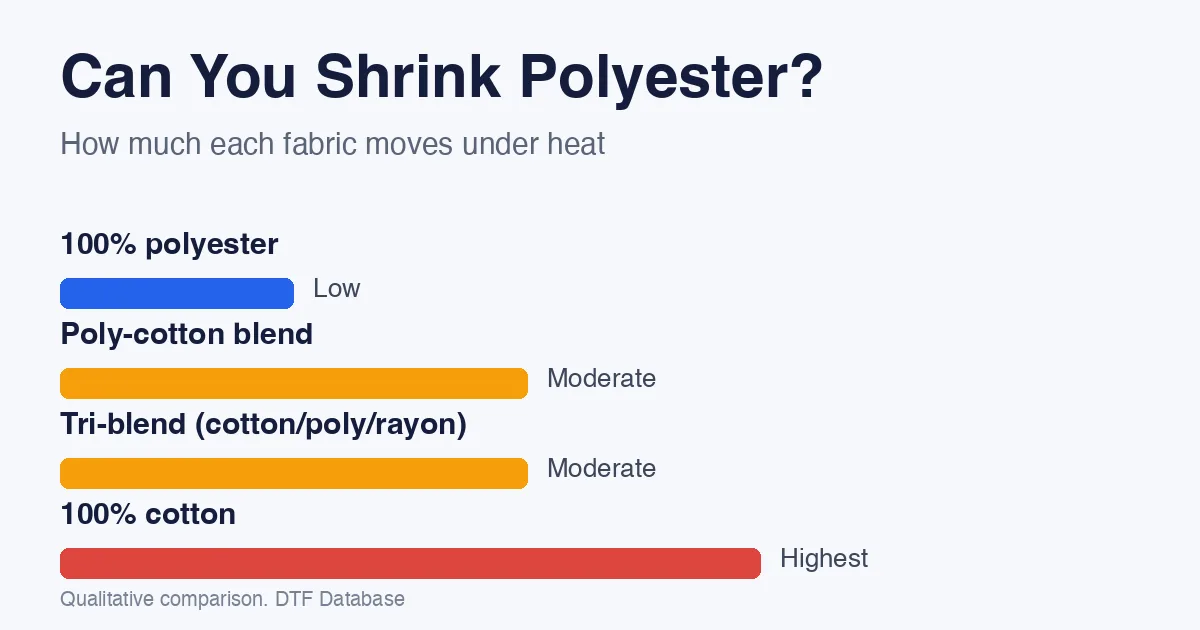
The cotton content in a blend drives most of the shrinkage. The table compares fabric types qualitatively. Exact percentages vary by brand, knit, and whether the garment was pre-shrunk, and this guide does not publish measured percentages.
| Fabric | Typical fiber mix | Shrink risk | What to expect |
|---|---|---|---|
| 100% polyester | Polyester only | Low | Minimal shrinkage; heat mainly causes wrinkling or distortion |
| Poly-cotton blend | Often 50/50 or 65/35 | Moderate | The cotton portion can tighten, so the garment may shrink and twist |
| CVC blend | Cotton-dominant, such as 60/40 | Moderate to high | Behaves more like cotton than polyester |
| Tri-blend | Cotton, polyester, and rayon | Moderate | Cotton and rayon can both shrink, and the hand may change after washing |
| 100% cotton | Cotton only | Highest | The most likely to shrink, unless pre-shrunk |
For DTF work, the fiber mix on the label matters for pressing temperatures as much as for shrinkage. The best shirts and blanks for DTF transfers guide compares blank types by fabric.
Does shrinking affect a DTF print?
It can, in two ways: shrinkage before the print and shrinkage after it.
Before the print. A blank that tightens in its first wash changes how a design sits. A design sized for the garment as sold ends up proportionally larger on a garment that has shrunk, so placement measured on an unwashed blank may not match the finished shirt. After the print. A DTF transfer is a layer of ink and adhesive bonded to the fabric. If the fabric underneath tightens, the print has to move with it. A garment that shrinks noticeably after printing puts stress on the transfer, and that can show up as wrinkling at the edges or cracking and peeling in the first washes. The DTF print cracking and peeling after washing guide covers the causes, and the DTF washing and care guide covers what to tell customers. On polyester, heat is the bigger risk. Polyester does not shrink much, but it reacts to press heat. The DTF Database temperature chart lists 100% polyester at 270 to 285 degrees F for 10 to 12 seconds with medium pressure (30 to 40 psi) and a cold peel, lower than the cotton range. Pressing hotter can cause dye migration, where dye in the polyester bleeds into the white or light ink layers. The dye migration guide explains how to prevent it. For general press technique, see the DTF heat press tips.How to prevent polyester from shrinking
Avoiding shrinkage is much easier than causing it.
- Wash cold or cool. Cold water does not stress the fibers.
- Dry on low heat or air dry. Heat is the main cause of shrinking, wrinkling, and distortion.
- Take it out while slightly damp. Hang or lay flat to finish.
- Follow the care label. It reflects the garment's actual fiber mix and finish.
- Keep blends away from hot cycles. Blends with cotton are the most sensitive to heat.
Should you pre-wash polyester before printing?
For 100% polyester, a pre-wash is usually not needed to prevent shrinkage, because the fabric moves very little. For cotton-rich blends, washing and drying the blank first lets the cotton shrink before the transfer is applied, so the garment moves less once printed. Either way, pre-press the garment for a few seconds before applying the transfer to remove moisture and wrinkles. The heat press tips guide explains why. Test a pre-washed blank first, since the shirt's finish can change how a transfer bonds.
Frequently Asked Questions
Does polyester shrink in the wash?
Polyester shrinks very little in a normal wash. A cold or warm cycle usually leaves 100% polyester close to its original size. Hot water can cause slight shrinkage, and blends with cotton are more likely to shrink than pure polyester.
Does 100% polyester shrink when you dry it?
A high-heat dryer cycle can shrink 100% polyester slightly, but the more common results are wrinkling and distortion. Low-heat drying or air drying avoids almost all of it. Always check the care label before using high heat.
Do polyester blends shrink more than pure polyester?
Yes. The cotton in a polyester blend absorbs water and tightens as it dries, so blends shrink more than pure polyester. The more cotton a garment contains, the more it is likely to shrink, unless the fabric was pre-shrunk.
Does shrinkage damage a DTF print?
It can. If the fabric tightens after a transfer is applied, the print has to move with it, and that stress can show up as edge wrinkling or cracking. Pre-washing cotton-rich blanks and following wash instructions reduces the risk.
Related Guides
- Heat pressing polyester: temperatures and iron burn repair
- DTF dye migration on polyester
- Is cotton moisture wicking?
- DTF washing and care guide
For how the fabric feels in the hand, see what polyester feels like.
Tags
About the Author
DTF Database Founder
Darrin DeTorres has over 10 years of experience in the print industry, specializing in screen printing, sublimation, embroidery, HTV, and DTF printing. He runs Notice Me Marketing and Media, a custom apparel production company that prints thousands of shirts per month.
More from Tutorials
Polyester feels smooth, light and slightly slick, but blends and microfiber can feel soft. Learn how it compares to cotton and how DTF prints feel on it.
Explore DTF Database
Browse and compare 20+ verified DTF printer models by price, features, and specifications.
Read moreCalculate your per-print costs, profit margins, and ROI for DTF printing.
Read moreBrowse verified DTF suppliers for ink, film, powder, and equipment.
Read moreFind DTF transfer suppliers shipping to your state, with verified turnaround times.
Read moreMetro-level DTF supplier guides for Los Angeles, NYC, Dallas, Houston, and more.
Read moreStep-by-step guide to the DTF printing process with temperatures and troubleshooting.
Read more