Etsy's Unedited Photo Rule: What Shirt Sellers Must Change
Etsy now requires one unedited photo of the real item in every listing. What counts for custom shirts, mockups, POD, and AI art, and when enforcement starts.
Etsy's new image rule at a glance
| Detail | What Etsy says |
|---|---|
| Core rule | At least one unedited photo of the actual item against a real background, for most items |
| Allowed on the unedited photo | Cropping, resizing, adding a watermark, changing the file format |
| Not allowed on the unedited photo | Adjusting lighting, color, or background |
| Which photo | Any position; the first listing image does not have to be the unedited one |
| How many | One per listing, even with multiple variations |
| Videos | An unedited video does not satisfy the requirement |
| Other photos | May be edited, including with AI, as long as the item does not look different from what the buyer receives |
| New AI limits | Bot-generated listings and AI-generated functional guides (patterns, recipes, instructions) are prohibited |
| Buyer reports | A new option to flag listings that use AI imagery in a misleading way; early reports will not trigger immediate enforcement |
| Proactive enforcement | Planned for early 2027, with advance notice promised |
All of the above comes from Etsy's announcement post and its Help Center article on how the Listing Image Requirements apply to listings.
What counts as an unedited photo
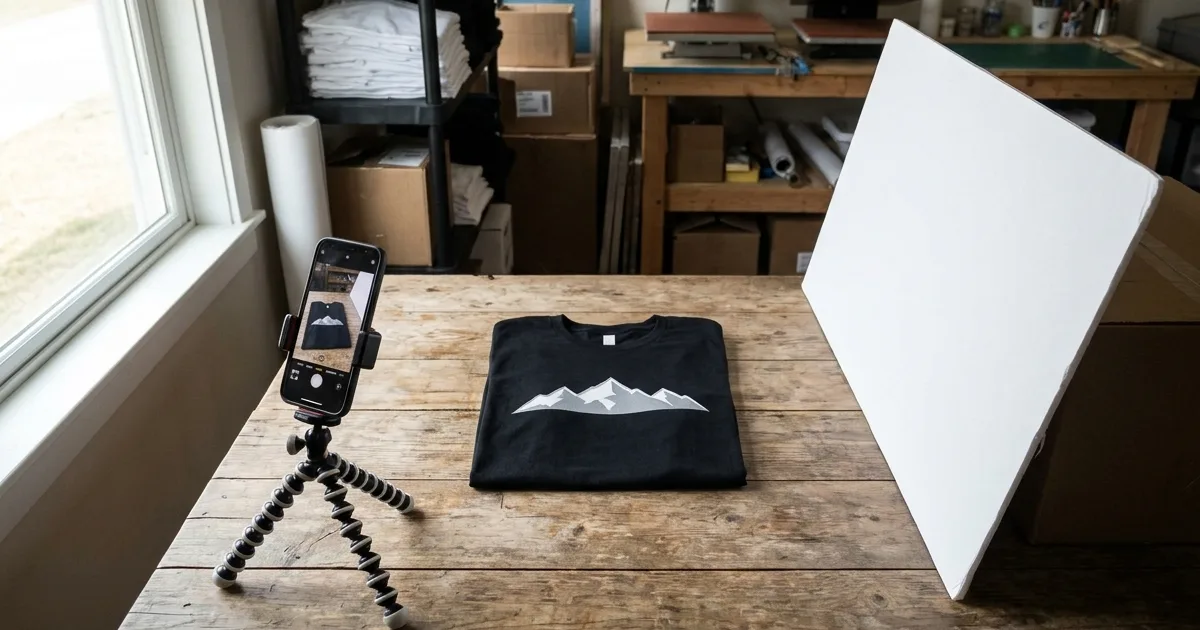
Etsy's Help Center describes the unedited photo as a picture of the actual item against a real background, and it names a light box or white backdrop as acceptable. A seller may crop or resize it, add a watermark, or change the file format. The staff clarification adds one trap: if those allowed changes are made with an AI-powered tool, Etsy's systems may flag the photo as AI-edited. Use a basic crop in the phone's own editor or a non-AI tool for that one photo.
Lighting is the rule most shirt sellers will trip on. Etsy states that lighting adjustments are not allowed in the unedited photo, because some editing tools use AI without making it obvious. That means the unedited shot has to look good straight out of the camera. A window with indirect daylight and a white foam board on the opposite side does most of the work a light box would.
Scans also count. Etsy says a scan can serve as the unedited photo if it is not color corrected or retouched, which is useful for sellers of flat goods such as printed transfer sheets.
How the rule applies to the way shirt shops sell
Etsy's Help Center lists several item types with different requirements. Three of them cover almost every apparel seller.
Shirts you press yourself (customized or made-to-order). Etsy says sellers who make customized items themselves should use photos of real finished items made in the past, and at least one of those photos must be unedited. If a shop has no unedited photo of a past piece, Etsy says it must photograph an example. For a DTF shop, that means pressing one sample of each design family, or at least one representative design per listing, and photographing it on a real surface. Print-on-demand items. Etsy makes a specific exception: if a production partner prints your original design on a standard base product such as a T-shirt or mug, you may use a stock photo mockup, as long as the owner of that stock photo has authorized its use. A paid mockup license or a mockup supplied by the production partner fits that wording. A mockup scraped from a search result does not. Digital downloads. Shops selling PNG files for sublimation or DTF need to show a preview of the actual content the buyer receives. Etsy allows representative or AI-generated imagery only for digital items without a visual component, which does not describe a design file. Physical DTF transfers. Etsy's article does not name gang sheets or ready-to-press transfers. Treated as physical items, they fall under the general rule, so one unedited photo of the actual transfer, or of a past transfer if the order is custom, is the safe reading.AI art on shirts
The image rule is separate from Etsy's policy on AI-generated designs. Etsy says it allows AI-generated art when sellers play a clear creative role and are transparent about their process. Sellers must disclose when an item is created using AI and cannot present AI-generated work as handmade or entirely their own. A shirt with an AI-assisted design therefore needs two things: the disclosure Etsy requires and, under the new rule, a real photo of the pressed shirt.
Why it matters before enforcement
Etsy says proactive enforcement starts in early 2027 with advance notice. The staff update also says something that matters right now: if a buyer opens a case because the item received is materially different from the listing, the seller may be responsible for the refund if the listing does not meet the updated image requirements. With holiday orders peaking in November and December, that is the risk worth fixing first. The holiday shipping deadline guide and the Black Friday and Small Business Saturday guide cover the rest of the season's planning.
A quick fix list for shirt listings
- Sort listings into the three groups above: made by you, made by a production partner, or digital.
- For listings you make yourself, press one sample per listing or per design family and shoot it in daylight on a plain surface. Do not adjust the lighting afterward.
- Keep your best mockup as the first image if you want. Etsy says the unedited photo can sit anywhere in the gallery.
- For print-on-demand, confirm the mockup license covers commercial use on Etsy and keep the receipt.
- Check every color variation's mockup against the real blank. A mockup that shows a deeper black or a brighter heather than the actual shirt is the kind of mismatch that turns into a "not as described" case.
- Add the AI disclosure to any listing with an AI-assisted design.
Frequently asked questions
Does Etsy require an unedited photo for every T-shirt listing?
For most items, yes. Etsy requires at least one unedited photo of the actual item against a real background per listing. Print-on-demand shirts made by a production partner may use an authorized stock mockup instead, and custom shirts can use an unedited photo of a past finished piece.
Can the unedited photo be my first listing image?
It can be, but it does not have to be. Etsy says the first image does not need to be the unedited photo, so a seller can lead with a styled photo or mockup and place the unedited photo anywhere else in the listing, as long as all images accurately show what the buyer receives.
Can I brighten or color correct the unedited photo?
No. Etsy states that lighting, color, and background changes are not allowed on the unedited photo. Cropping, resizing, watermarking, and changing the file format are allowed, but Etsy warns that making those changes with an AI-powered tool may cause the photo to be flagged as AI-edited.
Are T-shirt mockups banned on Etsy?
No. Mockups can still be used in the other listing photos as long as they accurately represent the item. For print-on-demand items, Etsy allows a stock photo mockup as the required image if the stock photo's owner authorized its use. Shirts a seller presses themselves still need one real, unedited photo.
When does Etsy start enforcing the new photo rule?
Etsy says it plans to begin proactively enforcing the image requirements in early 2027 and will give advance notice. Until then, buyer reports of misleading AI imagery are used for learning, but a seller can still owe a refund on a "not as described" case if a listing does not meet the new rules.
Where this fits in the DTF Database
The complete guide to selling DTF transfers on Etsy and the guide to selling T-shirts on Etsy cover fees, setup, and SEO; this update covers the photo side. Sellers deciding between pressing their own shirts and using a production partner can compare the two models in the print-on-demand platform guide and selling T-shirts online without inventory. For AI-assisted design work, the CorelDRAW 2026 text-to-vector breakdown explains where AI tools enter a DTF design workflow.
Tags
About the Author
DTF Database Founder
Darrin DeTorres has over 10 years of experience in the print industry, specializing in screen printing, sublimation, embroidery, HTV, and DTF printing. He runs Notice Me Marketing and Media, a custom apparel production company that prints thousands of shirts per month.
More from Industry News
Procolored's Black Friday Early Deals run Nov. 1 to 18, 2026. Every F13X, F13, F8, P13, and F13 Pro bundle price, the free ink set, and the fine print.
Explore DTF Database
Browse and compare 20+ verified DTF printer models by price, features, and specifications.
Read moreCalculate your per-print costs, profit margins, and ROI for DTF printing.
Read moreBrowse verified DTF suppliers for ink, film, powder, and equipment.
Read moreFind DTF transfer suppliers shipping to your state, with verified turnaround times.
Read moreMetro-level DTF supplier guides for Los Angeles, NYC, Dallas, Houston, and more.
Read moreStep-by-step guide to the DTF printing process with temperatures and troubleshooting.
Read more