
How to Acid Wash a T-Shirt
Learn how to acid wash a t-shirt at home with bleach and pumice-free methods, what to buy, safety steps, and how to print on the finished shirt.
Acid washing gives a dark t-shirt a faded, mottled, vintage look. Despite the name, the home method uses chlorine bleach, not acid. This guide gives the method with the ratios and timings that bleach maker Clorox and dye supplier Dharma Trading publish, the safety rules, which shirts work, and what to do before you print a DTF transfer on the finished shirt. DTF Database has not run its own acid wash test batch; every ratio below is credited to its source.
How do you acid wash a t-shirt?
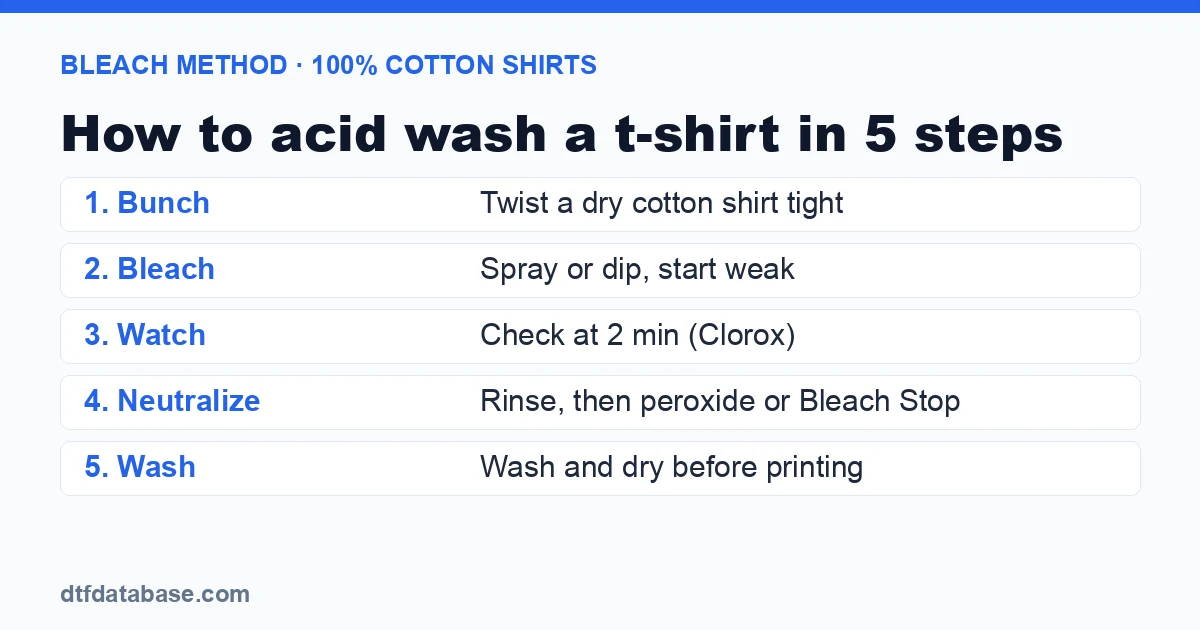
To acid wash a t-shirt, bunch a dry 100% cotton shirt into a tight mound, spray or dab it with diluted chlorine bleach, and watch until the color lightens in patches. Rinse it in cool water, neutralize the bleach, then wash and dry it. Wear gloves and eye protection, and work in a ventilated space.
The original "acid wash" was an industrial denim finish from the mid-1980s: jeans were tumbled with pumice stones soaked in chlorine bleach until patches faded almost white. At home, a spray bottle or a bleach bath on a bunched shirt gives the same mottled effect without the stones.
What you need
- A 100% cotton t-shirt in a dark or mid color. Clorox's bleach tie-dye guide says to "look for 100% cotton" and avoid polyester and spandex.
- Regular chlorine bleach
- A spray bottle, or a plastic tub for the dip method
- Rubber gloves and eye protection
- Rubber bands to hold the bunched shirt
- A neutralizer: 3% hydrogen peroxide (Clorox's method) or Dharma Trading's Bleach Stop (sodium thiosulfate)
- Cool water and a well-ventilated space, outdoors if possible
How to acid wash a t-shirt, step by step
- Spot test first. Clorox suggests dabbing a mix of 2 teaspoons bleach in 1/4 cup water on a hidden spot to see what color the dye turns.
- Bunch the shirt. Lay the dry shirt flat, twist or crumple it into a tight mound, and wrap it with rubber bands. Tighter folds give smaller, sharper patches.
- Apply the bleach. For a dip, Clorox's tie-dye method uses 1 cup of bleach in 1 gallon of cool water. For a spray, craft guides commonly use equal parts bleach and water, which is much stronger; start weaker and spray again if needed.
- Watch the color. Clorox says to check the color after about 2 minutes and to stop when you like it, or at 5 minutes in its bath. Dark fabric changes slower than light. Don't leave the bleach on for long periods: Dharma Trading warns that bleach left on for hours "may weaken the fabric."
- Rinse. Rinse the shirt in cool water until the water runs clear.
- Neutralize. Clorox's method soaks the shirt in 1 cup of 3% hydrogen peroxide per gallon of water, swirling until it stops fizzing, then rinses it several times. Dharma Trading's alternative is 1 oz of Bleach Stop per gallon of warm water, agitated for 15 minutes.
- Wash and dry. Wash the shirt on its own, then dry it.
Spray, dip and pumice methods compared
| Method | Look | Effort | Control | Risk to fabric |
|---|---|---|---|---|
| Spray bottle on a bunched shirt | Speckled, uneven patches | Low | High: spray more where you want it | Low if neutralized promptly |
| Dip of a bunched shirt in a bleach bath | Larger, connected faded areas | Low | Medium: timed by the bath | Low at Clorox's 1 cup per gallon |
| Bleach-soaked pumice stones (industrial acid wash) | Marbled, rubbed look | High; made for washing machines in factories | Low at home | Higher: abrasion plus bleach |
Which shirts work best
| Shirt | What to expect | Source |
|---|---|---|
| Black 100% cotton | Fades to rust or brown tones, not gray or white | Dharma Trading's discharge tutorial |
| Other dark 100% cotton | Usually lightens to a paler version of the same color; test first | Dharma Trading |
| Polyester or spandex blends | Avoid; Clorox recommends 100% cotton and non-chlorine bleach for spandex | Clorox |
| Wool or silk | Not recommended for bleach | Dharma Trading |
Results depend on the dye the maker used, so two black cotton shirts from different brands can fade to different colors. Run the spot test from step 1 on each new blank.
Don't want to bleach shirts yourself? Mineral-wash blanks come pre-faded. One example is the Smart Blanks MT600 mineral tee, listed by Blankstyle as 100% combed ring-spun cotton at about 6.5 oz with a mineral-dye finish. Garment-dyed blanks such as the Comfort Colors 1717 have a softer faded look without bleach; see the Comfort Colors 1717 color guide.
Safety
- Never mix bleach with other cleaners. Clorox warns that mixing bleach with ammonia or vinegar "can create toxic fumes," and the CDC warns that mixing bleach with other household cleaners can release chlorine gas. This rules out using vinegar to "neutralize" a bleach-soaked shirt.
- Ventilate. Clorox says to open windows or use fans; working outdoors is better.
- Gloves and eye protection. Clorox calls for gloves, and the CDC's cleaning guidance adds eye protection. A spray bottle can mist bleach toward your face.
- Protect your surroundings. Bleach spots clothes, carpet and countertops. Work on a covered surface or outside.
Can you print DTF transfers on an acid washed shirt?
Yes, an acid washed cotton shirt is still a cotton shirt, so a DTF transfer presses on it at normal cotton settings. DTF Database has not tested whether leftover bleach affects transfer adhesion, and we found no transfer maker that addresses it, so take these precautions:
- Neutralize and wash fully before printing (steps 6 and 7 above) so no bleach is left in the fabric.
- Dry the shirt completely, then pre-press it for a few seconds to drive out remaining moisture.
- Press at cotton settings: 300 to 325°F for 10 to 15 seconds at medium to firm pressure, from our DTF temperature and time chart, unless your transfer supplier says otherwise.
- Test one shirt and wash it before pressing a full run.
The mottled background changes how artwork reads. Bold, simple designs with a solid shape behind them hold up best; a DTF transfer prints its own white layer, so colors stay bright on the faded areas. Order custom DTF transfers from the supplier directory, or see DTF gang sheets to fit several designs on one sheet. More shirt prep tips are in our guide to pressing DTF transfers on cotton.
Common mistakes
- Leaving bleach on too long. It weakens cotton (Dharma Trading) and pushes black shirts toward rust.
- Skipping the neutralizer. Bleach keeps working after a plain rinse; neutralize, then wash.
- Using a polyester blend. The polyester fibers won't fade the same way, and Clorox recommends 100% cotton.
- Mixing chemicals. Never add vinegar, ammonia or other cleaners to a bleach bath.
- Expecting an exact match. Every bunch fades differently, so each shirt in a group set will look slightly different.
Sources
Ratios, timings, neutralizing and safety steps come from Clorox's bleach tie-dye guide and its bleach dos-and-don'ts page, Dharma Trading's Bleach Stop, bleach thickener and reverse tie-dye discharge pages, and the CDC's chlorine and cleaning safety guidance, read November 11, 2026. The history of acid wash comes from published accounts of 1980s denim finishing.
Written by Darrin DeTorres, DTF Database founder. AI helped research and draft this page; every figure was checked against the named sources before publishing.Tags
About the Author
DTF Database Founder
Darrin DeTorres has over 10 years of experience in the print industry, specializing in screen printing, sublimation, embroidery, HTV, and DTF printing. He runs Notice Me Marketing and Media, a custom apparel production company that prints thousands of shirts per month.
More from Tutorials
Explore DTF Database
Browse and compare 20+ verified DTF printer models by price, features, and specifications.
Read moreCalculate your per-print costs, profit margins, and ROI for DTF printing.
Read moreBrowse verified DTF suppliers for ink, film, powder, and equipment.
Read moreFind DTF transfer suppliers shipping to your state, with verified turnaround times.
Read moreMetro-level DTF supplier guides for Los Angeles, NYC, Dallas, Houston, and more.
Read moreStep-by-step guide to the DTF printing process with temperatures and troubleshooting.
Read more