
One Stroke Inks: Plastisol Ink Lines, Published Cure Temperatures and What Each Is For
One Stroke Inks is a Louisville, Kentucky plastisol ink maker. Its main ink lines, the cure temperatures its data sheets publish, and how it relates to DTF.
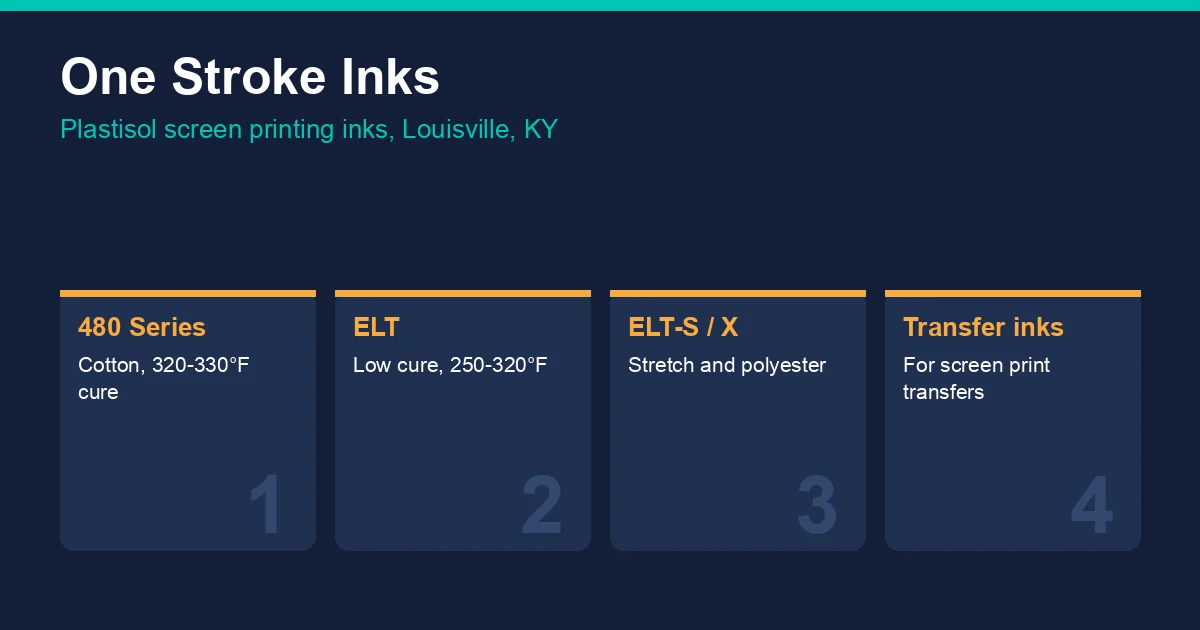
One Stroke ink lines
| Line | What One Stroke describes it for |
|---|---|
| 480 Series | General-purpose plastisol for cotton; prints well wet-on-wet, with a soft hand on light and medium garments |
| ELT | "Extreme low temperature" cure, to reduce dye migration, shrinking, scorching and fabric colour change |
| ELT-S | Low cure with stretch, for spandex and performance apparel |
| ELT-X | Low cure with added opacity and bleed resistance, for polyester |
| Hybrid | Coverage with a softer hand on cotton and poly-cotton |
| Watercolor | Plastisol with a soft, water-based feel that does not dry in the screen |
| Special effects | Puff, metallic, glow and glitter |
| Transfer inks | Including 380S, ELT Zip, Soft Peel and Poly Trans 25, for printing screen print transfers |
One Stroke also lists a PVC-free line alongside its plastisol ranges.
Published cure temperatures
One Stroke's technical data sheets give these cure ranges:
| Ink | Cure temperature | Notes from the data sheet |
|---|---|---|
| ELT Series | 250°F to 320°F | Metallic and glitter versions cure at a minimum of 270°F; a glossy finish means the dryer is too hot; listed for cotton, blends, polyester, stretch, nylon and more |
| 480 Series | 320°F to 330°F | Listed for 100% cotton and blends; a wet-on-wet additive is recommended for best wet-on-wet results |
One Stroke notes that its data sheet figures are lab conditions and recommends a test print and wash test before production.
Why low-cure plastisol matters for polyester
Polyester is dyed with disperse dyes that can migrate into a print when heated, staining white or light ink. Curing at a lower temperature reduces that risk, which is why low-cure lines such as ELT exist. DTF faces the same problem on polyester; the dye migration guide covers it, and the DTF temperature and time chart lists lower press settings for performance fabric.
One Stroke inks and DTF
One Stroke inks are for screen printing, not DTF printers, which use water-based pigment inks. Its transfer inks are used to make plastisol screen print transfers, which are applied with a heat press like a DTF transfer. The heat press silk screen look guide and the screen print transfers vs DTF comparison compare the two, and the screen printing at home guide covers getting started with plastisol.
Frequently asked questions
What is One Stroke ink?
A line of screen printing inks, mostly plastisol, made by One Stroke Inks in Louisville, Kentucky.
What temperature does One Stroke ELT cure at?
One Stroke's data sheet gives 250°F to 320°F for the ELT Series, with metallic and glitter versions needing at least 270°F.
What temperature does One Stroke 480 cure at?
320°F to 330°F, according to its data sheet.
Can you use One Stroke ink in a DTF printer?
No. One Stroke makes plastisol screen printing inks. DTF printers use water-based pigment inks made for the printer.
About the Author
DTF Database Founder
Darrin DeTorres has over 10 years of experience in the print industry, specializing in screen printing, sublimation, embroidery, HTV, and DTF printing. He runs Notice Me Marketing and Media, a custom apparel production company that prints thousands of shirts per month.
More from Equipment Reviews
Explore DTF Database
Browse and compare 20+ verified DTF printer models by price, features, and specifications.
Read moreCalculate your per-print costs, profit margins, and ROI for DTF printing.
Read moreBrowse verified DTF suppliers for ink, film, powder, and equipment.
Read moreFind DTF transfer suppliers shipping to your state, with verified turnaround times.
Read moreMetro-level DTF supplier guides for Los Angeles, NYC, Dallas, Houston, and more.
Read moreStep-by-step guide to the DTF printing process with temperatures and troubleshooting.
Read more