Printing Press Machine: Types, Uses & DTF Alternatives
What a printing press machine is, the main types (offset, flexo, gravure, screen, digital), how presses work and when a DTF printer is the better choice.
What is a printing press machine?
A printing press machine applies ink to a surface in a repeatable way. The image is first made into a carrier: a metal plate for offset printing, a flexible relief plate for flexo, an engraved cylinder for gravure or a mesh screen for screen printing. The press inks the carrier and transfers the image to the material over and over. Because making the carrier takes time and money, presses pay off when you print the same design many times.
What are the types of printing press machines?
| Type | How it prints | Typical use | Best run length |
|---|---|---|---|
| Offset | Ink moves from a plate to a rubber blanket, then to paper | Books, brochures, magazines | Thousands and up |
| Flexographic | Raised rubber or polymer plates carry the ink | Packaging, labels, bags | Long runs |
| Gravure | Image is engraved into a cylinder | Magazines, wrapping, packaging | Very long runs |
| Screen | Ink is pushed through a mesh stencil | T-shirts, posters, signs | Dozens to thousands |
| Digital | Image goes straight to the substrate with no plate | Short runs, variable data, DTF | One to a few hundred |
For apparel, screen printing is the traditional press method. Each color needs its own screen, so a four-color design needs four screens and setup time. The DTF vs screen printing comparison shows where each method wins.
How does a printing press work?
- Prepare the artwork. The design is separated into colors or sent to a RIP.
- Make the carrier. The shop creates plates, cylinders or screens for each color.
- Mount and ink. The carrier is fitted to the press and loaded with ink.
- Align and print. The press transfers the image to the material, one color at a time on a multi-color job.
- Dry or cure. The ink is dried with air, heat or UV light.
A digital press skips steps 2 and 3, which is why short runs cost far less on one.
What is a digital press?
A digital press prints straight from a file onto the substrate with no plates or screens. Inkjet and toner machines are the two common kinds. A DTF printer is a digital printer: it prints color and white ink onto PET film, the film is coated with adhesive powder and cured, and a heat press then bonds the design to the garment. See what DTF printing at home involves for the equipment and upkeep.
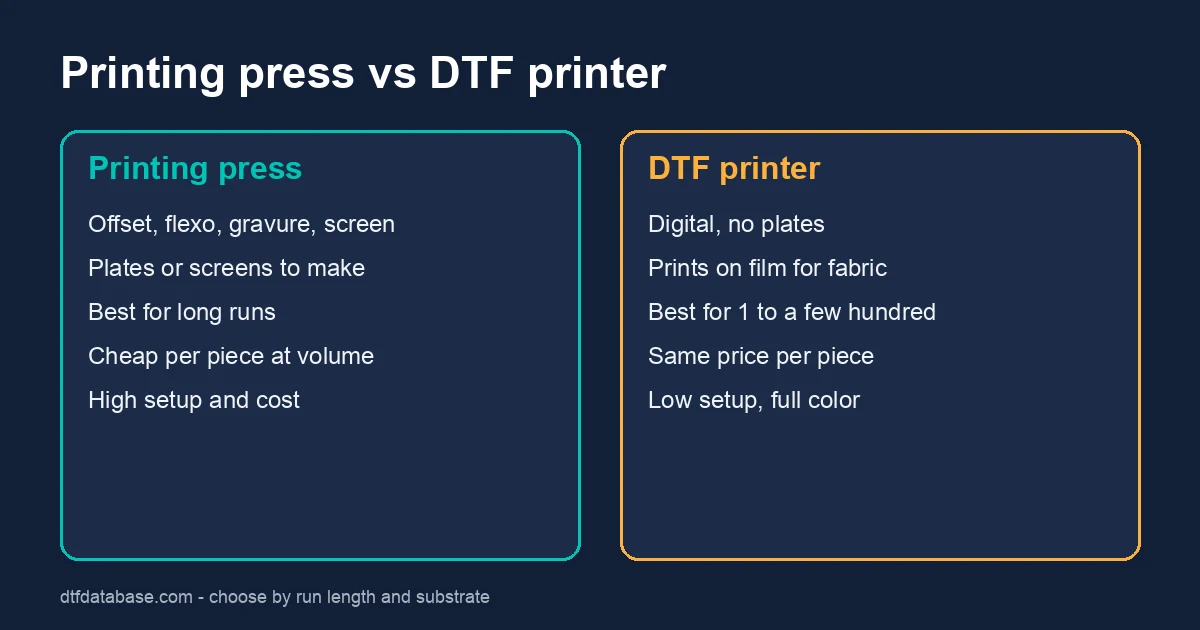
Printing press vs DTF printer: which should you choose?
| Question | Printing press (screen or offset) | DTF printer |
|---|---|---|
| Best run length | Hundreds to thousands | One to a few hundred |
| Setup per design | Plates or screens for each color | None |
| Colors | Cost rises with each color | Full color at one price |
| Fabrics | Screen printing handles many | Cotton, polyester, blends and more |
| Turnaround on a new design | Days, with setup | Same day |
| Upfront cost | High for industrial presses | Lower, plus a heat press |
If you sell custom shirts in small batches, a DTF printer or ordered DTF transfers give you full-color prints with no minimums. If you print one design on thousands of shirts, a screen press still lowers the cost per shirt. For a view across all methods, read the heat transfer printing methods guide.
How much does a printing press machine cost?
Prices vary widely with size and type. Industrial offset, flexo and gravure presses are large capital purchases, while a manual screen printing press for apparel and a desktop DTF printer are far more affordable starting points. Get written quotes from sellers and include consumables, installation and maintenance in your comparison. If you are weighing DTF, the cost calculator shows the per-shirt cost of ordering transfers instead of buying equipment.
Do you mean a heat press?
Many people searching for a "printing press machine" for shirts actually need a heat press, which bonds a transfer to fabric with heat and pressure. It is a separate machine from a printing press and is the one piece of equipment every DTF workflow needs. Our DTF transfer temperature guide covers the settings to use on it.
Frequently asked questions
What is a printing press machine?
A printing press machine is a mechanical device that transfers ink onto paper, fabric or other materials using a prepared image carrier, such as a plate or screen. Common types are offset, flexographic, gravure and screen presses.
What are the main types of printing presses?
The main types are offset, flexographic, gravure, screen and digital. Offset suits books and brochures, flexo suits packaging, gravure suits very long runs and screen suits apparel and posters. Digital presses print without plates.
Is a DTF printer a printing press?
No. A DTF printer is a digital inkjet printer that prints on film. The design is then bonded to fabric with a heat press. It needs no plates or screens, which makes it suit short runs.
Which is cheaper for t-shirts, screen printing or DTF?
DTF is usually cheaper for small orders because it has no setup per color. Screen printing becomes cheaper per shirt on large runs of one design with few colors.
Can a printing press print on fabric?
Yes. Screen printing presses are the traditional way to print on fabric, and some flexographic and digital presses also print on textiles. Offset presses are mainly for paper.
Tags
About the Author
DTF Database Founder
Darrin DeTorres has over 10 years of experience in the print industry, specializing in screen printing, sublimation, embroidery, HTV, and DTF printing. He runs Notice Me Marketing and Media, a custom apparel production company that prints thousands of shirts per month.
More from DTF Basics
Explore DTF Database
Browse and compare 20+ verified DTF printer models by price, features, and specifications.
Read moreCalculate your per-print costs, profit margins, and ROI for DTF printing.
Read moreBrowse verified DTF suppliers for ink, film, powder, and equipment.
Read moreFind DTF transfer suppliers shipping to your state, with verified turnaround times.
Read moreMetro-level DTF supplier guides for Los Angeles, NYC, Dallas, Houston, and more.
Read moreStep-by-step guide to the DTF printing process with temperatures and troubleshooting.
Read more