
Should You Use Fabric Softener? Effect on DTF Prints
Should you use fabric softener? It softens fabric but can leave residue that weakens DTF prints. See when to skip it and what to use instead.
Should you use fabric softener?
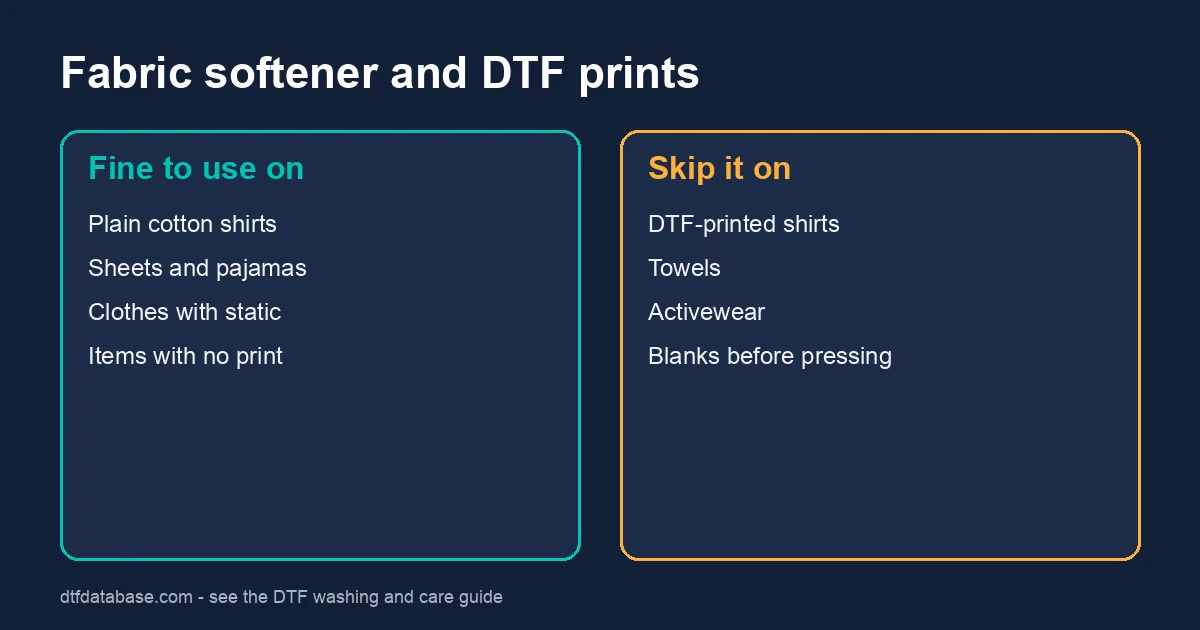
You do not need fabric softener, and for DTF-printed clothing it is safer to skip it. Softener coats fibers with a thin layer of lubricant. That feels soft, reduces static and helps clothes tumble freely, but the coating builds up. On a print it can weaken the bond between the adhesive and the fabric over many washes, and on towels and sports clothing it reduces absorbency and moisture-wicking. If your shirt has a heat transfer, leave it out.
Fabric softener and DTF prints
DTF prints are bonded with a hot-melt adhesive. Softener residue does not dissolve that adhesive immediately, but over repeated washes the coating can make edges lift, and strong chemicals do the same. Our DTF washing and care guide lists the safe routine: wash inside out in cool water on a gentle cycle, use mild liquid detergent and skip bleach and softener. If a print is already cracking or peeling, read how to fix peeling DTF prints.
Fabric softener before you press
Do not soften a blank shirt before you print it either. Softener residue on the fabric can keep the adhesive from bonding, which causes peeling later. Press blanks straight from the package, or wash them without softener and dry fully. Pre-press for 3 to 5 seconds to drive off moisture. For more press tips, see our heat press tips.
When fabric softener is fine
- Plain cotton shirts, sheets and pajamas with no print or transfer
- Clothes where static is a problem, such as polyester blends
- Items that do not need to absorb water
Avoid it on towels, microfiber, activewear, flame-resistant clothing and anything printed.
Alternatives to fabric softener
- White vinegar. A quarter cup in the rinse cycle softens fabric without a coating, but test on a hidden spot first and use less on prints.
- Wool dryer balls. Reduce static and drying time without chemicals.
- A cool wash and low-heat dry. Hot water and high heat make fabric stiff. Hang dry when you can.
Frequently asked questions
Should you use fabric softener on DTF prints?
No. Residue can weaken the adhesive over repeated washes. Wash printed shirts inside out in cool water with mild detergent and no softener.
Does fabric softener ruin clothes?
It does not ruin most clothes, but it can reduce the absorbency of towels and the wicking of activewear, and it can build up on fabric over time.
Can I use dryer sheets on printed shirts?
It is best not to. Dryer sheets leave a similar coating. Tumble dry on low or hang dry instead.
Can you use fabric softener before pressing a heat transfer?
No. Residue on the garment can stop the adhesive from bonding. Press a clean, dry blank that has not been treated with softener.
What is a good substitute for fabric softener?
Wool dryer balls or a splash of white vinegar in the rinse soften clothes without a coating. Test vinegar on a hidden area first.
Tags
About the Author
DTF Database Founder
Darrin DeTorres has over 10 years of experience in the print industry, specializing in screen printing, sublimation, embroidery, HTV, and DTF printing. He runs Notice Me Marketing and Media, a custom apparel production company that prints thousands of shirts per month.
More from DTF Basics
Comfort Colors 1566 sweatshirt size chart in inches and cm, with fit notes, how to measure and whether to size up. Includes print size and press tips.
Ready to press DTF transfers are pre-printed, powdered films you heat press at home. Learn how they work, how to press them and what to check before you buy.
A youth 10/12 is a Youth Medium: it fits a 28 to 30 inch chest and 54 to 58 inches in height. See shirt measurements and how it compares to youth S and L.
Explore DTF Database
Browse and compare 20+ verified DTF printer models by price, features, and specifications.
Read moreCalculate your per-print costs, profit margins, and ROI for DTF printing.
Read moreBrowse verified DTF suppliers for ink, film, powder, and equipment.
Read moreFind DTF transfer suppliers shipping to your state, with verified turnaround times.
Read moreMetro-level DTF supplier guides for Los Angeles, NYC, Dallas, Houston, and more.
Read moreStep-by-step guide to the DTF printing process with temperatures and troubleshooting.
Read more