
Brother GTX300 Hybrid DTG/DTF Printer: Specs and Price
Brother launched the GTX300 hybrid DTG and DTF printer in July 2026. Confirmed specs, $16,995 dealer pricing, warranty, and how it compares to the GTXpro.
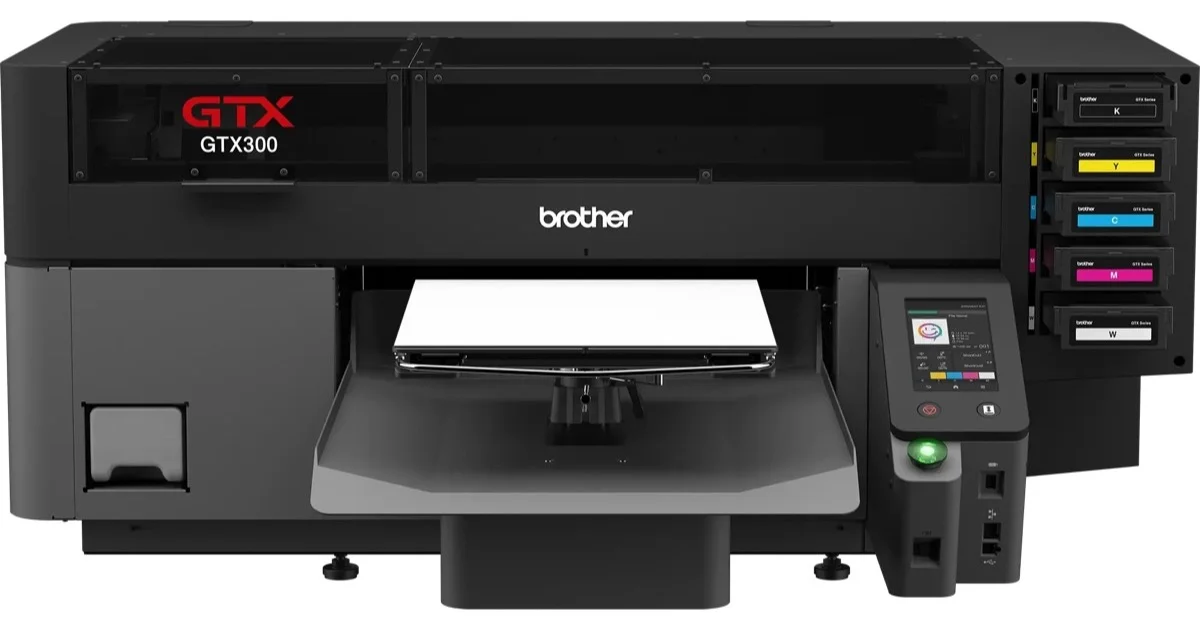
This article covers the confirmed specifications, what the hybrid workflow actually involves, and who the GTX300 makes sense for.
Brother GTX300 Specifications
| Specification | Brother GTX300 |
|---|---|
| Print modes | DTG and DTF |
| Maximum print area | 16 x 21 in (40.6 x 53.3 cm) |
| Resolution | 1,200 x 1,200 dpi |
| Print heads | 2 heads, 8 ink channels |
| Inks | Brother Innobella 5-color water-based pigment (CMYK + white) |
| Ink certifications | OEKO-TEX ECO PASSPORT, GOTS 7.0, CPSIA |
| White ink handling | Continuous circulation through sub tanks, ink lines, and print head |
| Speed (Brother promo figures) | Up to 42 dark or 57 light garments per hour |
| Control panel | 7-inch touchscreen |
| Software | GTX Graphics Lab (DTG and DTF workflows) |
| Platens | 14 x 16 in adult (included); 10 x 12 in youth and 7 x 8 in baby available |
| Weight | Approx. 276 lb (125 kg) |
| Width | Approx. 51 in |
| Power | 100 to 240 V, under 180 W while printing |
| Connectivity | Gigabit LAN, USB 3.0 |
| Computer requirements | macOS Sonoma/Sequoia or Windows 11 (64-bit) |
| Warranty | One-year limited, print heads included |
| Price | $16,995 (dealer listing, September 2026) |
Brother also advertises financing at about $384 per month on the base unit at a 3.9 percent promotional rate. Confirm current pricing and terms with a dealer, since promotions change.
What "Hybrid" Means in Practice
A hybrid DTG/DTF printer uses the same heads and inks for both jobs. The difference is what goes on the platen:
- DTG mode. A pretreated cotton or natural-fiber garment goes on the platen. The printer lays white underbase and color directly into the fabric. The shirt is then cured with a heat press or conveyor dryer. The result has the softest hand of any decoration method.
- DTF mode. A sheet of PET transfer film goes on the platen instead. The printer lays color first and white on top (the mirror of DTG). The wet print is powdered with hot-melt adhesive, cured, and stored until it is heat-pressed onto the final garment.
The second workflow is where new hybrid owners get surprised. The GTX300 prints the film. It does not powder or cure it. Like every DTF printer, it needs a powder application and curing step afterward, either by hand with a tray and a hovering heat press or with a separate shaker and dryer. Ask your dealer what DTF accessories are included in a quote. Our DTF powder guide explains that step in detail.
Brother positions the split this way: DTG for cotton and natural garments where soft hand matters, DTF for polyester, blends, performance fabrics, oversized graphics, and awkward print locations such as sleeves, hats, and bags. That matches how most decorators already think about the two methods. See our direct-to-garment vs DTF comparison for the full breakdown.
GTX300 vs GTXpro vs GTXpro Bulk
Brother's DTG lineup now has three tiers, all sharing the GTX Graphics Lab software and Innobella inks:
| Model | Print area | Positioning |
|---|---|---|
| GTX300 | 16 x 21 in | Compact hybrid for shops, classrooms, small production spaces |
| GTXpro | 16 x 21 in | Higher-volume hybrid; Brother quotes up to 40 dark or 55 light garments per hour |
| GTXpro Bulk | 16 x 21 in | GTXpro with bulk ink supply for continuous production |
| GTX600 | Larger format | Six-color DTG (adds orange and green), production platform |
The GTX300's advertised throughput of up to 42 dark or 57 light garments per hour is slightly above the GTXpro's published numbers, which suggests Brother is positioning it as the new entry to the professional range rather than a stripped-down model. Print area is identical. The practical differences are footprint, bulk ink options, and price, so compare quotes on the whole package rather than the base unit.
Where It Sits Against Epson's Hybrids
The obvious comparison is Epson's SureColor F1070 and F2270, both hybrid DTG/DTF printers Epson will show at PRINTING United Expo 2026 in Las Vegas. Epson's hybrids and the GTX300 target the same buyer. Points to weigh:
- Print heads and warranty. Brother's one-year warranty includes the print heads. Head replacement is the largest surprise cost on any garment printer, so check what each brand covers.
- Ink certification. The GTX300's inks carry OEKO-TEX ECO PASSPORT, GOTS 7.0, and CPSIA certifications, which matter for children's apparel and for brands that require certified inputs.
- Software. Brother's GTX Graphics Lab handles both DTG and DTF; Epson uses Garment Creator 2. Both are free with the printer.
- Dealer network. Both brands sell through authorized dealers with installation and training. Brother frames its support as the "At Your Side" program with guided onboarding.
For Epson's current DTF and hybrid lineup, see the Epson DTF printers page.
Who Should Consider the GTX300
At $16,995 the GTX300 is a professional purchase, not a starter machine. It fits three kinds of buyers:
- Shops adding DTG to an existing DTF business. If you already buy or print transfers and get regular requests for soft-hand cotton prints, one hybrid machine covers both without a second footprint.
- Schools and training programs. Brother explicitly lists classrooms as a target, and the sub-180 W power draw and 51-inch width fit a standard room.
- Decorators replacing an aging DTG printer. Gaining a DTF mode in the same purchase avoids a second machine for polyester and performance orders.
Buyers doing mostly DTF transfer volume are better served by a dedicated roll-fed DTF printer, which prints continuous film rather than sheets. The DTF printer database lists those options, and the best DTF printer for beginners guide covers lower-cost entry points.
Frequently Asked Questions
What is the Brother GTX300?
The Brother GTX300 is a hybrid garment printer announced on July 17, 2026 that can print direct-to-garment (DTG) onto cotton and natural fabrics and direct-to-film (DTF) onto transfer film from the same machine. It prints up to 16 by 21 inches at 1,200 by 1,200 dpi with two print heads and Brother's Innobella water-based pigment inks.
How much does the Brother GTX300 cost?
Authorized dealers were listing the GTX300 at $16,995 in September 2026, and Brother advertised financing at about $384 per month at a 3.9 percent promotional rate. Pricing and promotions vary by dealer.
Does the Brother GTX300 need a powder shaker for DTF?
Yes, in the sense that every DTF transfer needs adhesive powder applied and cured after printing. The GTX300 prints the film; powdering and curing are separate steps done by hand or with a shaker and dryer. Ask your dealer which DTF accessories are included.
What is the difference between the GTX300 and the GTXpro?
Both print a 16 by 21 inch area with DTG and DTF capability using GTX Graphics Lab software. The GTX300 is positioned as a compact entry to Brother's professional range, while the GTXpro and GTXpro Bulk add bulk ink supply options for higher-volume continuous production.
What inks does the GTX300 use?
The GTX300 uses Brother Innobella five-color water-based pigment inks (cyan, magenta, yellow, black, and white). The inks are certified under OEKO-TEX ECO PASSPORT and GOTS 7.0 and are CPSIA compliant.
What warranty comes with the GTX300?
Brother includes a one-year limited warranty that covers the print heads, along with guided installation, onboarding tools, and training resources under its At Your Side support program.
Related Resources
Compare the GTX300 with production DTF printers in the printer comparison tool, and read about the other new machine in this category, the Anker eufyMake fabric printer, which targets the consumer end of the hybrid market. For ink differences between the two methods, see DTG ink vs DTF ink.
Tags
About the Author
DTF Database Founder
Darrin DeTorres has over 10 years of experience in the print industry, specializing in screen printing, sublimation, embroidery, HTV, and DTF printing. He runs Notice Me Marketing and Media, a custom apparel production company that prints thousands of shirts per month.
More from Industry News
Anker eufyMake previewed a desktop DTG and DTF printer with foil finishes at IFA 2026 for a Q1 2027 launch. What is confirmed, what is not, why it matters.
Mimaki announced the TxF330-800 DTF printer in September 2026 with 16 ink cartridges, up to 4 L of white ink, new Sky Blue and Pale Pink inks, and 1.5x speed.
PRINTING United Expo runs September 23 to 25, 2026 in Las Vegas. The DTF walk plan: Epson G-series, DuPont automated lines, Mimaki TxF330-800, and more.
Explore DTF Database
Browse and compare 20+ verified DTF printer models by price, features, and specifications.
Read moreCalculate your per-print costs, profit margins, and ROI for DTF printing.
Read moreBrowse verified DTF suppliers for ink, film, powder, and equipment.
Read moreFind DTF transfer suppliers shipping to your state, with verified turnaround times.
Read moreMetro-level DTF supplier guides for Los Angeles, NYC, Dallas, Houston, and more.
Read moreStep-by-step guide to the DTF printing process with temperatures and troubleshooting.
Read more