
Can You Sublimate on Cotton? 5 Methods Compared (2026)
Standard sublimation washes out of cotton. Here is what works instead in 2026: cotton primers, sublimation HTV, Sawgrass VersiFlex, blends, and DTF.
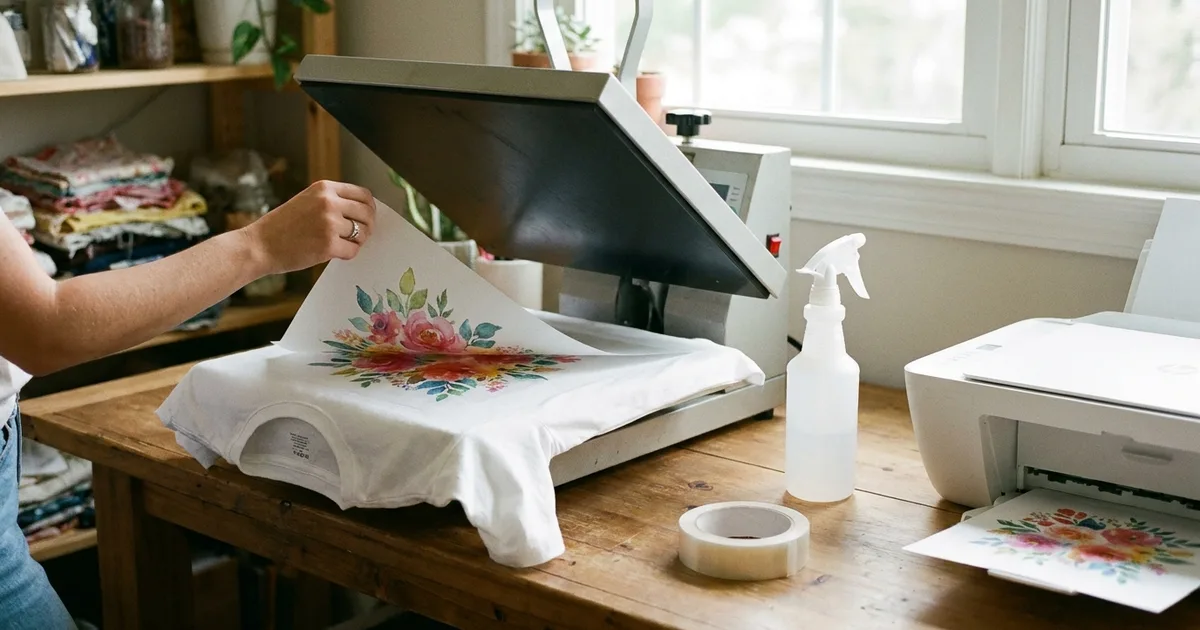
The question got more attention this week. On September 23, 2026, Epson announced a Sublimation Primer for Cotton alongside its new SureColor F370 printer. This guide compares every practical route in 2026, using each manufacturer's published settings, so you can pick the one that fits your shirts and your budget.
Why Plain Sublimation Fails on Cotton
Sublimation ink is printed onto coated paper, then heat turns the dye into a gas that enters polyester fibers or a polyester-based coating and locks in as it cools. Cotton is a plant fiber with no polymer to accept the dye. Some color transfers to the surface, but it is not bonded, so it fades and rinses out. Our sublimation settings and paper guide covers the standard process on polyester and coated blanks.
That is why every method below either adds a receptive layer to the cotton, changes the ink chemistry, or uses a blank that already contains polyester.
The Five Routes at a Glance
| Method | Garment colors | What it adds to the shirt | Published settings | Entry cost |
|---|---|---|---|---|
| Cotton sublimation primer (Epson) | White and light | A liquid primer applied before pressing | Not published yet | $149.95 primer (Nov. 2026) plus a sublimation printer |
| Sublimation HTV (Siser EasySubli) | Any, including dark | A thin vinyl layer under the image | 311°F, 15 seconds, medium pressure, peel cool | EasySubli vinyl plus a cutter and a Sawgrass printer with EasySubli ink |
| Sawgrass VersiFlex | White and light | Nothing; different ink and paper | 375°F, 30 seconds, very high pressure | From $699.95 (SG500 bundle) |
| High-polyester blends | White and light | Nothing; relies on the poly content | Standard sublimation settings | Blank cost only |
| DTF transfers | Any, including black | An ink and adhesive film on the surface | Per the transfer maker, typically 300 to 325°F on cotton | Order transfers, or a DTF printer |
1. Cotton Sublimation Primer
A primer or coating gives the cotton a surface that accepts sublimation dye. Epson's version is the most notable launch of 2026. According to Epson's September 23 announcement, the Sublimation Primer for Cotton is a liquid solution that enables sublimation on white and light-colored cotton garments and other natural fabrics. It is scheduled for November 2026 at $149.95 MSRP through authorized Epson partners and the Epson eStore.
What Epson has not published yet: how the primer is applied (spray, roller, or press-on), the heat press temperature and time, how many shirts one bottle covers, the wash durability, and whether it is supported with printers other than the F370. Until those numbers are out, a shop cannot calculate cost per shirt.
Other aftermarket sublimation sprays and coatings for cotton are sold online. Results vary by product, and we have not seen independent wash testing that makes one a safe production recommendation. Test any coating on your own blanks through several wash cycles before you sell with it.
2. Sublimation HTV: Siser EasySubli
EasySubli is a heat transfer vinyl built to accept sublimation ink. The printed design sits in the vinyl layer, and the vinyl adheres to the shirt, so it works on cotton, blends, and dark garments. Siser's instructions, as published by its distributors, describe two workflows:
- EasySubli ink: print directly onto EasySubli vinyl from a Sawgrass SG500 or SG1000 loaded with EasySubli ink (not mirrored), let it dry, cut and weed, apply the EasySubli Mask, then press at 311°F for 15 seconds at medium pressure and peel when cool.
- Standard SubliJet UHD ink: cut and press blank EasySubli vinyl first (365°F, 5 seconds, peel hot), then press a mirrored sublimation print on top (365°F, 60 seconds, peel hot).
The trade-off is hand feel and design shape. You are pressing a cut vinyl shape, so the design has an edge you can feel and see, and every design needs weeding. It suits names, numbers, and bold logos better than soft full-bleed art. Siser North America is now part of STAHLS'; see our coverage of the STAHLS' and Siser deal.
3. Sawgrass VersiFlex
VersiFlex is Sawgrass's ink and paper system for natural fibers. It needs no primer and no vinyl. It runs on a dedicated SG500 or SG1000 and prints to VersiFlex Light paper. Sawgrass's cotton guide calls for 375°F for 30 seconds at very high pressure. Sawgrass guarantees image quality up to 30 washes. There is no white ink, so it is limited to white and light garments, and VersiFlex inks cannot share a printer that has run standard sublimation ink.
We compared it to DTF in detail in Sawgrass VersiFlex vs DTF.
4. High-Polyester Blends
Many "cotton" requests can be met with a blend. Sublimation bonds only to the polyester share of the fabric, so a 50/50 shirt gives a softer, vintage-looking print and a 65% or higher polyester tri-blend or poly-rich blend looks closer to full color. It is the cheapest route because nothing is added, but the look is lighter than on 100% polyester and customers who asked for cotton may not accept a blend. Our best blanks for sublimation guide covers which blanks hold color best.
5. DTF Transfers
DTF prints the design on film with a white underbase, adds a hot-melt adhesive, and presses it onto the garment. It is not sublimation, but it answers the underlying need: full-color, photographic prints on 100% cotton in any shirt color, including black. The print sits on top of the fabric, so it has more hand feel than sublimation on polyester. Start with the DTF temperature and time chart for settings, and our HTV vs sublimation vs DTF comparison for a broader side-by-side.
You do not need a printer to use DTF. Most shops starting out order gang sheets from a DTF transfer supplier and press them in-house.
Which Route Should You Pick?
- Dark cotton shirts: DTF, or EasySubli if the design is a simple cut shape.
- White cotton, full-color art, low volume, already own a sublimation setup: wait for Epson's primer settings and wash data, or test VersiFlex on a dedicated printer.
- Customer only cares about the soft, vintage look: a 50/50 or poly-rich blend with standard sublimation.
- Mixed orders across fabrics and colors: DTF is the one process that covers all of them without changing blanks.
Frequently Asked Questions
Can you sublimate on 100% cotton?
Not with standard sublimation ink and paper alone. The dye needs polyester or a polymer coating to bond to, so on untreated cotton it fades quickly and washes out. You need a cotton primer, a sublimation-ready vinyl like Siser EasySubli, a different ink system like Sawgrass VersiFlex, or a switch to DTF.
Does Epson's Sublimation Primer for Cotton work on dark shirts?
Epson says the primer enables sublimation on white and light-colored cotton garments. Sublimation ink is transparent and there is no white ink in the process, so dark and black cotton shirts are not a fit. For dark cotton, DTF or a sublimation HTV is the practical choice.
When can you buy the Epson cotton primer and how much is it?
Epson lists the Sublimation Primer for Cotton at $149.95 MSRP, available in November 2026 through authorized Epson partners and the Epson eStore. Application steps, press settings, coverage per bottle, and wash durability had not been published as of September 26, 2026.
What temperature do you press EasySubli on cotton?
Siser's instructions for EasySubli printed with EasySubli ink call for 311°F for 15 seconds at medium pressure, peeled when cool, after cutting, weeding, and applying EasySubli Mask. The workflow using standard sublimation ink uses 365°F and two presses.
Is DTF better than sublimation for cotton shirts?
For cotton, yes in most cases. DTF bonds to cotton in any garment color and prints white, while sublimation on cotton needs an added primer, vinyl, or special ink and is limited to light colors for most methods. Sublimation stays the better choice for white polyester, where the print has no hand feel at all.
Where This Fits in the DTF Database
If you are pricing equipment, the DTF printer database compares machines by width, speed, and price, and our guide to buying a DTF printer versus ordering transfers walks through when owning equipment makes sense. For the new Epson hardware itself, see our SureColor F370 specs and price breakdown.
Tags
About the Author
DTF Database Founder
Darrin DeTorres has over 10 years of experience in the print industry, specializing in screen printing, sublimation, embroidery, HTV, and DTF printing. He runs Notice Me Marketing and Media, a custom apparel production company that prints thousands of shirts per month.
More from DTF Basics
No. Cotton absorbs sweat into the fiber and dries slowly. How wicking works, which cotton blends wick, and what it means for DTF-printed shirts.
Explore DTF Database
Browse and compare 20+ verified DTF printer models by price, features, and specifications.
Read moreCalculate your per-print costs, profit margins, and ROI for DTF printing.
Read moreBrowse verified DTF suppliers for ink, film, powder, and equipment.
Read moreFind DTF transfer suppliers shipping to your state, with verified turnaround times.
Read moreMetro-level DTF supplier guides for Los Angeles, NYC, Dallas, Houston, and more.
Read moreStep-by-step guide to the DTF printing process with temperatures and troubleshooting.
Read more