DTF vs Embroidery: Cost, Durability, and When to Use Each
DTF wins full-color and large prints; embroidery wins caps, small logos, and a premium feel. How they compare on cost, setup, fabrics, and durability.
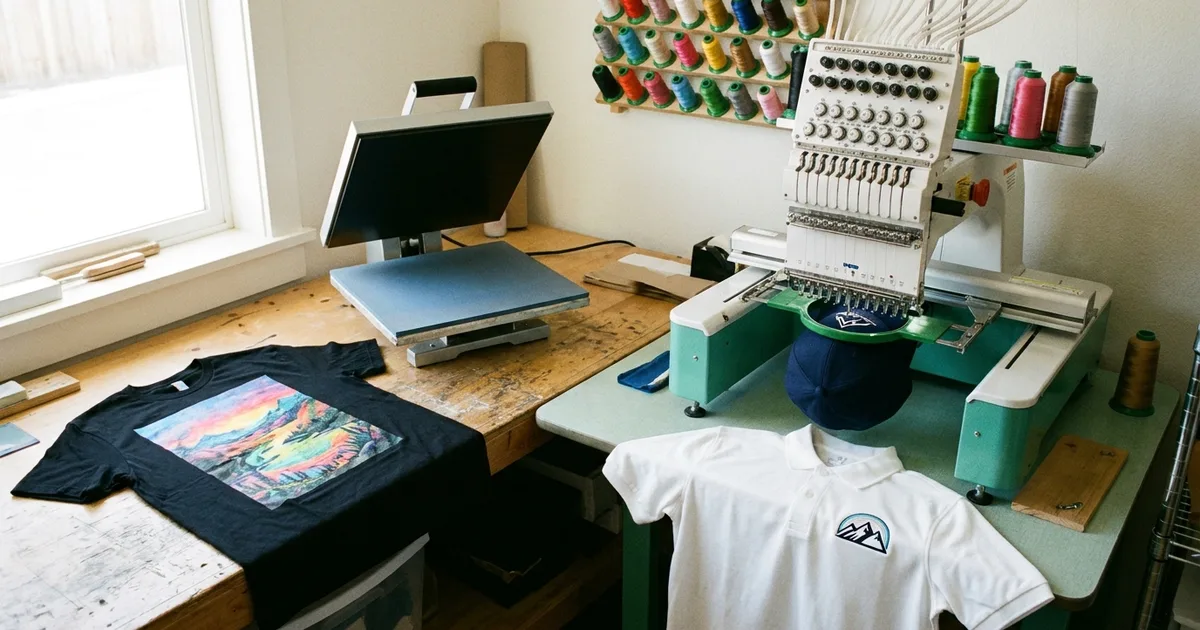
This guide compares the two on setup, cost structure, design limits, fabrics, durability, and equipment, so you can quote the right method or decide which one to add.
How Each Method Works
DTF (direct-to-film): artwork is printed in CMYK plus a white layer onto PET film, coated with adhesive powder, cured, and then pressed onto the garment with a heat press. You can print it yourself or order ready-to-press transfers. Our what is a DTF transfer guide covers the basics. Embroidery: the design is first converted ("digitized") into a stitch file, commonly in DST format, that tells the machine where each stitch goes and in what order. The garment or cap is hooped, and a multi-needle machine stitches it, switching between thread colors loaded on each needle.Side-by-Side Comparison
| Factor | DTF | Embroidery |
|---|---|---|
| Artwork prep | Print-ready image file | Design must be digitized into a stitch file |
| Colors | Full color, gradients, photos | Limited to the thread colors loaded (for example, 15 on a 15-needle machine) |
| Fine detail | Small text and thin lines print cleanly | Very small text and thin lines are hard to stitch legibly |
| Large designs | Easy, cost scales with film area | Slow and heavy, cost scales with stitch count |
| Hand feel | Thin printed layer on top of fabric | Raised, textured thread |
| Caps | Possible with a cap press, but curved structured fronts are tricky | The traditional method for structured caps |
| Stretchy performance fabric | Works at lower temperatures | Can pucker on thin, stretchy knits without the right stabilizer |
| Perceived value | Casual retail and event shirts | Corporate, uniform, and premium merchandise |
Cost Structure
The biggest practical difference is what drives the price.
DTF cost scales with size. A gang sheet is priced by length or area, so a 12-inch front design costs more than a 3-inch logo, but a 30-color photo costs the same as a one-color shape of the same size. There is no per-design setup fee when you print your own, and most transfer suppliers charge none either. Our DTF pricing strategy guide breaks down how shops price by size and quantity. Embroidery cost scales with stitches. Every design needs digitizing before the first garment, either in-house with software or through a digitizing service. After that, run time depends on stitch count. A small left-chest logo stitches quickly; a full back design can take much longer on a single-head machine. That is why embroidery shops usually price by stitch count and why large embroidered designs are expensive.The result: for a one-off full-color shirt, DTF is almost always cheaper. For 50 caps with the same small logo, embroidery's one-time digitizing cost is spread thin and the finished product commands a higher price.
Durability
Both methods last when done correctly, but they fail differently.
- DTF fails when it is under-pressed or pressed on the wrong fabric settings: edges lift or the print cracks after washing. Correct time, temperature, and pressure prevent most of it. See the DTF temperature and time chart and our fix guide for DTF cracking and peeling after washing.
- Embroidery does not crack or fade like a print, but thread can snag, and poorly stabilized designs can pucker or distort the fabric around them over repeated washing.
For garments that get heavy use, such as workwear and uniforms, embroidery's durability is a large part of why customers ask for it.
Fabrics and Garments
- Cotton and cotton blends: both work well. See the best blanks for DTF transfers.
- Polyester performance shirts: DTF works at lower temperatures, but watch for dye migration on dyed polyester; our dye migration guide explains the fix. Embroidery on thin, stretchy performance knits needs the right stabilizer to avoid puckering.
- Structured caps: embroidery is the standard. DTF on caps is possible with the right press and placement; see DTF on hats, shoes, and bags.
- Fleece and heavy hoodies: both work. Embroidery adds weight and stiffness to large areas, so large hoodie backs are usually printed.
- Polos and jackets: embroidered left-chest logos are the corporate norm.
Equipment Cost to Bring It In-House
You do not need equipment to sell either one. Many shops order DTF transfers from suppliers in our supplier directory and press them on a heat press, and embroidery can be subcontracted to a local shop.
To bring it in-house:
- DTF: a heat press is the only required purchase if you order transfers. Printing your own adds a DTF printer plus a powder and curing setup. Entry-level options are in our DTF printers under $1,000 list, and the buy a printer or order transfers guide shows where the break-even sits.
- Embroidery: a multi-needle machine, digitizing software or a digitizing service, stabilizer, bobbins, and thread. As one current example, HTVRONT's new 15-needle E15 embroidery machine listed at $5,399.99 for its Standard Kit in September 2026, with a cap drive included.
When to Use Each
Choose DTF when:- The design is full color, photographic, or has gradients.
- The design is large (full front or full back).
- The order is small or every piece is different, such as names and numbers.
- Turnaround is tight and there is no time to digitize.
- The product is a structured cap.
- The design is a small logo on a polo, jacket, or workwear.
- The customer wants a premium or corporate look.
- The same design repeats across many pieces.
Frequently Asked Questions
Is DTF cheaper than embroidery?
Usually, for full-color or large designs and for small orders. DTF has no digitizing step and its cost scales with print size, not color count. Embroidery can be competitive on repeat orders of small logos, where the one-time digitizing cost is spread across many pieces.
Which lasts longer, DTF or embroidery?
Embroidery generally holds up longer on heavily used garments because it does not crack or fade like a print. A correctly pressed DTF transfer also lasts many washes; most DTF failures come from low temperature, short press time, or light pressure.
Can you do DTF on hats instead of embroidery?
Yes, with a cap press or a curved platen, and DTF handles full-color logos embroidery cannot. Structured caps with seams and curved fronts are harder to press evenly, which is why embroidery remains the standard for structured hats.
Can DTF look like embroidery?
Not closely. DTF is a flat printed layer, while embroidery is raised thread. Some suppliers sell specialty puff or textured transfers for a raised look, but the texture and shine differ from real stitching.
Should a DTF shop add embroidery?
It makes sense when customers regularly ask for hats, polos, or corporate logos and you are turning that work away or subcontracting it. It adds digitizing, hooping, and slower per-piece run times, so price embroidery separately by stitch count rather than folding it into DTF pricing.
Tags
About the Author
DTF Database Founder
Darrin DeTorres has over 10 years of experience in the print industry, specializing in screen printing, sublimation, embroidery, HTV, and DTF printing. He runs Notice Me Marketing and Media, a custom apparel production company that prints thousands of shirts per month.
More from Product Comparisons
Explore DTF Database
Browse and compare 20+ verified DTF printer models by price, features, and specifications.
Read moreCalculate your per-print costs, profit margins, and ROI for DTF printing.
Read moreBrowse verified DTF suppliers for ink, film, powder, and equipment.
Read moreFind DTF transfer suppliers shipping to your state, with verified turnaround times.
Read moreMetro-level DTF supplier guides for Los Angeles, NYC, Dallas, Houston, and more.
Read moreStep-by-step guide to the DTF printing process with temperatures and troubleshooting.
Read more