Company T-Shirt Design: How to Design Shirts for Your Business, Staff and Events
How to design company t-shirts: logo placement and print sizes, the file to send, brand colours, blanks for staff, sizing a team order and what it costs.
How do you design company t-shirts?
Design company t-shirts in five steps: pick the placement (left chest logo, with a back print if the shirt also needs to advertise), get a clean logo file, choose the blank and colours, collect every employee's size, and order a proof before the full run. The logo artwork usually already exists, so the design work is mostly about size, position and contrast against the shirt colour.
Where does the logo go on a company shirt?
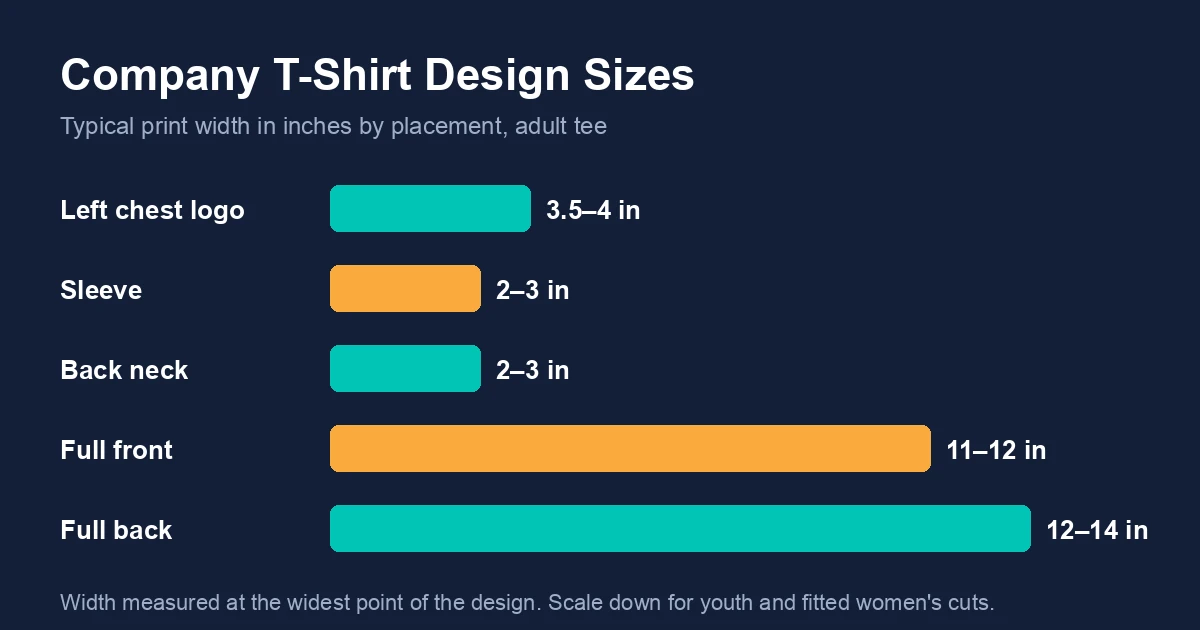
| Placement | Typical width on an adult tee | Use it for |
|---|---|---|
| Left chest | 3.5–4 in | The standard company logo spot; reads as a uniform |
| Full back | 12–14 in | Company name, website or phone number for crews and events |
| Back neck | 2–3 in | A small logo or website under the collar |
| Sleeve | 2–3 in | A second logo, a department or a slogan |
| Full front | 11–12 in | Event and promotional shirts rather than daily staff wear |
The left chest logo usually sits 7 to 9 inches down from the left shoulder seam, centred between the placket line and the side. The full figures for every shirt size, including youth and 2XL and up, are in the DTF transfer size chart, and the placement guide shows where each print sits. The placement calculator previews a logo size on any shirt size.
What file does a printer need for a company logo?
Send a vector file (SVG, AI, EPS or PDF) of the logo if the business has one; it scales to any size without blurring. For DTF printing, a PNG with a transparent background at about 300 pixels per inch at the print size also works, so a 4 inch left chest logo needs about 1,200 pixels across. A logo copied from a website or a social media profile is usually far too small and prints soft. The file prep guide covers transparent backgrounds and resolution.
Keeping brand colours consistent
Give the printer the brand's exact colour values (Pantone, CMYK or hex) and ask how close the method can match them. DTF prints full colour from a digital file, so it suits logos with gradients or many colours, but it reproduces colour through ink rather than a mixed spot colour, and a specific brand red or blue can shift slightly. Screen printing mixes each spot colour, which matches a Pantone more closely and is the usual choice for large runs of a one- or two-colour logo. Whichever method you use, approve a printed sample when the colour matters, and check the logo's contrast on the shirt colour: a navy logo disappears on a black shirt, so most brands keep a one-colour white version for dark shirts.
Which blank shirts work for company tees?
Choose the blank for where staff will wear it:
- Office, retail and front-of-house: a soft, fitted cotton or blend tee such as the Bella+Canvas 3001 or Next Level 3600. They hold a clean look and come in many colours.
- Field crews, warehouses and events: a heavier, cheaper cotton tee such as the Gildan 5000, or a 6.0 oz Gildan 2000 Ultra Cotton for durability.
- Hot outdoor work: a polyester performance tee such as the Port & Company PC380, pressed at the lower polyester setting.
Offer a women's or fitted cut alongside the unisex tee if the team wants it, and keep the same colour across styles so the shirts still read as one uniform.
Sizing a company t-shirt order
Collect each person's size before you order instead of guessing a spread; reprints of missing sizes are the most expensive shirts in the order. Share a size chart with the team, since unisex sizing runs larger than many women's sizes. The unisex size chart gives the measurements to send round, and a medium in most mainstream unisex tees is 20 inches across the chest and 29 inches long, laid flat. Order one or two spares in the most common sizes for new hires.
How much do company t-shirts cost?
Printed company shirts usually cost about $7 to $15 each, blank included, for orders up to a hundred, and $4 to $10 each for larger runs, depending on the blank, the number of print locations and the method. A left chest logo alone is the cheapest layout; adding a back print adds a second transfer or screen per shirt. DTF transfers are usually the cheapest method for small and mixed-size orders because there is no setup per design, while screen printing gets cheaper above a few hundred shirts with one or two colours. The cheap t-shirt printing guide breaks the cost down by quantity, and bulk custom t-shirts covers larger runs.
Frequently Asked Questions
What size should a company logo be on a shirt?
A company logo on the left chest of an adult t-shirt is usually 3.5 to 4 inches wide, set 7 to 9 inches down from the left shoulder seam. A back print is larger, 12 to 14 inches wide, and youth or fitted women's shirts take a slightly smaller logo.
Can I use my company logo on t-shirts?
Yes, if the business owns the logo or has the right to use it. A printer may ask you to confirm that you have permission to print the artwork. Do not add other brands' logos, sports team marks or characters to company shirts without a licence.
What is the best method to print company t-shirts?
DTF transfers suit small orders, mixed sizes and full-colour logos because there is no setup per design. Screen printing suits large runs of a simple one- or two-colour logo, and embroidery suits polos and jackets where a stitched logo looks more formal.
How many company shirts should I order?
Order one shirt per person in their collected size, plus a few spares in the most common sizes for new staff and replacements. If staff wear the shirt daily, budget for three to five shirts each so they are not washing one shirt every night.
Related Guides
Tags
About the Author
DTF Database Founder
Darrin DeTorres has over 10 years of experience in the print industry, specializing in screen printing, sublimation, embroidery, HTV, and DTF printing. He runs Notice Me Marketing and Media, a custom apparel production company that prints thousands of shirts per month.
More from Business Tips
Christian t-shirt design ideas for church groups, youth groups, VBS and mission trips, plus Bible verse copyright, layout and printing a faith shirt order.
When the 100th day of school falls in 2027 for big US districts, how to calculate it, 100 Days Smarter shirt ideas and how to run a class set order.
Dr. Seuss Enterprises holds a class 25 trademark for THE GRINCH. Who owns Elf, Rudolph and other Christmas characters, and what is public domain in 2026.
Explore DTF Database
Browse and compare 20+ verified DTF printer models by price, features, and specifications.
Read moreCalculate your per-print costs, profit margins, and ROI for DTF printing.
Read moreBrowse verified DTF suppliers for ink, film, powder, and equipment.
Read moreFind DTF transfer suppliers shipping to your state, with verified turnaround times.
Read moreMetro-level DTF supplier guides for Los Angeles, NYC, Dallas, Houston, and more.
Read moreStep-by-step guide to the DTF printing process with temperatures and troubleshooting.
Read more