Affordable Custom T-Shirts
Find affordable custom t-shirts. Compare cheap printing methods, blank shirt costs, and order sizes to get personalized shirts for less.
How much do affordable custom t-shirts cost?
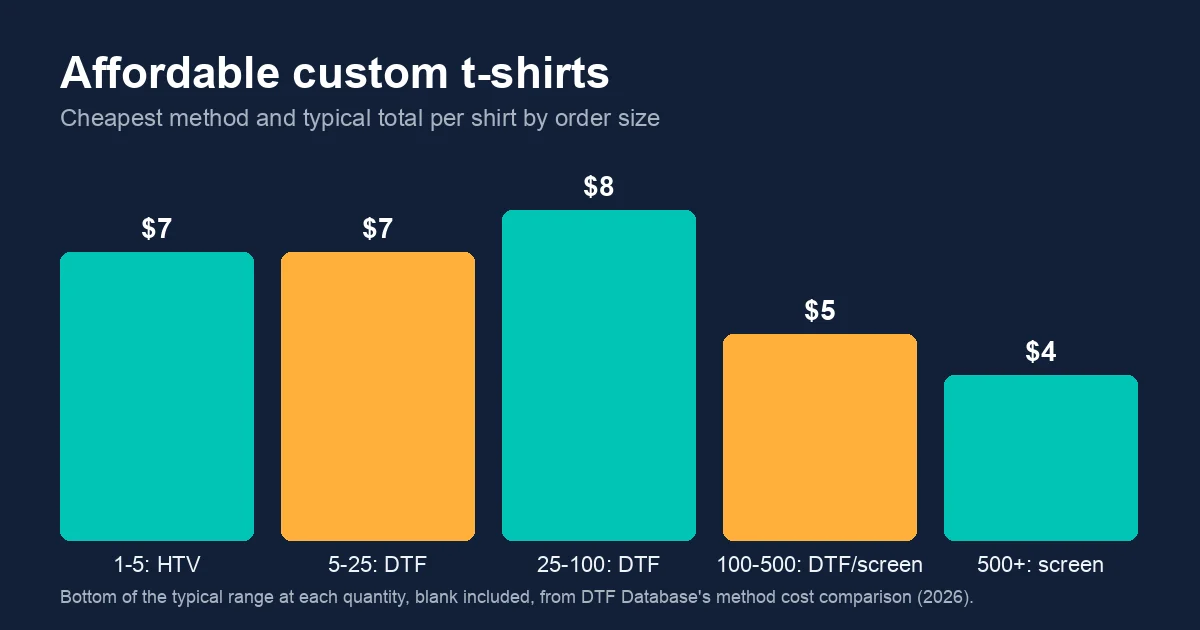
Affordable custom t-shirts usually cost $7 to $15 each, blank included, in orders of up to a hundred shirts, and $4 to $10 each above that. Quantity, print method and the blank set the price. A single personalized shirt costs the most per shirt; DTF transfers for small runs and screen printing for large ones are the cheapest methods.
| Quantity | Cheapest method | Typical total per shirt | Where the money goes |
|---|---|---|---|
| 1–5 shirts | HTV or iron-on at home; a single DTF transfer | $7–$12 | The blank and a $1–$5 print; no setup |
| 5–25 shirts | DTF transfers | $7–$13 | The blank and a $2–$8 transfer; pressing labour if a shop does it |
| 25–100 shirts | DTF transfers (or DTG for photos on cotton) | $8–$15 | Same, with volume tiers starting to bite |
| 100–500 shirts | DTF pressed in-house, or screen printing for 1–3 colours | $5–$10 | Screen setup spread thin; gang sheet tiers |
| 500+ shirts | Screen printing | $4–$8 | Blank cost dominates |
The ranges are DTF Database's standard method comparison, assuming a $4 to $5 cotton blank; the custom t-shirts guide explains each method, and the cost calculator prices a specific job.
The cheapest ways to get custom shirts
DTF transfers you press yourself
The cheapest route for anything from 5 to a few hundred shirts, if you own or borrow a heat press. A supplier prints your design on film for about $0.05 to $0.10 per square inch at small volumes (a 4-inch logo is around a dollar, an 11 by 10 inch front $5 to $11), and a packed gang sheet halves that. Add a $3 to $5 blank and the shirt costs $5 to $10 with no setup fee and no colour limit. The DTF transfer buying guide covers pricing and ordering, and the custom direct to film transfers guide covers by-size versus gang sheet.
An entry-level heat press costs $150 to $300; the heat press buying guide compares them. On a 24-shirt order, the press pays for itself against a shop's pressing charge the first or second time.
DTF transfers pressed by the supplier
No press needed: the supplier prints the transfer and applies it to a blank they stock. Expect $2 to $5 per shirt on top of the transfer-and-blank cost for the labour, which still beats most online custom-shirt shops at 10 shirts and up.
Heat transfer vinyl for text and numbers
For one to twenty-five shirts with a name, a number or a one-colour logo, HTV is the cheapest print there is: $1 to $5 per shirt in material, cut on a Cricut or Silhouette and pressed at home. It cannot do photos or many colours. The HTV buying guide covers types and brands.
Screen printing at volume
Above a few hundred shirts in one to three colours, nothing beats screen printing: $3 to $10 per print at small runs falls toward $1 to $2 at 500, and the print outlasts the shirt. Below 100 shirts the setup fees ($15 to $30 per colour per design at most shops) make it the expensive option. The DTF vs screen printing comparison has the crossover maths.
Print on demand
Zero upfront cost and no inventory, but the per-shirt price is the highest of any route, typically $12 to $20 before the platform's margin. It is affordable only in the sense that one shirt costs the same as the hundredth. Sensible for testing a design, not for a team order.
Budget blank shirts: the value picks
The blank is half the cost of a cheap custom shirt, so the brand matters more than any printing decision at small quantities.
| Blank | Fabric | Why it is the value pick | Watch for |
|---|---|---|---|
| Gildan 5000 Heavy Cotton | 100% cotton, 5.3 oz | The cheapest widely stocked tee; classic boxy fit; takes DTF and screen print well | Runs big; heavy hand in summer |
| Gildan 64000 Softstyle | 100% ring-spun cotton, 4.5 oz | Softer and more fitted than the 5000 for a small premium | Narrower cut; check the size chart |
| Port & Company PC54 Core Cotton | 100% cotton, 5.4 oz | Gildan 5000 pricing with wide colour range from SanMar | Same boxy fit |
| Jerzees 29M Dri-Power | 50/50 cotton-poly, 5.6 oz | Cheap blend that resists shrinking; good for uniforms | Blend press settings |
| Hanes 5250 Beefy-T | 100% cotton, 6.1 oz | Heavier, longer-lasting cotton at a mid price | Heaviest option; costs more than a 5000 |
The best blanks for DTF guide compares how each takes a transfer, and the Gildan size chart and youth t-shirt size chart help a group order land on the right sizes the first time. Buying blanks wholesale (SanMar, S&S Activewear, JiffyShirts) rather than from the print shop saves another dollar or two a shirt on bigger orders; most DTF suppliers will press onto blanks you send them.
Personalized shirts on a budget
A name and number on every shirt used to mean HTV or nothing, because screen printing charges a setup per design. With DTF, a roster of 20 names is one gang sheet: lay out every name and number at the right size, order the sheet by the foot, cut and press. The cost per shirt is the same as for a single design, and photos, gradients and full-colour logos cost nothing extra. For a one-off personalized gift, a single DTF transfer pressed at home comes in under $7 including the blank; a print-on-demand shop charges two to three times that for the same shirt.
How to cut custom shirt costs
- Order the right quantity once. Reprints are the most expensive shirts in any order. Collect sizes against the blank's chart before quoting.
- Pick the method for the quantity, from the table above, not the method the shop prefers.
- Fewer colours only matters for screen printing. With DTF, use as many as you like.
- Smaller prints cost less, and a left-chest logo is a fraction of a full front. Use the placement chart to size it.
- Gang the designs. Several designs on one DTF sheet cost about half of ordering them separately; the gang sheet guide explains the layout.
- Buy the blank where it is cheapest, and supply it to the presser if that is allowed.
- Give it a week. Rush production and overnight shipping add 25 to 50 percent to an order.
- Watch for deals. Transfer suppliers run promotions constantly; the DTF transfer deals guide tracks them.
Hidden costs to watch
- Setup and screen fees on screen-print quotes, sometimes listed as "art charges".
- Per-colour pricing that turns a four-colour logo into four fees.
- Print-location charges: front and back is two prints, not one.
- Shipping, both for blanks coming to the presser and shirts going to you.
- Rush surcharges and minimum-order fees on small runs.
- Design fees for converting a JPEG into print-ready art. Sending a transparent PNG at about 300 pixels per inch avoids them; the file prep guide and the Canva shirt design guide show how.
- Reprints for wrong sizes, which the size chart prevents.
Frequently Asked Questions
What is the cheapest way to print custom shirts?
For one to five shirts, heat transfer vinyl or iron-on at home. For five to a few hundred, DTF transfers pressed on a home heat press, at roughly $5 to $10 a shirt including the blank. Above a few hundred shirts in one to three colours, screen printing drops to $4 to $8 a shirt and is the cheapest method of all.
Is DTF cheaper than screen printing?
Below about 100 shirts, yes: DTF has no setup fees and no per-colour charge, so a 24-shirt full-colour order costs $7 to $13 a shirt against $12 or more with screens. Above a few hundred shirts in one to three colours, screen printing is cheaper per shirt, because the setup is spread across the run.
How much does one custom t-shirt cost?
A single custom shirt usually costs $7 to $12 made at home with a DTF transfer or HTV, and $15 to $25 from a print-on-demand or online custom shop. The blank is $3 to $5 of that; the rest is the print, and for a shop, the labour and margin on a one-off order.
What is the cheapest blank t-shirt for printing?
The Gildan 5000 Heavy Cotton and the Port & Company PC54 are the cheapest widely stocked blanks, usually $3 to $4 in basic colours when bought wholesale. Both take DTF and screen printing well. The Gildan 64000 Softstyle costs slightly more and is softer and more fitted.
Is there a minimum order for cheap custom shirts?
Not with DTF, DTG or HTV: a single shirt is fine, and the price per shirt is the same as for ten. Screen printers usually set a minimum of 12 to 24 shirts per design, because each colour needs its own screen. Print-on-demand has no minimum but the highest per-shirt price.
Are cheap custom t-shirts good quality?
They can be. The wash life of a shirt depends on the blank and on the print being applied correctly, not on the price of the order. A Gildan 5000 with a properly pressed DTF transfer lasts 50 or more washes. What makes a cheap shirt bad is an under-pressed transfer or a thin, unknown blank, both of which a sample order catches.
Sources
- Method and per-shirt cost ranges from DTF Database's custom t-shirts guide and DTF vs screen printing comparison, built from published supplier and print-shop price lists in 2026.
- Transfer pricing from the DTF transfer buying guide.
- Blank weights from the manufacturers' spec sheets (Gildan, Port & Company, Jerzees, Hanes); blank prices are typical wholesale ranges and move with cotton and tariff costs, as covered in the 2026 blank t-shirt tariff guide.
Prices are typical ranges, not quotes. DTF Database lists and reviews suppliers and does not sell shirts.
Related Guides
Tags
About the Author
DTF Database Founder
Darrin DeTorres has over 10 years of experience in the print industry, specializing in screen printing, sublimation, embroidery, HTV, and DTF printing. He runs Notice Me Marketing and Media, a custom apparel production company that prints thousands of shirts per month.
More from Business Tips
Heavyweight fleece is the 2026 trend. Which hoodie blanks to stock, DTF press settings for fleece, hoodie placement, and when to peel hot or cold.
Explore DTF Database
Browse and compare 20+ verified DTF printer models by price, features, and specifications.
Read moreCalculate your per-print costs, profit margins, and ROI for DTF printing.
Read moreBrowse verified DTF suppliers for ink, film, powder, and equipment.
Read moreFind DTF transfer suppliers shipping to your state, with verified turnaround times.
Read moreMetro-level DTF supplier guides for Los Angeles, NYC, Dallas, Houston, and more.
Read moreStep-by-step guide to the DTF printing process with temperatures and troubleshooting.
Read more