
Types of Neck on Shirts: 12 Necklines Explained
Types of neck on shirts explained: crew, V-neck, scoop, henley, mock, polo, ringer and boat neck, plus the DTF transfer placement for each.
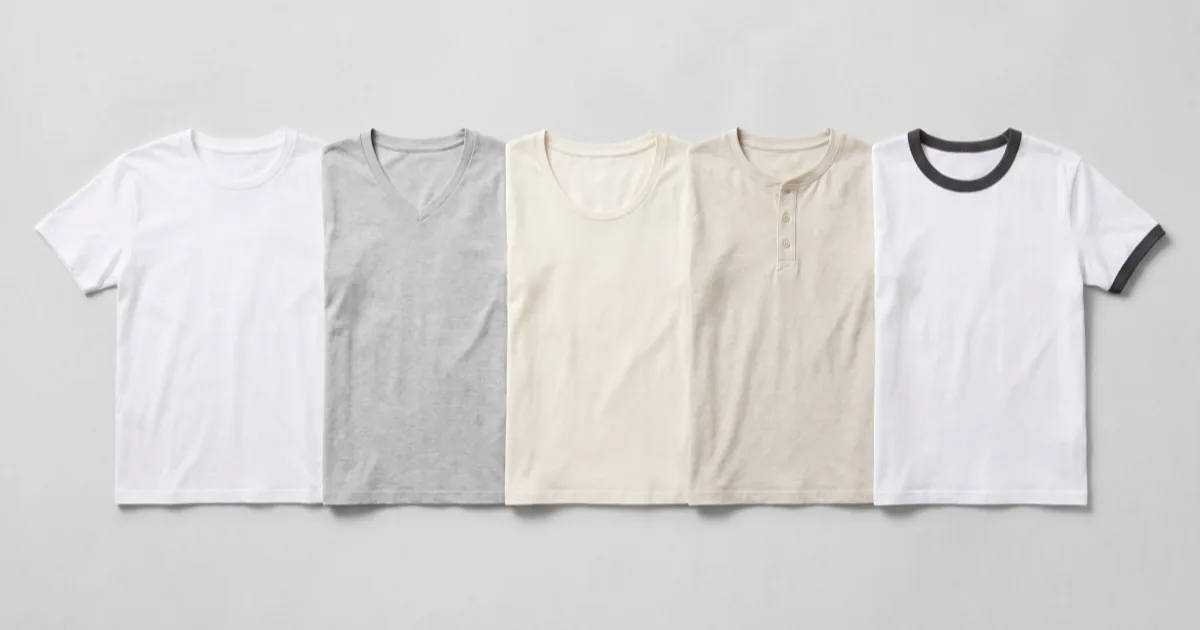
This guide covers every common t-shirt neck type, what each one is called in blank apparel catalogs, and how far down the chest a transfer needs to start on each one.
What are the different types of neck on shirts?
The most common types of neck on shirts are the crew neck, V-neck, scoop neck, henley, mock neck, polo collar, ringer and boat neck. A crew neck sits high and round, a V-neck dips to a point, a scoop neck curves lower, and a henley adds a button placket. Each shape changes where a print can start, so a transfer that sits well on a crew neck can crowd the collar on a V-neck or scoop.
T-Shirt Neck Types at a Glance
| Neck Type | Shape | Typical Drop Below Shoulder Seam | Common Blanks |
|---|---|---|---|
| Crew Neck | Round, sits at the base of the neck | Reference point for all other styles | Gildan 5000, Bella+Canvas 3001 |
| V-Neck | V-shaped point below the collarbone | 2–4 in deeper than a crew | Bella+Canvas 3005 |
| Deep V-Neck | Extended V, well below the collarbone | 4–6 in deeper than a crew | Fashion and retail tees |
| Scoop Neck | Wide, low, rounded curve | 2–3 in deeper and wider than a crew | Women's and fashion-fit tees |
| Henley | Crew neck with a 3–5 button placket | Same as crew, placket runs down center | Casual and outdoor shirts |
| Mock Neck | Stands 1–2 in upright, does not fold | Higher than a crew | Performance and base layers |
| Turtleneck | Tall collar that folds over | Highest neckline | Cold-weather knits |
| Polo Collar | Fold-over collar with 2–3 button placket | Placket occupies center chest | Sport-Tek and corporate polos |
| Ringer | Crew neck with contrast color binding | Same as crew | Retro and vintage-style tees |
| Boat Neck | Wide horizontal opening, shoulder to shoulder | Shallow but very wide | Women's fashion tops |
| Square Neck | Straight horizontal cut with squared corners | Similar depth to a scoop | Women's fashion tops |
| Hooded | Hood replaces the collar entirely | Hood seam sets the print ceiling | Hoodies and hooded tees |
What Is a Crew Neck?
A crew neck is a round neckline that sits at the base of the neck, finished with a ribbed knit collar. It is the standard neckline on the overwhelming majority of blank t-shirts, and it is the reference point every other neckline gets measured against.
Because the collar is a separate ribbed band stitched to the body, a crew neck gives a clear, consistent landmark: the collar seam, where the rib meets the body fabric. That seam is what most placement charts measure down from.
Crew neck also describes the neckline, not the sleeve length or the garment type. A crewneck t-shirt, a crewneck long sleeve, and a crewneck sweatshirt all share the same round neckline — the crewneck sweatshirt is simply a pullover with no hood.
DTF note: On adult crew neck tees, a standard front chest transfer starts 2–3 inches below the collar seam. See the DTF placement guide and transfer size chart for the full measurement set by garment size.What Is a V-Neck?
A V-neck is a neckline that comes to a point below the collarbone, forming a V. Depth varies considerably between blanks, which is exactly why V-necks cause placement problems.
Types of V-neck commonly found in blank catalogs:
- Classic V-neck — a shallow V ending a few inches below the collar line. The most common retail V.
- Deep V-neck — an extended V dropping well down the chest, common in fashion-forward women's blanks.
- Y-neck — a V with a short button placket at the point.
What Is a Scoop Neck?
A scoop neck is a wider, lower, rounded neckline — the same basic curve as a crew neck, but cut further out toward the shoulders and further down the chest. It is most common on women's and fashion-fit blanks.
Scoop necks reduce usable print width as well as height, because the curve eats into the upper chest from both sides. Wide horizontal designs that fit a crew neck may need to be scaled down or moved lower on a scoop.
What Is a Henley?
A henley is a crew neck with a short button placket, typically 3 to 5 buttons, running down the center of the chest. There is no collar.
Henleys are the most difficult common neckline to decorate. The placket sits directly in the center chest print zone, and buttons create raised bumps that prevent a heat press from applying even pressure. Options:
- Place the transfer below the bottom of the placket.
- Move to a left chest placement, clear of the placket entirely.
- Use a heat press pillow to raise the print area above the button line — see the heat press accessories guide for pillow sizing.
What Is a Mock Neck vs a Turtleneck?
A mock neck stands 1–2 inches up the neck and does not fold over. A turtleneck is taller and folds down on itself.
Both raise the neckline above a crew, which lowers the effective print ceiling on the chest. Neither is common in DTF work, but both appear in performance and cold-weather blanks.
What Is a Polo Collar?
A polo has a fold-over collar with a 2–3 button placket. Catalogs list these as collared shirts rather than by neckline, and they are the standard for corporate, golf, and uniform work.
DTF note: Polos are almost always decorated at the left chest, not center chest, precisely because the placket runs down the middle. Most polos are polyester or a poly blend, which brings dye migration risk into play — see the dye migration guide before running dark polyester polos.What Is a Ringer Tee?
A ringer tee is a crew neck finished with a contrasting color binding at the collar and, usually, matching contrast cuffs at the sleeves. The neckline shape is identical to a standard crew — only the trim color differs.
Ringers are popular in retro and vintage-styled merchandise. Because the collar binding is a strong visual element, designs are often kept smaller and centered to avoid competing with it.
Boat Necks, Square Necks and Off-Shoulder
- Boat neck (bateau) — a wide, shallow horizontal opening running nearly shoulder to shoulder.
- Square neck — a straight horizontal cut with squared corners.
- Off-shoulder — the neckline sits below the shoulders entirely.
All three are fashion cuts found in women's blanks. They share one decorating constraint: the wide opening severely limits horizontal print width in the upper chest, pushing designs lower and smaller than a crew neck of the same garment size.
T-Shirt Neck Types for Men
Men's blank catalogs are dominated by three neck types:
- Crew neck — the default for nearly all printed merchandise.
- V-neck — a slightly dressier retail option, usually a shallow classic V.
- Henley — casual and outdoor styling.
Polo collars cover corporate, golf, and uniform programs. Mock necks and turtlenecks appear in performance and cold-weather lines. Boat, scoop, square, and off-shoulder necklines are almost exclusively women's cuts.
How Neckline Changes DTF Transfer Placement
The rule that matters: measure from the neckline, not from the shoulder.
| Neckline | Measure From | Standard Adult Clearance |
|---|---|---|
| Crew | Collar seam | 2–3 in |
| V-neck | Bottom point of the V | 1.5–2 in |
| Scoop | Lowest point of the curve | 1.5–2 in |
| Henley | Bottom of the button placket | 1–2 in, or use left chest |
| Polo | Left chest standard | Placket clearance, not neckline |
| Hooded | Hood attachment seam | 2–3 in |
Two additional constraints apply regardless of neckline:
- Collar seams and plackets are not pressable. Any raised seam under the platen creates uneven pressure, and uneven pressure is a leading cause of edges lifting after washing. A heat press pillow slipped inside the garment lifts the print area clear of the seam.
- Youth garments scale down. Youth neck openings are proportionally smaller, so youth clearances typically run 1–2 inches rather than 2–3. The t-shirt design size master chart covers adult, youth, hoodie, and sweatpant placement together.
Where Neck Type Meets Neck Labels
Removing the manufacturer tag and heat-pressing a branded neck label is standard practice for private-label apparel. Neckline shape determines how much room that label has to sit in.
Crew necks give the most consistent tag area. V-necks and scoops offer less vertical room below the collar seam before the label starts to show through the neckline opening. Full details are in the custom heat transfer neck labels guide and the tagless branding guide.
Choosing Blanks by Neckline
Most major blank brands offer the same design in several necklines under different style numbers. Size charts and fit notes by brand:
- Gildan shirt guide — every style and fabric
- Bella+Canvas size chart — 3001, 3413, 3719
- Next Level size chart — 3600, 6210, 9301
- Jerzees size chart and style codes
- District size chart — DT6000, DT104, DM130
For sourcing, the wholesale blank apparel buying guide covers distributor accounts and minimums.
Frequently Asked Questions
What are the different types of neck on shirts?
The main types of neck on shirts are crew, V-neck, scoop, henley, mock neck, polo collar, ringer and boat neck. They differ in depth, shape and collar, which decides how far below the neckline a transfer should start.
What are the different t-shirt neck types?
The common t-shirt neck types are crew neck, V-neck, deep V-neck, scoop neck, henley, mock neck, turtleneck, polo collar, ringer, boat neck, square neck, and hooded. Crew neck is the standard on nearly all blank t-shirts used for custom printing.What is the difference between a crew neck and a round neck?
They are the same thing. "Round neck" is a descriptive term for the shape; "crew neck" is the standard name used in blank apparel catalogs. In Spanish-language catalogs the equivalent term is camiseta cuello redondo.What is the most common t-shirt neckline?
Crew neck. It is the default neckline on the highest-volume blanks from Gildan, Bella+Canvas, Next Level, Jerzees, and every other major blank supplier.Which neckline is hardest to print on?
Henleys and polos, because the button placket sits in the center chest print zone and the buttons prevent even heat press pressure. Both are usually decorated at the left chest instead.How far below the neckline should a DTF transfer start?
On an adult crew neck, 2–3 inches below the collar seam. On a V-neck or scoop, measure from the lowest point of the neckline opening instead and allow 1.5–2 inches.Does neckline affect heat press settings?
No. Temperature, time, and pressure are set by the garment's fabric content, not its neckline. See the DTF heat press settings guide for settings by fabric.What is a ringer t-shirt?
A ringer tee is a crew neck t-shirt with contrasting color binding at the collar and usually matching contrast sleeve cuffs. The neckline shape is the same as a standard crew neck.Related Resources
- Types of t-shirts: fits, necklines and sleeves
- T-shirt fit guide: how shirts should fit
- DTF placement guide and transfer size chart
- T-shirt design placement and size chart
- Placement guide tool
Background reading: the DTF process explained.
Tags
About the Author
DTF Database Founder
Darrin DeTorres has over 10 years of experience in the print industry, specializing in screen printing, sublimation, embroidery, HTV, and DTF printing. He runs Notice Me Marketing and Media, a custom apparel production company that prints thousands of shirts per month.
More from DTF Basics
Explore DTF Database
Browse and compare 20+ verified DTF printer models by price, features, and specifications.
Read moreCalculate your per-print costs, profit margins, and ROI for DTF printing.
Read moreBrowse verified DTF suppliers for ink, film, powder, and equipment.
Read moreFind DTF transfer suppliers shipping to your state, with verified turnaround times.
Read moreMetro-level DTF supplier guides for Los Angeles, NYC, Dallas, Houston, and more.
Read moreStep-by-step guide to the DTF printing process with temperatures and troubleshooting.
Read more