
Custom Direct to Film Transfers: How to Order and Compare Providers
Compare custom direct to film transfers: how ordering works, gang sheet vs. by-size pricing, file prep, turnaround and what to check before you buy.
What are custom direct to film transfers?
Custom direct to film transfers are designs printed in color onto a special PET film, coated with hot-melt adhesive powder, then cured. You heat press the film onto fabric, peel it away, and the design bonds to cotton, polyester and blends. Buyers can order by size or fill a gang sheet.
"Custom" is the word that separates them from pre-made (stock) transfers, which are the supplier's own designs printed in volume. With a custom transfer the supplier prints what you upload, at the width you choose, in the quantity you choose, and most will print a single one. The beginner's DTF transfer FAQ covers what DTF is in general; this guide is about buying the custom kind.
Custom DTF by size vs gang sheet: which should you order?
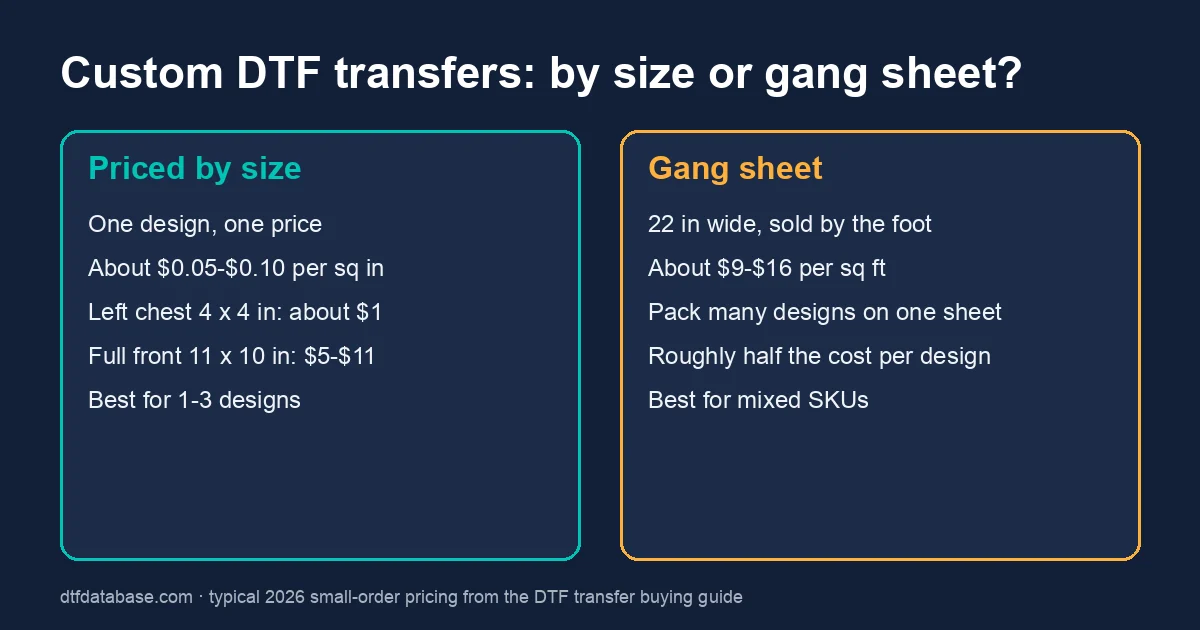
Suppliers sell custom transfers two ways, and the right one depends on how many different designs you have.
| By size (single transfers) | Gang sheet | |
|---|---|---|
| What you buy | One design at one width, in a quantity | A sheet (usually 22 in wide, sold by the foot) that you fill with any designs |
| Typical price | $0.05–$0.10 per square inch at small volumes | $9–$16 per square foot, falling steeply above 5–10 sq ft |
| Example | 4 × 4 in left-chest logo: about $1. 11 × 10 in full front: $5–$11 | A 22 × 12 in sheet (1.83 sq ft) at $11/sq ft is $20; packed with 12 left-chest logos, $1.67 each |
| Cost per design | List price | Roughly half, when the sheet is packed well |
| File effort | Upload one PNG per design | Lay out the sheet yourself (most suppliers have a builder) or upload a finished sheet |
| Best for | 1–3 designs, reorders of the same design | Several designs, mixed sizes, team rosters with names and numbers |
| Waste | None | Whatever space you leave empty |
Pricing figures are the typical small-order ranges from the DTF transfer buying guide; the gang sheet optimization guide shows how to pack a sheet, and the gang sheet calculator works out what a layout will cost. Volume tiers apply to both: expect 15 to 20 percent off at 10 square feet and 25 to 40 percent off at 50, with wholesale accounts beyond that.
A rule of thumb: one or two designs, order by size; three or more, or anything with names and numbers, build a gang sheet.
Ready-to-press vs upload-your-own-artwork transfers
Every custom transfer arrives ready to press; the phrase "ready to press" on a supplier's site usually means its pre-made catalogue of stock designs (holiday, sports, faith, slogans) sold per sheet at $2 to $8. They are a different product: no artwork to prepare, ships within a day, but it is the supplier's design and every other shop can buy it too. Upload-your-own is what "custom" means. Many shops run both: custom transfers for their own line, stock transfers to fill a booth table at an event.
How to prepare artwork for a custom DTF transfer
What suppliers ask for is consistent:
- A PNG with a transparent background. Every non-transparent pixel prints, with a white ink underbase beneath it, so a white box behind the art prints as a white box.
- About 300 pixels per inch at the print size. An 11-inch-wide front needs roughly 3,300 pixels across. Suppliers accept less, but fine text and edges suffer below about 150.
- No semi-transparent pixels. Drop shadows, glows and layers below 100% opacity print as speckle. Fades and shadows have to be solid or left out.
- Line weights and text that will survive washing. Suppliers publish their own minimums; hairlines and 6-point text are the usual failures.
- RGB is fine. The supplier converts to CMYK plus white; expect neon colours to print duller than the screen.
- State the print width. The supplier scales the height to match. The placement size chart gives widths by placement and shirt size.
The DTF file prep guide covers PNG and PSD setup in detail, and the Canva shirt design guide covers the export from the tool most beginners use.
How to press a custom DTF transfer
The transfer comes with the supplier's instructions, and those take priority, because film, powder and ink differ between suppliers. As a reference, DTF Database's temperature and time chart publishes 300 to 325°F for 10 to 15 seconds on 100% cotton, with firm pressure, and 270 to 285°F for 10 to 12 seconds on 100% polyester, with medium pressure and a cold peel. The steps:
- Pre-press the blank for 3 to 5 seconds to remove moisture and wrinkles.
- Place the transfer film side up, design face down, using the placement chart.
- Press at the supplier's temperature, time and pressure.
- Peel as instructed: hot (straight off the press), warm, or cold (after the film cools). Peeling a cold-peel film hot lifts the design.
- Post-press for 5 to 10 seconds with parchment or a Teflon sheet over the design to set it and soften the hand.
The heat press tips guide covers pressure, platen checks and the common mistakes, and the heat pressing polyester guide covers the fabric that scorches most easily. A household iron can apply a DTF transfer in a pinch, but it cannot hold even pressure or temperature, and most suppliers will not guarantee the result.
What to compare between providers
| What to check | Why it matters |
|---|---|
| Minimum order | Many custom DTF suppliers have none; some set a 1 sq ft or $10 minimum |
| Price per square inch or square foot, and the volume tiers | The list price matters less than the tier your usual order lands in |
| Turnaround in business days | 24 to 72 hours is common for custom orders; same-day exists at a premium |
| Shipping cost and speed | Transfers ship flat and light; free shipping thresholds vary |
| Gang sheet builder | A good online builder saves an hour per sheet |
| Peel type and press instructions | Hot-peel film is faster in production; cold-peel is more forgiving |
| Wash durability claim and warranty | Look for a stated wash count and a reprint policy for defects |
| Reorder tools | Saved artwork and one-click reorders matter for a shop |
| Reviews from shops, not just a gallery | Consistency over months is what you are buying |
Which fabrics work with DTF transfers?
Cotton, polyester, cotton-poly blends, tri-blends, fleece, canvas, denim, nylon with the right settings, and most synthetics. Dark and light garments both work, because of the white underbase. The exceptions are fabrics that cannot take the press temperature (some coated nylons, very thin performance knits) and heavily textured surfaces, which need extra pressure. The best blanks for DTF guide compares shirts by how well they take a transfer.
DTF vs screen print vs sublimation vs HTV transfers
| Transfer type | Colours | Fabrics | Best at | Weak spot |
|---|---|---|---|---|
| Custom DTF | Unlimited | Almost all, light and dark | Small and mixed orders, full colour | Hand feel on large solid areas |
| Screen print transfers | Priced per colour | Cotton, blends | Large runs of 1–3 colour designs | Setup cost per design |
| Sublimation | Unlimited | White or light 100% polyester | All-over prints, jerseys | Does not work on cotton or dark garments |
| Heat transfer vinyl | 1–2 solid colours | Most | Names, numbers, simple text | Weeding time; no photos |
The custom screen print transfers guide and the HTV vs sublimation vs DTF comparison go into each.
Where to order custom direct to film transfers
DTF Database's supplier directory lists DTF transfer suppliers by state, with minimums and products. A few of the verified listings with no minimum order: RSD DTF in Texas, DTF Printer in Michigan (one transfer minimum), Crystal DTF in Arkansas (budget pricing), Captivated By Nova in Kentucky and Got Transfers? in Maine. The largest national suppliers are reviewed in depth: the Ninja Transfers review and the Transfer Kingdom review. For pickup, the local DTF suppliers directory lists options by state, and the DTF transfer deals guide tracks current promotions.
If you are weighing buying transfers against printing your own, the DTF transfer cost and durability guide puts the crossover at roughly 50 to 100 transfers a week.
Frequently Asked Questions
How much do custom DTF transfers cost?
At small volumes, about $0.05 to $0.10 per square inch by size, so a 4-inch left-chest logo is around a dollar and an 11 by 10 inch front is $5 to $11. Gang sheets run $9 to $16 per square foot, which roughly halves the cost per design when the sheet is packed. Volume tiers take 15 to 40 percent off larger orders.
Is there a minimum order for custom DTF transfers?
Usually not. Most custom DTF suppliers print a single transfer, and gang sheets start at one foot. A few set a small minimum, such as one square foot or ten dollars, so check the order page. Screen print transfers, by contrast, almost always carry a minimum per design.
How long do custom DTF transfers take?
Most suppliers print custom transfers in 24 to 72 hours and ship flat, so a week door to door is typical and two to three days is possible with expedited shipping. Same-day production and local pickup exist at some suppliers. Pre-made stock transfers usually ship within a day.
Can I press custom DTF transfers at home?
Yes, with a heat press. Follow the supplier's temperature, time, pressure and peel instructions, which for cotton are usually around 300 to 325°F for 10 to 15 seconds. A household iron can apply a transfer but cannot hold even pressure, so results vary and most suppliers do not guarantee them.
How long do custom DTF transfers last on a shirt?
Applied and cared for correctly, 50 or more home washes is the usual claim, and many outlast that. Wash cold, inside out, and tumble dry on low. Cracking or peeling in the first washes points to a press problem (too cool, too short, uneven pressure) rather than the transfer.
What size gang sheet should I order?
Order the shortest sheet that holds your designs with little empty space. Sheets are usually 22 inches wide and sold by the foot; a 22 by 12 inch sheet holds about a dozen 4-inch logos or one adult front plus several small designs. Use the supplier's builder or the gang sheet calculator to check before paying.
Sources
- Pricing, lead-time and volume-tier figures from published supplier price lists, as compiled in the DTF transfer buying guide (2026).
- Press settings from DTF Database's temperature and time chart, which reconciles the ranges suppliers publish.
- Supplier minimums and locations from the listings in the supplier directory, checked October 2026.
Prices are typical ranges, not quotes, and change with film and ink costs. DTF Database lists suppliers and does not sell transfers.
Related Guides
Tags
About the Author
DTF Database Founder
Darrin DeTorres has over 10 years of experience in the print industry, specializing in screen printing, sublimation, embroidery, HTV, and DTF printing. He runs Notice Me Marketing and Media, a custom apparel production company that prints thousands of shirts per month.
More from DTF Basics
Get tee shirts printed the right way. Compare DTF, screen printing, and heat transfer by cost, quality, and order size before you buy.
Explore DTF Database
Browse and compare 20+ verified DTF printer models by price, features, and specifications.
Read moreCalculate your per-print costs, profit margins, and ROI for DTF printing.
Read moreBrowse verified DTF suppliers for ink, film, powder, and equipment.
Read moreFind DTF transfer suppliers shipping to your state, with verified turnaround times.
Read moreMetro-level DTF supplier guides for Los Angeles, NYC, Dallas, Houston, and more.
Read moreStep-by-step guide to the DTF printing process with temperatures and troubleshooting.
Read more