
Tee Shirts Printed: How to Choose the Right Method
Get tee shirts printed the right way. Compare DTF, screen printing, and heat transfer by cost, quality, and order size before you buy.
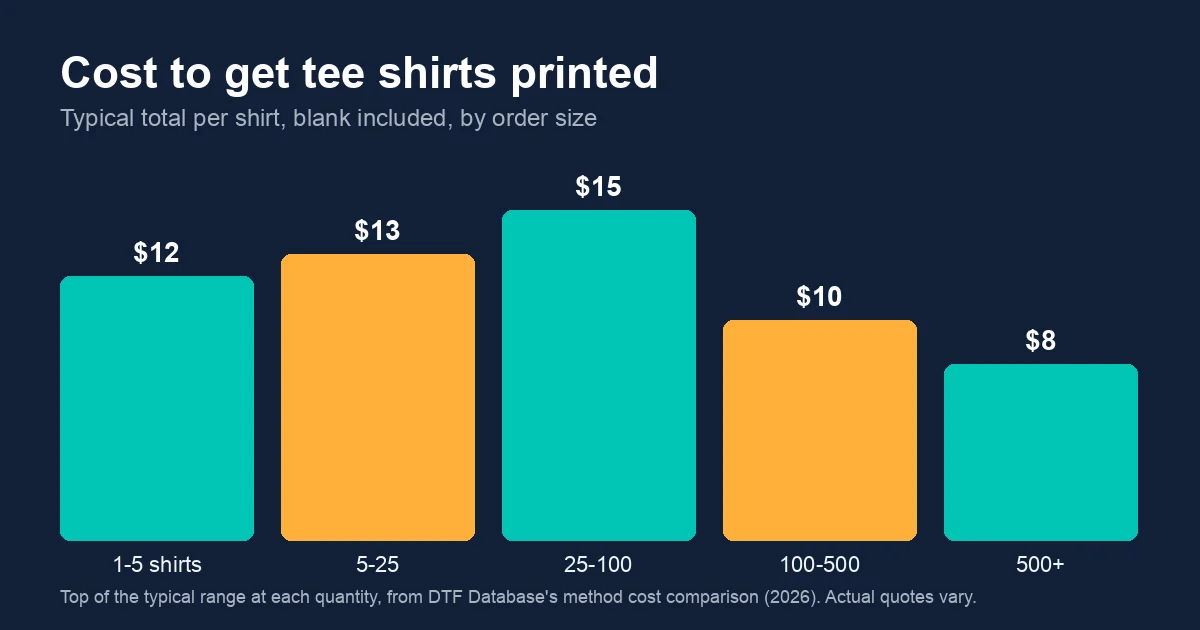
How much does it cost to get tee shirts printed?
The cost to get tee shirts printed depends mostly on quantity, number of colors, and print method. Small orders usually cost more per shirt because of setup and handling, while bulk orders lower the unit price. DTF suits small and mixed orders because it avoids screen setup fees, so compare quotes at your exact quantity.
The table gives typical total cost per shirt, blank included, assuming a standard cotton tee at $4 to $5. The figures are the ranges DTF Database uses across its method comparisons; a specific quote depends on the design size, the number of print locations, the blank and the supplier.
| Quantity | Usual cheapest method | Typical total per shirt |
|---|---|---|
| 1–5 shirts | HTV or iron-on at home, or single DTF transfers | $7–$12 |
| 5–25 shirts | DTF transfers (ordered, pressed by you or the supplier) | $7–$13 |
| 25–100 shirts | DTF transfers, or DTG for photographic cotton designs | $8–$15 |
| 100–500 shirts | DTF in-house, or screen printing for 1–3 colour designs | $5–$10 |
| 500+ shirts | Screen printing | $4–$8 |
What moves a quote inside those ranges:
- Print size and locations. A left-chest logo is a fraction of the cost of a full front, and a front-and-back print is close to double.
- Colours, for screen printing only. Each colour is a screen and a setup fee. DTF and DTG charge the same for one colour or fifty.
- The blank. A Gildan 5000 costs less than half of a Bella+Canvas 3001 or a performance tee. The blank shirts guide compares them.
- Rush. Same-day and two-day production carry a surcharge, often 25 to 50 percent.
- Who presses. Ordering transfers and pressing them yourself removes the shop's labour from the price, if you own a heat press.
The DTF transfer cost and durability guide goes deeper on the unit economics, and the cost calculator runs the numbers for a specific order.
Which printing method should you choose?
| Method | Best order size | Per-shirt print cost (small run) | Colours | Works on | Durability |
|---|---|---|---|---|---|
| DTF transfers | 5–500 | $2–$8 | Unlimited, photographic | Cotton, polyester, blends, most synthetics | 50+ washes applied correctly |
| Screen printing | 100+ | $3–$10 | Priced per colour; best at 1–3 | Cotton, blends, polyester with care | Highest; plastisol can exceed 100 washes |
| DTG (direct to garment) | 1–50 | $5–$15 | Unlimited, photographic | Cotton and cotton-rich blends | Good on cotton; fades faster than DTF or screen |
| Heat transfer vinyl (HTV) | 1–25 | $1–$5 | One or two solid colours | Cotton, polyester, blends | Good for text and numbers |
| Sublimation | Any | $2–$6 | Unlimited | White or light 100% polyester only | Permanent (dye in the fibre) |
The per-shirt print costs are from the custom t-shirt methods guide, which explains each method; the DTF vs screen printing comparison and the HTV vs sublimation vs DTF guide go head to head.
The short version by situation:
- A few shirts, simple text or a number: HTV, at home with a cutter or from a shop.
- A few shirts, full-colour art: DTF transfers or DTG. DTF works on any fabric and dark shirts without pretreatment.
- A team, class, event or small brand (10 to a few hundred): DTF. No setup fees, any colour count, any blank, and the price per shirt is flat across the run.
- Hundreds of shirts in one to three colours: screen printing. The setup fee is spread thin, and the print is the most durable there is.
- All-over or polyester-only prints (jerseys, performance tees): sublimation, on white or light polyester.
When DTF is the best way to get tee shirts printed
DTF prints the design in CMYK plus white onto a film, bonds adhesive powder to it, and heat-presses the film onto the shirt. It became the default for custom tee orders in the 5-to-500 range because:
- There is no setup fee, so a 12-shirt order costs 12 times the one-shirt price, not 12 times the price plus $40 of screens.
- Colour count does not change the price. A photograph costs the same as a one-colour logo.
- It works on dark shirts and on polyester, which DTG and sublimation each struggle with.
- Mixed orders are easy. Ten designs across 30 shirts is one gang sheet, not ten screen setups.
- You can split the job. Order the transfers from a supplier for a dollar or two each and press them yourself, or have the supplier press them onto blanks.
Where DTF is not the answer: very large single-design runs (screen printing is cheaper above a few hundred), prints that need the softest possible hand on light cotton (DTG or water-based screen printing feel lighter), and all-over prints (sublimation). The DTF shirts guide covers how a DTF shirt feels, washes and costs in more detail.
How to order printed tee shirts, step by step
- Fix the quantity and the size breakdown. Collect sizes before you quote; the size split changes the blank cost and reprints are the most expensive shirts you will buy. The Gildan size chart and the youth t-shirt size chart help with group orders.
- Choose the blank. Decide on fabric (cotton, blend, polyester), weight and colour, and check that the method you want works on it.
- Prepare the artwork. For DTF and DTG, a PNG with a transparent background at about 300 pixels per inch at print size; for screen printing, vector art (SVG, AI, PDF) with colours separated. The file prep guide covers the requirements, and the Canva shirt design guide covers the most common beginner tool.
- Decide the print size and placement. Use the placement chart or the placement calculator; a design sized for an adult front is too big for a youth small.
- Get quotes at your exact quantity from two or three providers. Ask for the all-in price with blanks, printing, setup and shipping.
- Approve a proof. A digital proof at minimum; for a brand colour or a large order, a printed sample.
- Confirm turnaround and shipping. Standard production is usually 3 to 7 business days plus shipping; rush is available at a surcharge.
- Check the delivery against the size breakdown and wash one shirt before handing the order over, so a care problem shows up on your shirt, not the customer's.
What to check before you choose a printer
- Minimum order. Many DTF suppliers have none; screen printers often start at 12 or 24.
- Turnaround, stated in business days, and whether it starts at proof approval or at payment.
- Proofing. A free digital proof is standard; ask what a physical sample costs.
- Blanks offered, or whether you can supply your own.
- Wash guidance. A printer that tells you how to wash the shirts has tested them. The DTF washing and care guide has the standard care card.
- Reprint policy for misprints, and who pays shipping.
- Reviews from buyers, not just the shop's gallery.
DTF Database's supplier directory lists verified DTF transfer suppliers with their minimums and locations, and the Ninja Transfers review and Transfer Kingdom review cover two of the largest.
Getting tee shirts printed near you
A local shop makes sense for a rush order, a pickup, or a large screen-printing run where you want to see a sample. For DTF, the transfer itself ships flat and light, so a supplier two states away is often faster and cheaper than the shop across town, and the pressing can be done locally or at home. The local DTF suppliers directory lists pickup options by state, and the custom t-shirts guide has an honest section on what "near me" buys you.
Frequently Asked Questions
What is the cheapest way to get tee shirts printed?
For one to five shirts, heat transfer vinyl or iron-on at home is cheapest. For five to a few hundred shirts, DTF transfers are usually the lowest total cost because there are no setup fees and any colour count costs the same. Above a few hundred shirts in one to three colours, screen printing wins on price per shirt.
How much does it cost to print one tee shirt?
A single printed tee usually costs $7 to $12 all in: a $4 to $5 blank plus $2 to $8 for the print, depending on the method and the print size. A single DTF transfer for a left-chest logo costs about a dollar from most suppliers, so a one-off shirt pressed at home can come in under $7.
How long does it take to get tee shirts printed?
Standard production is usually 3 to 7 business days after proof approval, plus shipping. Many DTF suppliers ship transfers in 24 to 72 hours, and some offer same-day pickup locally. Rush printing of finished shirts is widely available at a surcharge of roughly 25 to 50 percent.
Is there a minimum order to get tee shirts printed?
Not for DTF, DTG or HTV: most suppliers will print a single shirt or a single transfer. Screen printers usually set a minimum of 12 to 24 shirts per design because each colour needs its own screen and setup, and the setup cost has to be spread across the run.
Do printed tee shirts last?
A correctly applied DTF transfer lasts 50 or more home washes, and a screen print can last longer than the shirt. Durability depends more on the application and the care than on the method: wash cold, inside out, and dry on low. A print that cracks in the first few washes was under-pressed or under-cured.
Can I get tee shirts printed with my own design?
Yes. Every method accepts your artwork. For DTF and DTG, send a transparent PNG at about 300 pixels per inch at the print size; for screen printing, vector art with the colours separated. Most suppliers show a digital proof before printing, so you can confirm size and placement first.
Sources
- DTF Database's method cost comparison in the custom t-shirts guide and the pricing in the DTF transfer buying guide, both built from published supplier price lists in 2026.
- Durability and care figures from the DTF washing and care guide and the DTF vs screen printing comparison.
Prices are typical published ranges, not quotes. DTF Database does not print shirts; it lists and reviews the suppliers that do.
Related Guides
Tags
About the Author
DTF Database Founder
Darrin DeTorres has over 10 years of experience in the print industry, specializing in screen printing, sublimation, embroidery, HTV, and DTF printing. He runs Notice Me Marketing and Media, a custom apparel production company that prints thousands of shirts per month.
More from DTF Basics
Compare custom direct to film transfers: how ordering works, gang sheet vs. by-size pricing, file prep, turnaround and what to check before you buy.
Explore DTF Database
Browse and compare 20+ verified DTF printer models by price, features, and specifications.
Read moreCalculate your per-print costs, profit margins, and ROI for DTF printing.
Read moreBrowse verified DTF suppliers for ink, film, powder, and equipment.
Read moreFind DTF transfer suppliers shipping to your state, with verified turnaround times.
Read moreMetro-level DTF supplier guides for Los Angeles, NYC, Dallas, Houston, and more.
Read moreStep-by-step guide to the DTF printing process with temperatures and troubleshooting.
Read more