
Dual Station Auto Heat Press: 30 to 70 Shirts an Hour
We bought a $2,500 automatic two station pneumatic heat press from Upload Transfers. Output went from about 30 shirts an hour to about 70. What to know first.
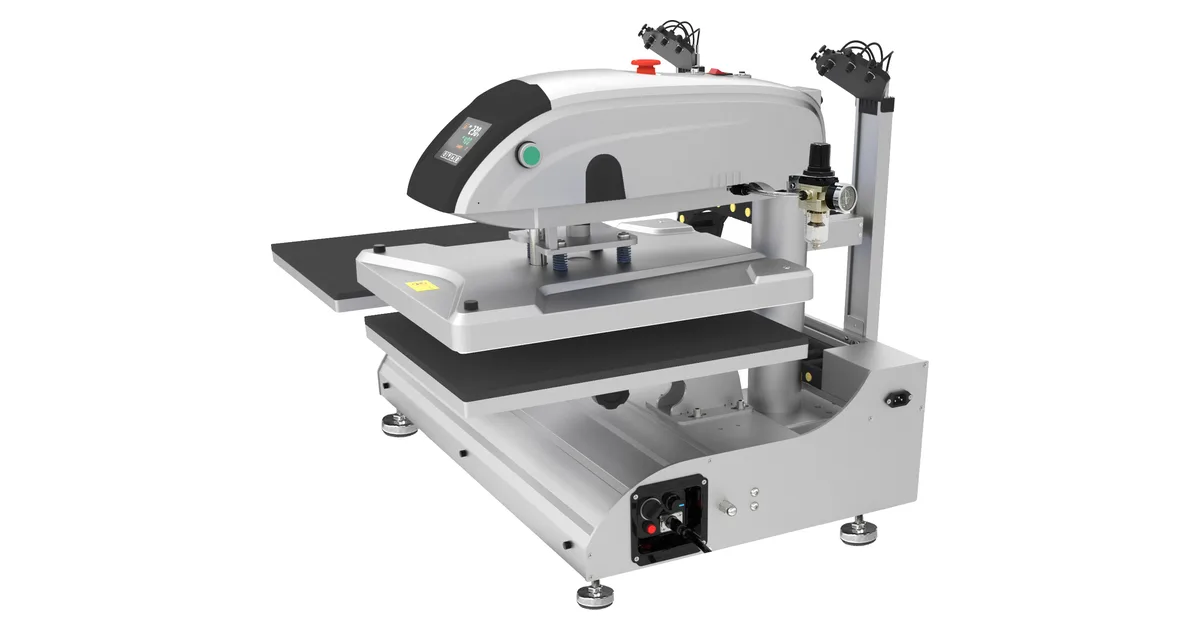
Image: Upload Transfers
What a Dual Station Pneumatic Press Actually Is
A dual station press has one heated upper platen and two lower platens side by side. The head presses the left station, then swings or slides over and presses the right station while you unload and reload the left. Pneumatic means an air cylinder, fed by a compressor, closes and opens the press with consistent pressure instead of your arm. Fully automatic means the cycle is timed: set temperature, time, and pressure, load a shirt, hit the button or pedal, and the press does the rest.
The result is that you are never standing there holding a handle or waiting on a timer. One station is always curing while you are working the other. That is where the throughput comes from, and it is why every high volume shop runs one.
What We Bought
| Spec | Upload Transfers Dual Swing Away 16x20 |
|---|---|
| Price | $2,500 (10 in stock on September 22, 2026) |
| Platens | Two lower stations, 16 x 20 inches |
| Drive | Pneumatic, fully automatic cycle |
| Upper platen | Swing away |
| Alignment | Laser positioning |
| Base | Threadable, with interchangeable platens |
| Power | 110V plug |
| Air compressor | Not included, required |
| Weight | Not published |
Upload Transfers is better known as a transfer vendor, and they are in our supplier directory for that reason. They also sell equipment, and the press is listed as a "Pneumatic Dual Station Swing Away Fully Automatic Press with Lasers, Threadable Base and Interchangeable Platens." The 110V plug is worth calling out because a lot of production presses want 220V, and running a dedicated 220V line is a real cost in a home or small commercial space.
What Changed for Us
| Before (15x15 manual clamshell) | After (dual station pneumatic) | |
|---|---|---|
| Shirts per hour, one operator | About 30 | About 70 |
| Operator effort | Pull handle every press | Load, press button, unload |
| Consistency | Pressure varies with fatigue | Same pressure every cycle |
| Two-step transfers (press, peel, second press) | Awkward, ties up the press | Second press happens on the other station |
| Floor space | Tabletop | Its own bench, roughly a full workbench wide |
The 70 number is real production, not a best case: unfold shirt, load, press, peel, second press on the other station, fold, next. The laser alignment is the part we did not expect to care about and now would not give up. Lining up a chest print in two seconds instead of ten, without a ruler, adds up over a run of 150 shirts.
The other thing that changed is our bodies. A manual clamshell at 40 to 60 pounds of force, a couple hundred times a day, is a repetitive strain injury on a schedule. That was the reason we upgraded, and it is the reason the person asking this question every day upgrades. The throughput was the bonus.
What Nobody Warns You About
It is extremely heavy. Plan on two strong people to uncrate it and a bench that can carry a few hundred pounds without flexing. It is not going on a folding table. The listing does not publish a weight, so ask before you order and make sure the freight delivery includes a liftgate. You need an air compressor, and it is not included. Ours required a separate compressor, which was an added cost we had not budgeted, plus the noise of a compressor cycling in the same room where we work. Ask the seller what PSI and tank size the press needs, and if you can, put the compressor in another room with a longer air line. It needs its own footprint. Two 16 x 20 platens plus the swing radius of the head is roughly a full workbench. Measure before you buy. It is a freight shipment. Not a box on the porch. Budget for freight and a delivery window.None of those are reasons not to buy. They are the difference between a good week and a bad week when the truck shows up.
The Rest of the Market Around $3,000
You do not have to spend $5,000 at a national heat press retailer to get a pneumatic dual station press. The same question in a recent group thread drew a consistent set of answers, and they line up with what we found when we shopped.
| Option | What owners report | Notes |
|---|---|---|
| Upload Transfers Dual Swing Away 16x20 | $2,500, in stock, 110V | The one we bought. US seller with a phone number. |
| MEM dual station pneumatic | Around $2,000 direct from the factory, $2,500 or so from US resellers plus freight | Owners describe an all metal build, a 1,400 member owner group, and one shop reporting 300,000 presses with a single $25 repair part |
| Hidden Print Shop 16x20 semi-automatic pneumatic double station | Ships from Southern California | Laser positioning, in stock per the seller |
| OKAI dual station | Sold direct by OKAI Machinery | Same company whose A3 printers come up in beginner threads |
| Audley dual station | Owners report around $2,000 | Sold through US dealers like DTF OneStop |
| Two single station pneumatic presses | Around $1,800 each from printer suppliers | One owner runs two singles and argues it is faster than one dual and gives you a backup |
We have not pressed on the MEM, Hidden Print Shop, OKAI, or Audley units ourselves. Those rows are what owners in the thread reported, and MEM in particular has enough owners that its group is a decent place to check before you buy. Prices from overseas sellers change with tariffs and freight, so confirm the door to door number, not the listing price. Our 2026 apparel tariffs explainer shows how much import costs have moved this year on the blanks side, and equipment has followed the same curve.
Dual Station vs Two Singles
One owner made a good case for two single station pneumatic presses instead of one dual: two singles are faster than one dual if you have two operators, and if one press goes down you still have the other. That is true. The counterargument is that one operator cannot run two separate presses as smoothly as one dual, because the dual's cycle is designed around one person walking between stations. If you are a one person shop, the dual is the right call. If you have a helper on busy days, two singles are worth pricing.
Who to Avoid
The person asking this question always asks who to avoid, and we are going to disappoint them. We will not name a company we have not personally had a problem with, and the one negative brand experience in that thread was one owner's account, not a pattern we can verify. What we will do is give you the vetting list we used:
- Warranty in writing before you pay. What is covered, for how long, and who pays freight on a warranty repair.
- Support hours in your time zone, with a phone number, not only a chat widget.
- Parts availability. Ask what the common failure parts are (pressure gauge, solenoid, heating element, controller) and whether they stock them in the US.
- An owner community. A brand with a thousand owners in a group has a thousand people who have already solved your problem.
- Voltage and air requirements stated clearly. If the seller cannot tell you the PSI and the plug type, move on.
The Hotronix and Stahls' presses that cost $5,000 and up are not overpriced. You are paying for a US built machine, a long warranty, and a support desk. Our Hotronix Fusion IQ vs Air Fusion comparison and Fusion IQ review explain what that money buys. If the budget is $3,000, the imported dual station pneumatics in the table above are how most small shops get there, and our experience with the Upload Transfers unit has been good.
Frequently Asked Questions
How many shirts per hour can a dual station heat press do?
With one operator doing a full DTF cycle (press, peel, second press), we went from about 30 shirts an hour on a 15x15 manual clamshell to about 70 on a 16x20 dual station pneumatic press. Simpler single-press jobs run faster. Two operators on a dual station can push past 100.
Does a pneumatic heat press need an air compressor?
Yes. A pneumatic press uses compressed air to close and open the platen, and the compressor is almost never included in the price. Budget for the compressor, the air line, and the noise, and ask the seller what PSI and tank size the press requires before you order.
How much does an automatic dual station heat press cost?
Imported dual station pneumatic presses from US sellers run about $2,000 to $3,000 plus freight in 2026. Upload Transfers lists its 16x20 dual swing away at $2,500. US built auto presses from Hotronix and Stahls' start around $5,000 for a single station and go up from there.
Is a dual station press better than two single presses?
For one operator, a dual station press is smoother because the cycle is designed around one person alternating between stations. For two operators, two single presses are faster and give you a backup if one fails. Price both, then decide based on how many people will be pressing.
Do I need 220V for a pneumatic heat press?
Not always. The Upload Transfers dual station we bought runs on a standard 110V plug. Many larger production presses do require 220V, so check the listing and, if it does not say, ask. Running a dedicated 220V circuit adds real cost to a home or small shop setup.
Where This Fits in the DTF Database
Before you buy any press, read our heat press buying guide for platen sizes and mechanism types and our auto press and laser alignment guide for the price tiers. If you are shopping the premium tier, the Cricut Autopress vs Hotronix review and the Hotronix Threadable LowRider update cover the US built options. Once the press arrives, our DTF press settings guide and the temperature and time chart will get your first run dialed in.
Tags
About the Author
DTF Database Founder
Darrin DeTorres has over 10 years of experience in the print industry, specializing in screen printing, sublimation, embroidery, HTV, and DTF printing. He runs Notice Me Marketing and Media, a custom apparel production company that prints thousands of shirts per month.
More from Equipment Reviews
Explore DTF Database
Browse and compare 20+ verified DTF printer models by price, features, and specifications.
Read moreCalculate your per-print costs, profit margins, and ROI for DTF printing.
Read moreBrowse verified DTF suppliers for ink, film, powder, and equipment.
Read moreFind DTF transfer suppliers shipping to your state, with verified turnaround times.
Read moreMetro-level DTF supplier guides for Los Angeles, NYC, Dallas, Houston, and more.
Read moreStep-by-step guide to the DTF printing process with temperatures and troubleshooting.
Read more