
Is Cotton Moisture Wicking? No, Here's Why
No. Cotton absorbs sweat into the fiber and dries slowly. How wicking works, which cotton blends wick, and what it means for DTF-printed shirts.
This guide explains the fiber science behind that answer, which cotton blends and treatments do wick, and what the choice means for shops ordering blanks for DTF-printed shirts.
Why Isn't Cotton Moisture-Wicking?
Cotton is almost pure cellulose. Cellulose molecules carry many hydroxyl (-OH) groups, which form hydrogen bonds with water molecules. When sweat touches a cotton shirt, water is pulled into the fiber and bound there, and the fiber swells.
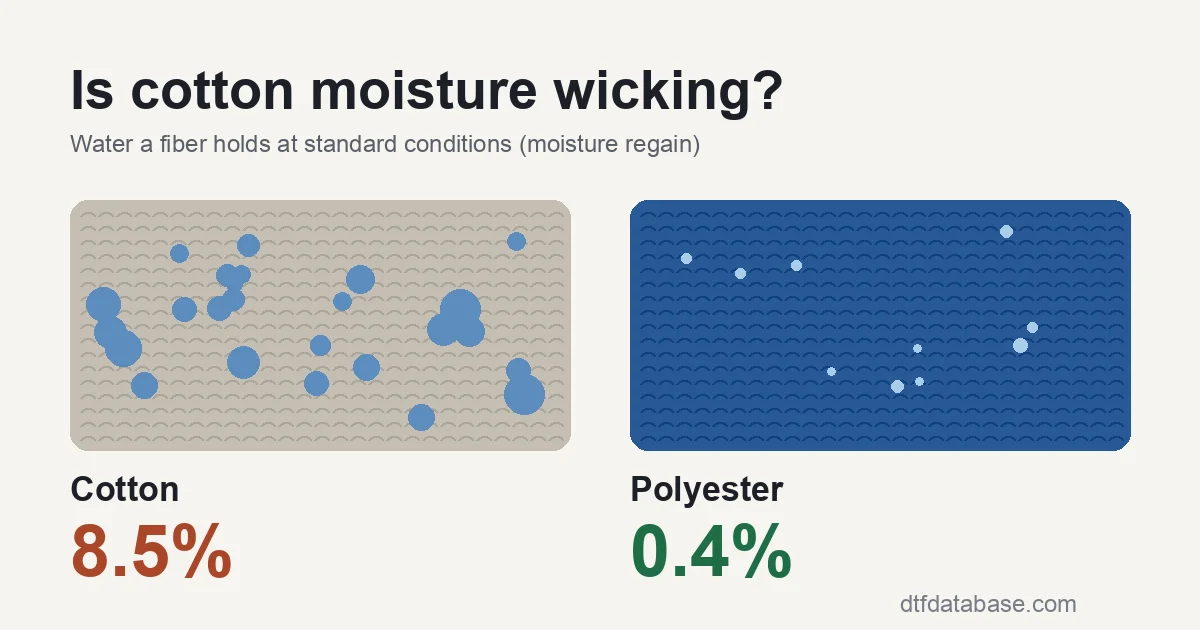
The standard way the textile industry measures this is moisture regain: the weight of water a fiber holds at standard conditions, as a percentage of its dry weight. The commercial regain values used in fiber testing are:
| Fiber | Standard moisture regain | What it means on the body |
|---|---|---|
| Cotton | 8.5% | Pulls water into the fiber and holds it |
| Polyester | 0.4% | Absorbs almost nothing; water stays between fibers |
Cotton holds roughly 20 times more water in the fiber than polyester under the same conditions. Water locked inside a fiber evaporates slowly, so a sweat-soaked cotton tee:
- Gets heavier and clings to the skin
- Stays damp long after activity stops, which can feel cold once the wearer cools down
- Can rub more against the skin, because wet fabric creates more friction than dry fabric
None of this makes cotton a bad fabric. It makes cotton an absorbent fabric, which is the opposite of what the term "moisture-wicking" describes.
What Does "Moisture-Wicking" Actually Mean?
Wicking is capillary action: liquid moving through the tiny channels between fibers and yarns, the same way water climbs a paper towel. In apparel, "moisture-wicking" describes a fabric that does two things together:
- Moves sweat away from the skin through those capillary channels to the outer face of the fabric.
- Releases it so it spreads over a large area and evaporates quickly, which is what cools the body.
This is where the common "cotton doesn't wick" answer needs one layer of nuance. Cotton fibers do move water by capillary action, which is why cotton has long been used for towels and lamp wicks. The problem is step 2. Because cotton also absorbs the water into the fiber, it keeps the sweat instead of releasing it. Polyester has the opposite profile: the fiber absorbs almost nothing, so the water stays in the channels between fibers, where it can spread and evaporate. Performance fabrics are engineered to improve on that further with finer fibers, knit structures, and finishes that help sweat spread.
Cotton vs. Moisture-Wicking Fabrics: Quick Comparison
| Fabric | Absorbs sweat into the fiber? | Drying speed | Feels wet during hard exercise? | Best for | DTF printing notes |
|---|---|---|---|---|---|
| 100% cotton | Yes | Slow | Yes, heavy and clingy | Everyday tees, retail merch, casual events | The most forgiving DTF substrate; handles the highest press temperatures |
| 50/50 cotton/polyester (DryBlend, DRI-POWER) | Partly | Faster than cotton | Less than cotton | Budget event, camp, and team shirts | Press at blend settings; the polyester lowers the safe temperature |
| 100% polyester performance | Very little | Fast | Least of the three | Workouts, races, sports teams, hot-weather jobs | Lower temperature and shorter dwell; watch for dye migration on dyed polyester |
| Treated wicking cotton (such as Cotton Incorporated's TransDRY) | Reduced by treatment | Faster than untreated cotton | Less than untreated cotton | Brands that want cotton feel with some performance | No DTF-specific guidance published; test-press before a production run |
For exact temperatures and dwell times by fabric, use the DTF temperature and time chart.
Is a Cotton Blend Moisture-Wicking?
Some are, and the label usually says so. A blend behaves somewhere between its fibers, and manufacturers add wicking claims when the fabric is designed for it:
- Gildan 8000 DryBlend is a 50% cotton / 50% polyester tee that Gildan markets with moisture-wicking technology. See the Gildan 8000 DryBlend guide for fit and DTF settings.
- Jerzees 29MR DRI-POWER is a 50/50 cotton/polyester tee sold as moisture-wicking. The Jerzees 29MR guide covers sizing and pressing.
- Tri-blends (polyester, cotton, and rayon) are usually bought for softness and drape, not sweat management. Rayon, like cotton, is a cellulose-based fiber that absorbs water, so a tri-blend should not be assumed to wick unless the manufacturer says it does. The viscose fabric guide explains how rayon behaves under a heat press.
There are also wicking treatments for cotton itself. Cotton Incorporated's TransDRY technology treats a portion of the cotton yarns to repel water and blends them with untreated cotton, so the fabric moves moisture outward instead of saturating. Cotton Incorporated states that TransDRY fabrics dry up to twice as fast as untreated cotton. A plain 100% cotton tee with no treatment on the label should be treated as absorbent, not wicking.
When Is Cotton Still the Right Choice?
Cotton is still the best-selling fabric in custom apparel for good reasons:
- Everyday comfort. For casual wear, low-activity events, and dry heat where the wearer is not soaking the shirt, cotton feels soft and breathable.
- Print forgiveness. Cotton tolerates higher heat than polyester, it does not have polyester's dye migration problem, and DTF transfers bond to it reliably. The Gildan 5000 Heavy Cotton guide shows why a basic cotton tee is a default DTF blank.
- Cost and color range. Basic cotton tees are among the cheapest blanks in every distributor catalog, with the widest color selection. See the wholesale blank apparel guide for where shops buy them.
- Retail feel. Customers buying a band, brand, or souvenir shirt usually expect cotton hand feel, not an athletic knit.
When Should You Choose Moisture-Wicking Fabric Instead?
Choose a wicking polyester or a wicking blend when the wearer will sweat through the shirt:
- Races and fun runs. 5K shirts are worn while running, often in warm months.
- Sports teams, practices, and camps. Players wear the shirt for hours of activity.
- Outdoor work and hot-climate events. Staff shirts for festivals, landscaping crews, and summer events.
- Gym and fitness brands. Customers buying workout apparel expect performance fabric.
Budget performance tees such as the Port & Company PC380 and premium options such as the Sport-Tek ST350 are both 100% polyester and widely used for DTF printing. For a broader comparison of blanks by fabric, see best shirts and blanks for DTF transfers.
What Changes When You DTF Print on Moisture-Wicking Fabric?
DTF works on moisture-wicking polyester, which is one of its advantages over methods like DTG that are built around cotton. Three things change compared with a cotton tee:
- Lower heat. Polyester scorches and shows platen marks at cotton temperatures. The guide to heat pressing polyester covers settings and how to fix iron burns.
- Dye migration. On dyed polyester, heat can release dye into the white ink layer and tint the print pink or gray. The dye migration guide explains blocker films, low-temperature adhesives, and test presses.
- Pre-press. A short pre-press drives off moisture and flattens the garment before the transfer goes down, on any fabric.
Frequently Asked Questions
Does 100% cotton wick sweat?
No. 100% cotton absorbs sweat into the fiber rather than wicking it away. Cotton can move water by capillary action, but it holds that water instead of releasing it to evaporate, so the shirt becomes damp, heavy, and slow to dry during hard exercise.
Is cotton good for hot weather?
Cotton is comfortable in hot weather when the wearer is not sweating heavily, because it is soft and breathable. During high-sweat activity it becomes saturated and stays wet, so moisture-wicking polyester or a wicking blend is the better choice for workouts, races, and long days outdoors.
Is a cotton-polyester blend moisture wicking?
It depends on the product. Blends such as the Gildan 8000 DryBlend and Jerzees 29MR DRI-POWER are 50/50 cotton/polyester tees marketed as moisture-wicking. A blend without a wicking claim will usually dry faster than 100% cotton but should not be assumed to wick like a performance polyester.
Does DTF printing work on moisture-wicking fabric?
Yes. DTF transfers bond to moisture-wicking polyester and polyester blends. The main differences from cotton are a lower press temperature to avoid scorching and the risk of dye migration on dyed polyester, which can tint the white ink layer. A test press on one garment is recommended before a production run.
What fabric is best for gym shirts?
Moisture-wicking polyester, often blended with a small amount of spandex for stretch, is the standard fabric for gym shirts because it absorbs very little sweat and dries quickly. Cotton gym shirts are comfortable for light workouts but become heavy and damp during intense training.
Tags
About the Author
DTF Database Founder
Darrin DeTorres has over 10 years of experience in the print industry, specializing in screen printing, sublimation, embroidery, HTV, and DTF printing. He runs Notice Me Marketing and Media, a custom apparel production company that prints thousands of shirts per month.
More from DTF Basics
Explore DTF Database
Browse and compare 20+ verified DTF printer models by price, features, and specifications.
Read moreCalculate your per-print costs, profit margins, and ROI for DTF printing.
Read moreBrowse verified DTF suppliers for ink, film, powder, and equipment.
Read moreFind DTF transfer suppliers shipping to your state, with verified turnaround times.
Read moreMetro-level DTF supplier guides for Los Angeles, NYC, Dallas, Houston, and more.
Read moreStep-by-step guide to the DTF printing process with temperatures and troubleshooting.
Read more