
Heat Transfer T-Shirts: Methods, Costs and How-To
What heat transfer t-shirts are, how DTF, HTV, sublimation and iron-on compare, what you need to press one, and how to make a shirt last.
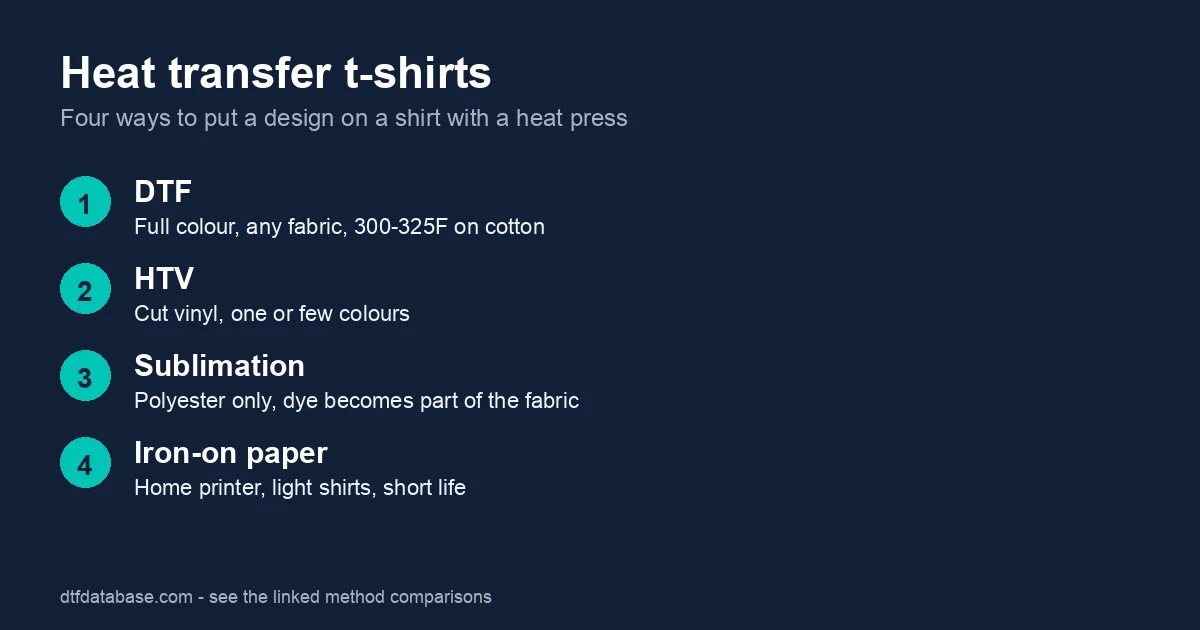
What are heat transfer t-shirts?
Heat transfer t-shirts are shirts where a design is applied from a carrier to the fabric using a heat press. Heat softens the adhesive or dye on the carrier, pressure bonds it to the fibers, and the carrier is peeled away. The same press can apply any of the methods, which is why most home and small-shop decorators start with one.
The four main heat transfer methods
| Method | Best for | Fabrics | Colors | Feel |
|---|---|---|---|---|
| DTF transfers | Full-color art, photos, small and mid orders | Cotton, polyester, blends | Unlimited | Soft, thin film |
| HTV (heat transfer vinyl) | Names, numbers, one-color logos | Cotton, polyester | One color per layer | Solid vinyl layer |
| Sublimation | All-over and bright polyester designs | Polyester or poly-coated only | Unlimited | No feel, dye in fabric |
| Iron-on paper | One-off home projects | Mostly light cotton | Full color | Plastic-like, short life |
For a side-by-side look, read the heat transfer printing methods guide and the HTV vs sublimation vs DTF comparison. For the DTF comparisons, see DTF vs vinyl and DTF vs sublimation.
What you need to make a heat transfer t-shirt
- A heat press. A 15 by 15 inch press handles most adult shirts; the heat press buying guide compares models. An entry-level press costs about $150 to $300.
- A transfer. Buy a printed DTF transfer from a supplier, cut your own HTV, or print sublimation paper.
- A blank shirt. Match the fabric to the method. Our wholesale blank apparel guide lists good blanks.
- Parchment paper and a lint roller to protect and clean the shirt.
A household iron is not recommended for DTF, because it cannot hold an even temperature or pressure across the design.
How to press a heat transfer t-shirt
For a DTF transfer on cotton, use the standard settings:
- Pre-press the shirt for 3 to 5 seconds.
- Position the transfer, film side up, on the shirt.
- Press at 300 to 325°F for 10 to 15 seconds at medium-firm pressure.
- Cold peel after the film cools.
- Cover with parchment and press 5 to 10 seconds more.
Other methods use different times and temperatures, so use the temperature and time chart and the heat press settings guide, and follow the supplier's sheet. For help with placement, see the shirt placement guide and the beginner heat press tutorial.
How much do heat transfer t-shirts cost?
A single shirt made at home with a DTF transfer or HTV usually costs $7 to $12 with the blank included, based on our affordable custom t-shirts guide. Prices fall with quantity: $5 to $10 for 100 to 500 shirts. See bulk custom t-shirts for pricing by order size.
How long do heat transfer prints last?
A properly pressed DTF or HTV print survives many washes. Wash the shirt inside out in cool water, tumble dry low and skip fabric softener. Peeling edges usually mean the press was too cool, too short or too light. Our DTF care guide covers the details.
Frequently asked questions
What is the best heat transfer method for t-shirts?
For full-color designs and small to mid-size orders, DTF is the most flexible, because it works on cotton and polyester and needs no weeding or setup. For names, numbers and one-color logos, HTV is cheaper.
Can you heat transfer onto any t-shirt?
Most methods work on cotton, and DTF and HTV also work on polyester and blends. Sublimation needs polyester, and iron-on paper works best on light cotton. Check the transfer instructions for your fabric.
Do heat transfer t-shirts crack or peel?
Not when pressed correctly. Cracking or peeling is usually the result of too little heat, time or pressure, or of washing too soon or drying too hot. Re-press with parchment to repair a lifted edge.
Do you need a heat press for heat transfers?
A heat press gives the even heat and pressure that DTF and HTV need. A household iron is not recommended for DTF and gives inconsistent results with most methods.
How long do you press a heat transfer on a shirt?
For DTF on cotton, about 10 to 15 seconds at 300 to 325°F. Times differ by method and fabric, so check the supplier's instructions and the temperature and time chart.
Step by step: design and print a t-shirt.
Tags
About the Author
DTF Database Founder
Darrin DeTorres has over 10 years of experience in the print industry, specializing in screen printing, sublimation, embroidery, HTV, and DTF printing. He runs Notice Me Marketing and Media, a custom apparel production company that prints thousands of shirts per month.
More from DTF Basics
Compare custom direct to film transfers: how ordering works, gang sheet vs. by-size pricing, file prep, turnaround and what to check before you buy.
Get tee shirts printed the right way. Compare DTF, screen printing, and heat transfer by cost, quality, and order size before you buy.
Explore DTF Database
Browse and compare 20+ verified DTF printer models by price, features, and specifications.
Read moreCalculate your per-print costs, profit margins, and ROI for DTF printing.
Read moreBrowse verified DTF suppliers for ink, film, powder, and equipment.
Read moreFind DTF transfer suppliers shipping to your state, with verified turnaround times.
Read moreMetro-level DTF supplier guides for Los Angeles, NYC, Dallas, Houston, and more.
Read moreStep-by-step guide to the DTF printing process with temperatures and troubleshooting.
Read more